Choosing the right beet pulp can transform your horse’s diet, hydration and hindgut health — especially through a UK winter yard routine. If you want low sugar, fast soaking and proven digestibility, Speedi-Beet stands out — but you still need to feed it right.
Key takeaway: For UK horses needing low-sugar fibre that soaks in minutes, Speedi-Beet (5–6% sugar) offers quick hydration and university-backed digestibility; feed it as part of a balanced ration, weigh it dry, and monitor for colic signs.
What is Speedi-Beet and why it matters
Speedi-Beet is an unmolassed sugar beet pulp with only 5–6% sugar that cold-soaks in 5–10 minutes to around 5–6 times its weight. That makes it a safe, low-sugar fibre for laminitis-prone horses and a practical option on busy UK livery yards.
Unlike traditional molassed beet shreds, Speedi-Beet is designed to deliver fibre-derived energy without the sugar spike. According to British Horse Feeds, Speedi-Beet has a guaranteed sugar limit of 5%, compared to up to 18% in molassed shreds. It also absorbs water rapidly: in cold water, it reaches five times its weight in 5 minutes and over six times in 10 minutes, helping you get soaked feeds done fast even without hot water.
For owners comparing options, PuraBeet is also unmolassed and low in sugar (around 5–6%), with sugar removed at the factory stage. Both are suitable for low-sugar diets; Speedi-Beet’s edge is its rapid cold soak. See our overview of the differences in our own guide: Speedi-Beet vs PuraBeet (10-minute or overnight soak) on the Just Horse Riders blog.
Speedi-Beet vs molassed shreds: the hard numbers
Speedi-Beet caps sugar at 5% versus up to 18% in molassed shreds and absorbs over six times its weight in cold water within 10 minutes (compared with roughly three times for shreds). Over 24 hours, Speedi-Beet can absorb around nine times its weight.
Those numbers matter in day-to-day yard life. A lower sugar content gives you more flexibility to build a diet with a lower glycaemic index, while the superior soak and water-holding capacity support hydration — handy in winter when horses often drink less. The rapid soak also suits livery yards with limited hot water: you can safely soak a fresh, soft mash in the time it takes to fetch rugs or bring in from the field. British Horse Feeds confirms these figures in their head-to-head comparison of Speedi-Beet and shreds (source).
Quick tip: Always weigh the dry product before soaking; volume changes dramatically with water and a scoop of soaked beet never equals a scoop of a dry cereal like oats (Equiglo).
Energy, digestibility and gut health
University of Glasgow research shows Speedi-Beet ferments 10% more than standard beet pulp and is up to 25% more digestible than hay and lucerne. That extra fermentability delivers energy on par with the “missing” sugar from molassed shreds, but as slow-release hindgut fuel.
British Horse Feeds summarises the Glasgow work clearly:
"Work conducted at Glasgow University shows, using hindgut bacteria, that fermentation of Speedi-Beet is 10% greater than standard beet pulp, giving an energy lift that could equate to the extra sugar in shreds."
They also note:
"University of Glasgow has proven Speedi-Beet to be up to 25% more digestible than other fibres such as hay and lucerne, meaning the horse can absorb more fibre and nutrients."
Unmolassed beet pulp is almost starch-free and contains approximately 5–7% sugar. It also has a naturally high calcium to phosphorus ratio (about 6:1), making it useful for balancing higher-phosphorus feeds like oats (Equiglo). Combined with its water-holding capacity, a soaked beet mash can help maintain gut fill and fibre flow — factors widely valued for digestive comfort and consistent performance.
At Just Horse Riders, we recommend using Speedi-Beet as part of a fibre-first ration, topped up with a broad-spectrum vitamin–mineral balancer from our curated range of horse supplements and balancers to fill any gaps.
Who should feed unmolassed beet — and who shouldn’t?
Choose unmolassed beet for laminitis-prone, good-doer or metabolically sensitive horses, and be cautious with molassed shreds due to their higher sugar. However, monitor for colic: a Liverpool University study linked all sugar beet (molassed and unmolassed) to a higher risk of large colon torsion.
For native ponies, Cushing’s/PPID cases, or horses on spring/autumn grass flushes, unmolassed products like Speedi-Beet or PuraBeet keep non-structural carbohydrate intake lower, aligning with a BHS-style, low-sugar approach. Our customers often use an unmolassed beet mash to carry supplements, to soften feeds for veterans, or to boost fibre and hydration after work or travel.
That said, an important red flag comes from peer-reviewed work at Liverpool University (Joanna Mary Suthers, 2012), as summarised by Horse & Hound:
"Peer-reviewed research carried out at Liverpool University (Joanna Mary Suthers: September 2012) highlighted a surprising relationship between feeding sugar beet and the likelihood of a horse suffering from large colon torsion (twisted gut)... Further research is needed to determine whether unmolassed sugar beet is less of a risk factor."
What to do with this information:
- Introduce beet pulp gradually and monitor gut comfort, particularly around the spring grass surge when colic incidence tends to rise in the UK.
- Keep total beet pulp to 50% or less of the diet and maintain ad-lib forage where appropriate.
- Watch for early colic signs (reduced appetite, pawing, flank-watching, unsettled behaviour) and contact your vet promptly if concerned.
If your horse is sharp on sugar or laminitis-prone, stick to unmolassed beet; if you have any history of colic or torsion in your horse, discuss beet inclusion with your vet and adjust your fibre sources accordingly.
How to feed and soak correctly
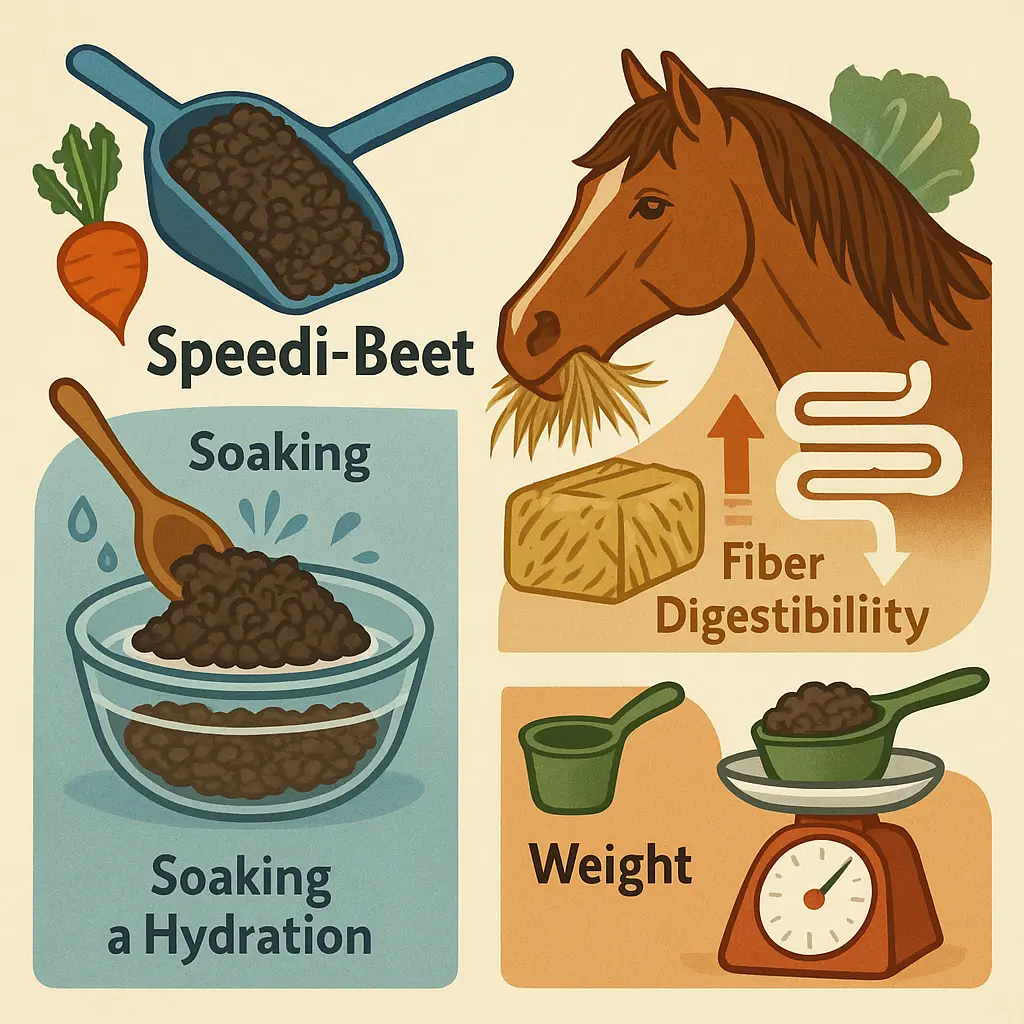
Weigh beet pulp dry, then soak Speedi-Beet for 5–10 minutes in cold water at roughly 5–6 parts water to 1 part beet (by weight), or use at least a 2:1 water-to-pulp ratio for shreds and leave 15 minutes or until fully soft. Using hot water speeds up soaking, but feeds must be cool before serving.
Practical steps:
- Weigh the dry beet first to meet your planned nutrient target; never substitute by volume as soaked beet expands greatly (Equiglo).
- For Speedi-Beet, allow 5 minutes for roughly 5x water uptake and around 10 minutes for 6x; shreds require longer and take in less water overall (British Horse Feeds).
- Storage: in warm weather, soaked beet can spoil quickly; discard anything that smells of wine or vinegar and do not keep soaked feeds longer than 24 hours (Horse & Hound).
- Choke/impaction note: soaking isn’t strictly required to prevent impaction, but it’s strongly recommended for hydration, dentition and palatability benefits (Horse & Hound).
Feeding rates and limits:
- General guideline: 100 g per 100 kg bodyweight (dry weight) as a baseline.
- Upper guidance per British Horse Feeds: up to 500 g per 100 kg bodyweight per day (e.g., up to 2.5 kg dry for a 500 kg horse) (BHF Feeding FAQs).
- Additional guidance from Equiglo: up to 6 g/kg bodyweight/day (max ~3 kg dry for a 500 kg horse) or a maximum of 50% of the total diet (Equiglo).
Because beet pulp is relatively low in protein (around 8–10%) and lacks key vitamins/minerals, it must not be your horse’s sole fibre source. Pair it with good-quality hay or haylage and add a balancer or appropriate vitamin–mineral supplement to complete the ration.
Switching from shreds to Speedi-Beet
To swap, replace 2 units of soaked molassed shreds with 1.5 units of soaked Speedi-Beet and adjust to your horse’s condition. A rapid changeover is acceptable because nutrient profiles are similar, minus the added sugar.
British Horse Feeds recommend this simple substitution ratio to maintain energy intake while cutting sugar (source). Monitor your horse’s weight, droppings and appetite over the first 10–14 days and tweak the volume as needed to keep condition steady.
Pro tip: If your horse tends to drop weight in winter, consider using Speedi-Beet as a carrier for oil or a higher-protein chop (or try Fibre-Beet, which blends Speedi-Beet with alfalfa) to raise calorie density without resorting to high-starch cereals.
Cost, yield and UK yard practicalities
A 20 kg bag of Speedi-Beet costs about £18.79–£20.79 in the UK and yields roughly 125 Stubbs scoops once soaked; Equibeet sits around £13/20 kg. Budget for Speedi-Beet’s convenience and low sugar, and expect excellent soak-to-yield efficiency for yard routines.
Numbers to know:
- Speedi-Beet price examples: £18.79–£20.79 per 20 kg (UK), with one bag producing about 125 Stubbs scoops when soaked (British Horse Feeds).
- Equibeet example: approximately £13 for 20 kg (Horse & Hound Forum).
- Soak speed and water uptake: Speedi-Beet reaches 5x water in 5 minutes and 6x in 10 minutes; shreds only about 3x and need longer soaking (British Horse Feeds).
For UK winters, the quick cold-soak is a real advantage when taps are icy or hot water is limited. A warm beet mash can also tempt fussy drinkers after a frosty hack. If you’re riding after work in low light, stay safe and seen with our curated rider hi-vis essentials. And to keep weight steady through temperature dips, pair smart feeding with the right rugs — browse winter turnout rugs for the field and cosy stable rugs for nights in.
Balancing the ration around beet pulp
Keep beet pulp to 50% or less of the total diet and pair it with forage, protein and a vitamin–mineral balancer. Use the high calcium content (about 6:1 Ca:P) to advantage alongside higher-phosphorus cereals if used, and add micronutrients your horse won’t get from beet alone.
Simple framework to build a balanced ration around Speedi-Beet:
- Forage first: ad-lib hay/haylage for good-doers as appropriate; beet pulp can replace a portion of forage but never all of it.
- Protein and topline: add alfalfa or a quality chaff if your horse needs more amino acids (Fibre-Beet is a convenient blend of Speedi-Beet and alfalfa for veterans or poor dentition).
- Micronutrients: finish with a balancer or targeted vitamin–mineral supplement to cover selenium, vitamin E, copper, zinc and others that beet doesn’t supply in sufficient amounts.
- Special cases: for laminitis-prone horses, stick to unmolassed beet and consider vetted laminitis management supplements from trusted brands like NAF as part of a broader management plan.
Body condition scoring every 2–4 weeks and a regular curry with a good grooming kit will help you spot changes early (coat feel, fat pads, topline). In cold snaps, prevent unnecessary calorie burn with the right rugging choices and consistent routines. This BHS-aligned, fibre-first, low-sugar approach keeps many UK natives and good-doers on an even keel through spring grass flushes and winter lulls alike.
FAQs
Is Speedi-Beet safe for laminitis-prone ponies?
Yes. As an unmolassed beet pulp, Speedi-Beet contains only about 5–6% sugar, making it far safer than molassed shreds, which can reach up to 18% sugar (British Horse Feeds). It’s widely used for laminitis-prone and good-doer horses when fed as part of a balanced, low-sugar diet.
Do I need to soak beet pulp before feeding?
It isn’t strictly required to prevent impaction, but soaking is recommended for hydration, dentition and palatability. For Speedi-Beet, cold-soak for 5–10 minutes (5–6x water uptake); for shreds, use at least a 2:1 water-to-pulp ratio and soak 15 minutes or until soft (Horse & Hound, BHF).
What’s the difference between PuraBeet, Speedi-Beet and regular sugar beet?
PuraBeet and Speedi-Beet are both unmolassed, low-sugar options (around 5–6%). Regular sugar beet is often molassed and can be up to 18% sugar. Speedi-Beet’s main advantage is its very fast cold soak (H&H Forum, Just Horse Riders blog guidance).
Can I feed beet pulp as the only forage?
No. Keep beet pulp to 50% or less of the total diet. It’s low in protein (around 8–10%) and short of key vitamins and minerals, so it must be paired with hay/haylage and a balancer or appropriate supplement (Equiglo).
How much Speedi-Beet should I feed a 500 kg horse?
Typical ranges are 2.5–3.0 kg dry weight per day for a 500 kg horse, depending on workload and condition. British Horse Feeds advises up to 500 g per 100 kg bodyweight (2.5 kg/day), while Equiglo quotes up to 6 g/kg (3.0 kg/day) — always weigh dry, then soak (BHF Feeding FAQs, Equiglo).
Does sugar beet increase the risk of colic (twisted gut)?
A Liverpool University study found a statistically significant association between feeding sugar beet (both molassed and unmolassed) and large colon torsion risk, although more research is needed to clarify risk in unmolassed beet specifically (Horse & Hound). Introduce gradually, keep total beet to 50% or less of the ration, and monitor for colic signs.
How do I switch from molassed shreds to Speedi-Beet?
Replace 2 units of soaked shreds with 1.5 units of soaked Speedi-Beet, then adjust to maintain condition. A quick switch is acceptable because the main difference is the removed sugar, not the underlying fibre (British Horse Feeds).
Need help fine-tuning your horse’s fibre plan? Speak to your vet or nutritionist, then build your shopping list with high-quality fibre, a suitable balancer from our supplements collection, and season-appropriate rugs from turnout to stable to keep condition consistent.