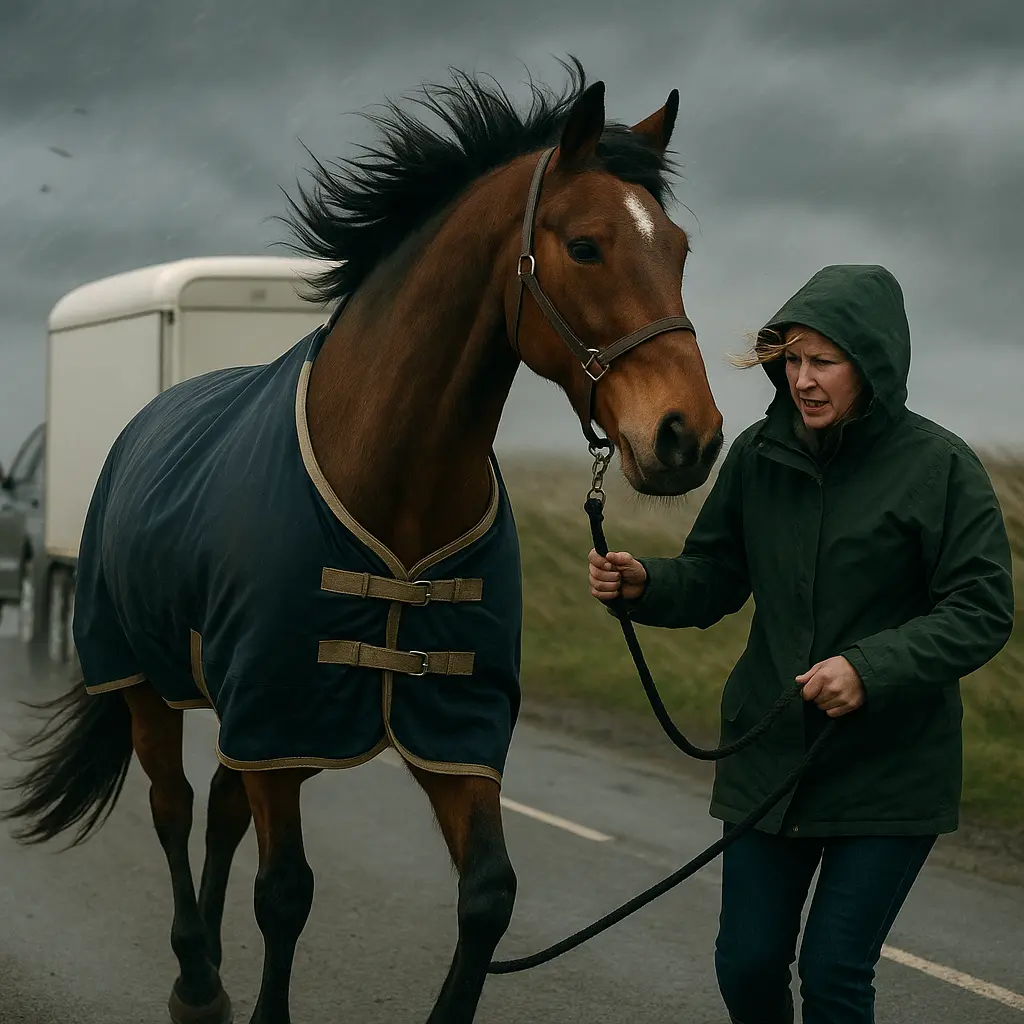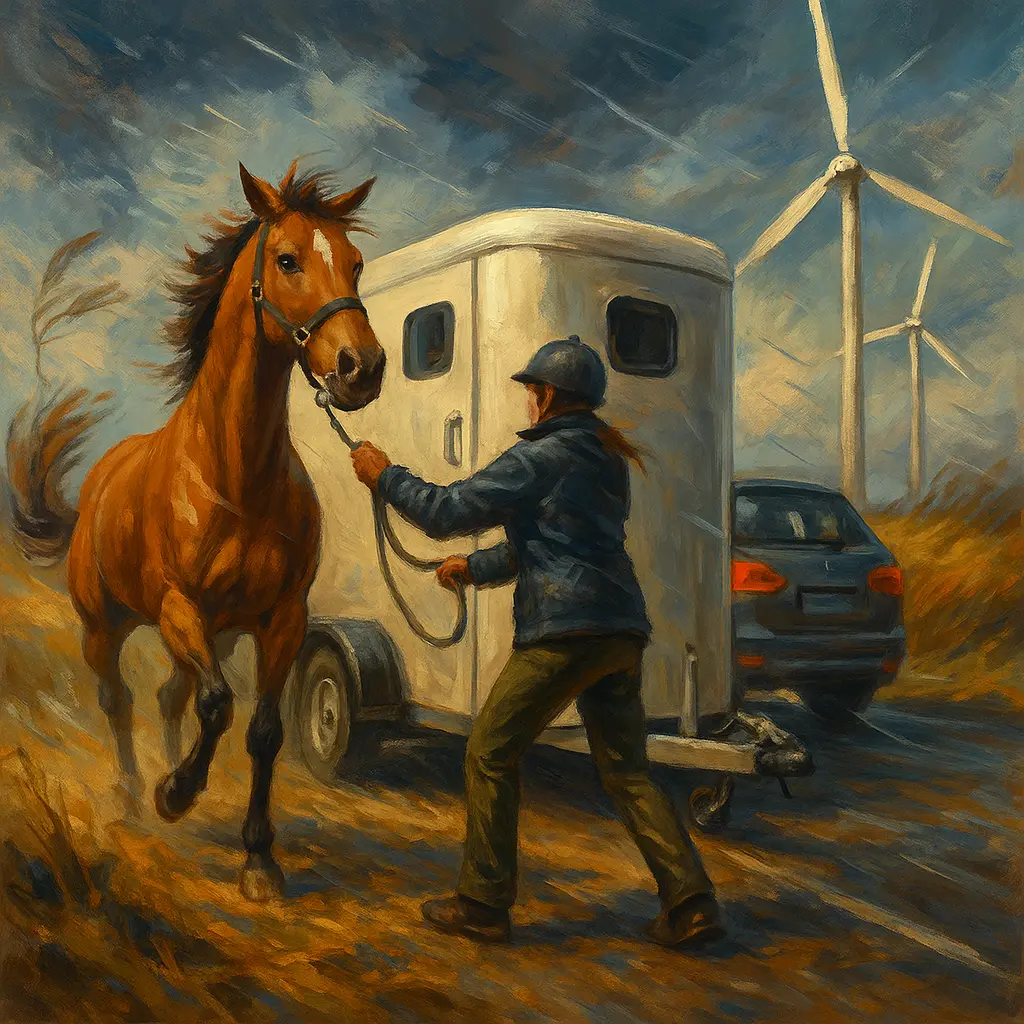
Wind can turn a routine hack or an easy haul to a show into a genuine safety risk. UK storms bring sudden gusts, flying debris and fallen branches that spook even the most level-headed horses — and make trailers unstable.
Key takeaway: Postpone riding once winds top 20mph, and cancel towing plans when average winds approach 40mph with higher gusts — it’s not worth the risk to you or your horse.
When is it too windy to ride or tow?
Riding becomes risky above 20mph winds, and towing should be cancelled around 40mph average winds (with higher gusts), especially on exposed routes. Red Met Office warnings with 70–90mph gusts mean stay home and stable your horses.
Once winds push past 20mph, spooking is far more likely, fallen branches are common, and visibility drops. The UK-based Equi-Box guide sums it up clearly:
"Once wind speeds push past 20mph, horse riding safety becomes a real concern… If you hear weather warnings about gale-force winds or see trees bending significantly, it's best to stay off the roads." — Equi-Box UK Horse Riding Weather Guide
For towing, experienced UK drivers report that 40mph average winds — often gusting 10–20mph higher — make trailers feel “alive” on the hitch, particularly across open farmland, coastal stretches and moorland. That’s your cue to cancel. During severe storms like Eunice (with gusts up to 90mph in places), the Met Office issues red warnings for danger to life; trailers and horseboxes should not be on the road in these conditions.
Quick tip: Watch the trees. If medium trees are bending and smaller branches are moving constantly, winds are likely above 20–25mph. Trust your eyes and your gut.
UK towing laws you must follow in windy conditions
UK trailer speed limits are 60mph on motorways/dual carriageways, 50mph on single carriageways, and 30mph in urban areas; post-1997 drivers can tow up to 3,500kg MAM after the 2021 rule change. Trailers can’t use the outside lane on motorways with three or more lanes, and towing mirrors are required if your trailer is wider than your tow vehicle.
These rules still apply in bad weather — you’ll often need to drive well below the limit to keep your horse comfortable and your outfit stable. As UK towing specialists at Whickr put it:
"Drive smoothly so your horse can balance... Obey towing speed limits: 30mph (urban), 50mph (single carriageways), 60mph (motorways)." — Whickr Horse Trailer Guide
Licence basics for horse owners:
- If you passed your car test on or after 1 January 1997, you can tow trailers up to 3,500kg MAM since the 2021 changes.
- Pre-1997 drivers retain higher combined allowances (often up to 8,250kg), but always confirm the MAM for your vehicle and trailer.
- Horseboxes over 3,500kg require the appropriate HGV entitlement, and commercial use may involve operator licensing; if you only transport your own horses for non-commercial purposes, a restricted licence may apply for larger vehicles.
Practical must-dos every time you tow in blustery weather:
- Fit towing mirrors if the trailer is wider than your car — you must be able to see 4m out from the trailer and 20m behind it on both sides.
- Check lights, brakes and breakaway cable are working; poor maintenance plus crosswinds is a dangerous combination.
- Stay in the left or middle lanes; no outside lane on 3+ lane motorways when towing.
How to tow safely when it’s breezy
Slow down below the posted limit, drive smoothly with long gaps, and keep your laden trailer within 80% of your tow vehicle’s rated towing capacity. Plan sheltered routes and avoid exposed bridges, open moorland and coastal stretches.
Wind multiplies everything: small steering inputs, sudden braking and harsh acceleration all get amplified into trailer sway that unsettles your horse. In breezy but manageable conditions:
- Ease back the speed by 5–15mph below the limit; stability increases dramatically with even small reductions.
- Double your following distance to allow feather-light braking.
- Make wider, slower turns and feed in power progressively.
- Use lower gears on descents to avoid heavy braking.
- Grip the wheel lightly and look far ahead; anticipate gusty gaps when passing hedgerows, gateways and HGVs.
The “80% rule” is your friend. If your vehicle is rated to tow 2,500kg braked, aim to keep the fully laden trailer under roughly 2,000kg. A live, shifting load is less forgiving than static cargo, and that margin improves control when wind hits.
Horse comfort matters too. Load calmly at home before big days to reduce stress, and use familiar routines. If your horse is tense in wind, consider proven, legal calming options; at Just Horse Riders, many owners choose targeted calming supplements from trusted brands to take the edge off loading and travel noise in blustery conditions.
Pro tip: If you feel “sailing” through the steering wheel or constant trailer tugging at 30–40mph, that journey is already marginal. Find a safe place to stop and reassess — taking the long, sheltered route home at 30mph is far better than pushing on.
Managing horses at home in high winds
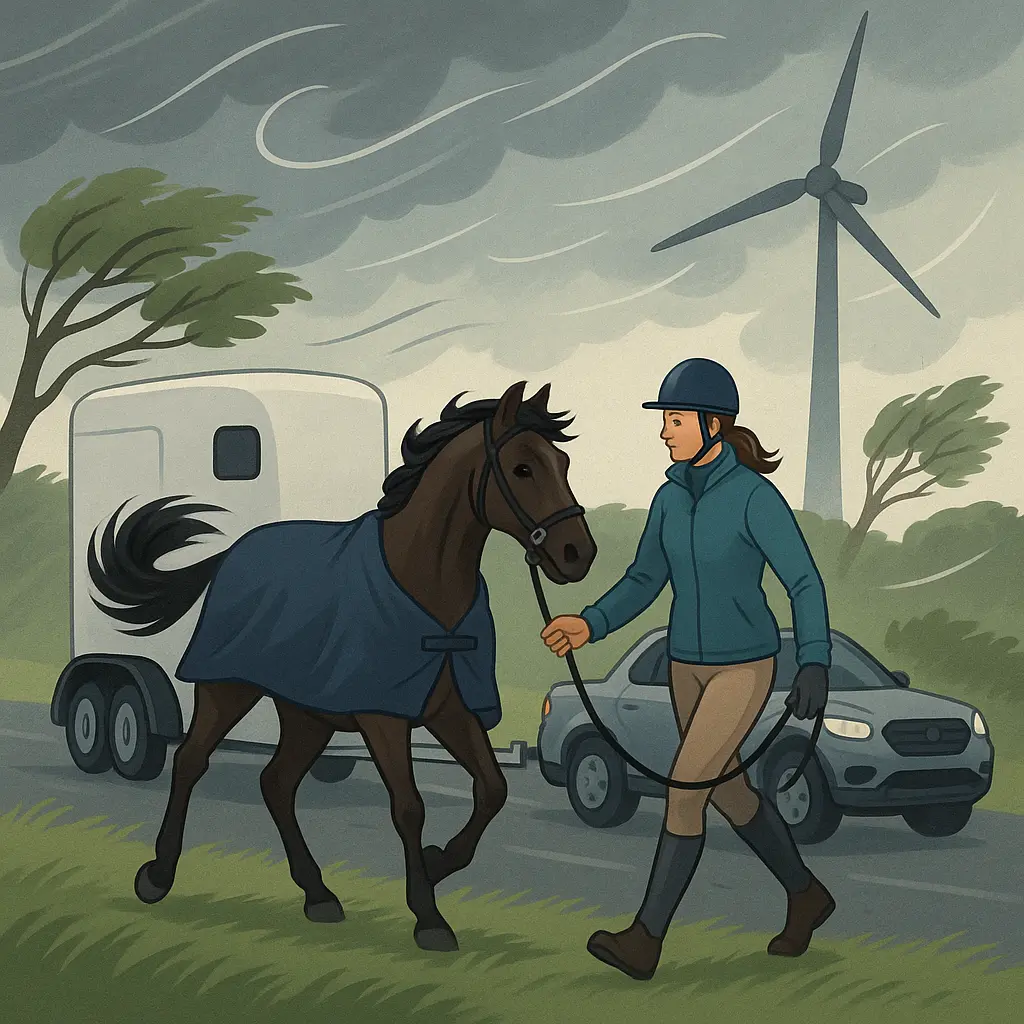
When yellow or amber wind warnings are issued, stable horses if possible, or provide robust shelter and appropriate rugs to reduce wind chill and stress. Secure loose yard items, check fencing, and keep turnout short and supervised during gusty spells.
High winds can push wind chill far below the ambient temperature and whip debris across fields and yards. Your plan for autumn/winter storm days should include:
- Shelter first: Prioritise stabling during the worst gusts. If stabling isn’t an option, use a well-sited field shelter with the back to the prevailing wind and good footing.
- Rug to conditions: Waterproof, windproof turnouts prevent chilling and stress. Most unclipped horses cope well, but clipped/sensitive horses appreciate extra protection. Explore durable, weather-ready turnout rugs and snug, recovery-friendly stable rugs for overnight comfort.
- Secure the yard: Tie down jumps, bins, wheelbarrows and tarps; latch gates; walk fence lines for wind damage before turnout.
- Short, safe turnout: Avoid full-day fields in storms; rotate smaller, sheltered paddocks to reduce exposure to flying debris and fallen branches.
- Head, leg and eye safety: Consider fly masks in dusty gusts, and protect legs for box rest or hand-walking with supportive horse boots and bandages.
The British Horse Society also warns that moving structures and noise can spook horses near equestrian routes — a consideration for farms near wind energy sites and masts (see guidance below). For reliable weather protection, many of our customers favour tough, well-cut rugs from WeatherBeeta, built for the UK’s wet, windy winters.
Quick tip: Keep a “storm box” by the stable door: headcollar and rope, torch, spare batteries, scissors, vet wrap, and a power bank for your phone. Ten minutes of prep on a calm day pays off when the gusts hit at 2am.
Wind turbines, masts and bridleway hazards: BHS guidance
Keep horses at least the blade tip height plus 10% from commercial wind turbines, and be ready for spooking from moving blades and noise; visibility measures are also advised around anemometer masts near bridleways. Plan routes that respect the British Horse Society (BHS) “fallover distance”.
The BHS is clear about separation from turbines on equestrian routes:
"The Society now recommends a separation distance of blade tip height plus 10% — ‘fallover distance’ — between a commercial turbine and any route used with horses." — BHS Wind Turbines Advice
They also highlight how moving blades can unsettle horses:
"In windy weather the blades will be moving fast and scare horses... Appropriate mitigation can reduce adverse reaction of horses." — BHS Wind Turbines Advice
Practical takeaways for UK riders and drivers:
- Give turbines a wide berth; avoid passing directly downwind where blade flicker or sudden movement is more intense.
- Expect stronger gusts channelling around large structures and gaps in tree lines or hedges.
- Where anemometer masts are installed near bridleways/byways, cables should be wrapped or sleeved to 2m height for visibility, with ground anchors at least 3m from any unfenced equestrian route. If that’s not in place, re-route.
Pro tip: If you must pass a turbine with a sensitive horse, dismount, loosen your rein contact, and keep the horse’s feet moving forward with calm voice cues until you’re well clear.
Route planning and kit for stormy show days
Choose lower, more sheltered roads, avoid exposed bridges and moorland, and pack essential safety kit including towing mirrors, hi-vis, and a well-fitted riding hat. Keep your loading routine calm and predictable to reduce wind-related spooks.
Routing matters as much as driving technique when it’s blowing a hoolie. A slightly longer, tree-lined B-road can be far safer than a high, exposed A-road viaduct. Before you leave:
- Check hour-by-hour wind maps and gusts at key times along your route, not just at home or destination.
- Schedule your drive for the lowest gust window of the day and build extra time for slower speeds.
- Identify safe lay-bys for breaks if conditions deteriorate.
Kit to have on board for windy-day trips:
- Towing mirrors, wheel chocks, triangle, gloves, torch, spare fuses, first-aid kit (equine and human), and a charged power bank.
- Hi-vis for you and any ground helper — reflective rider high-visibility gear is essential if you’re out of the vehicle at dusk or in poor visibility.
- A current, well-fitted hat — browse our certified riding helmets if yours is due an upgrade after a knock or five years of service.
- Treats, a familiar haynet and a calm loading routine; arrive early so there’s no pressure on the ramp.
At Just Horse Riders, we recommend walking the last 50–100 yards of an unknown showground on arrival if the wind is up. Note flappy banners, rattly metalwork and wind tunnels between barns, then pick the quietest path to the arena or box park.
Go, delay or cancel: a simple decision framework
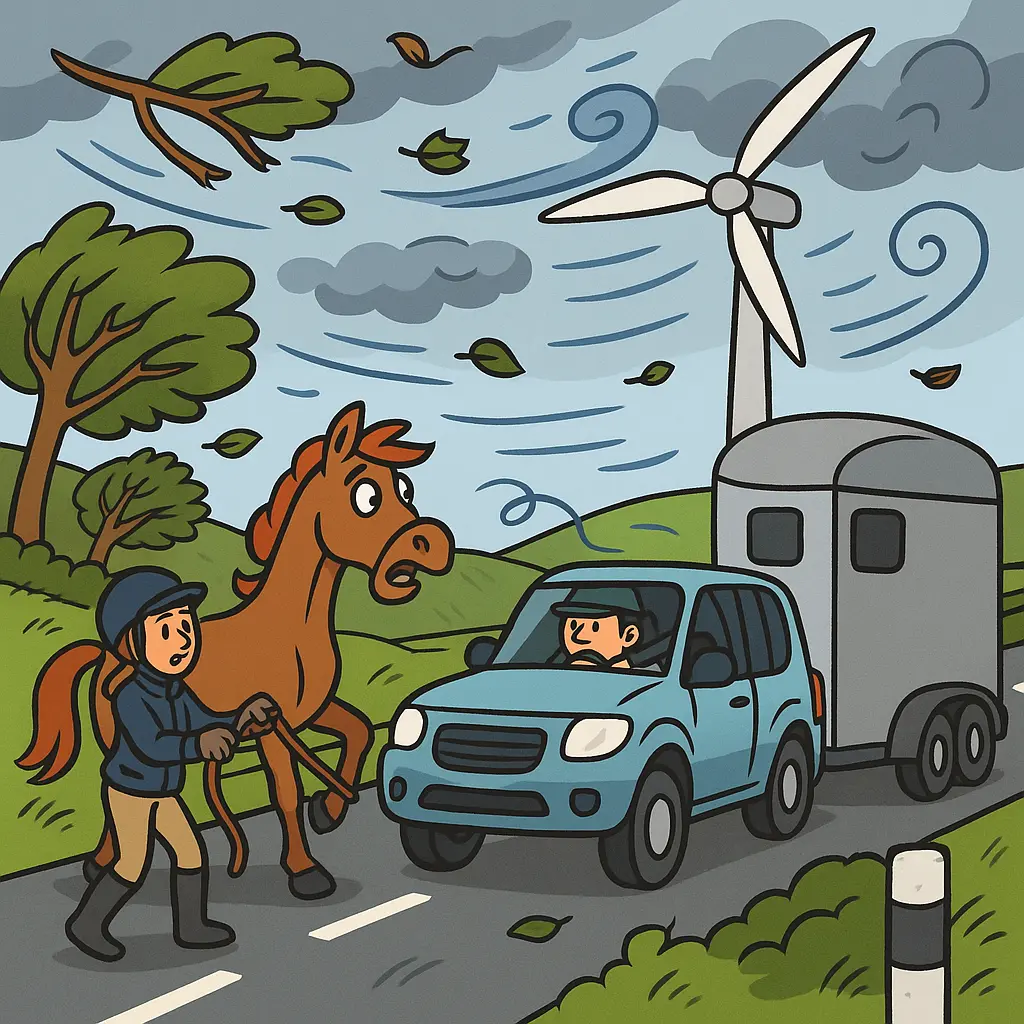
Cancel if average winds approach 40mph (with higher gusts) or if the Met Office issues amber/red wind warnings; delay or choose an arena day if steady winds exceed 20mph for riding or loading. When in doubt, stand down — your horse’s welfare and your trailer insurance both prefer the cautious call.
Use this quick sequence before every windy-day plan:
- Check forecasts: Look at average wind and gusts at home, en route and at destination, hour by hour. Yellow can be workable; amber usually isn’t; red means stay put.
- Watch the trees: If branches are thrashing and you’re buffeted on foot, it’s already a “no”.
- Risk map your route: Bridges, open moors, coastal sections and high embankments magnify gusts — avoid them or don’t go.
- Weigh and balance: Confirm your outfit respects the 80% rule, nose weight is correct, and the trailer is in top condition.
- Horse readiness: Is your horse loading calmly at home? If wind noise is setting them off today, choose a schooling session instead of a road trip.
If you opt to ride at home in a breeze, choose a hedged arena, skip the spooky corners, and keep sessions short and positive. Save the hack for a quieter day — and consider protective layers that cut the wind. For stable recovery after a blustery session, a cosy stable rug helps maintain muscle warmth between workouts.
FAQs
What wind speed is too risky for riding or towing horses?
Riding risk rises past 20mph; plan arena work or postpone if trees are bending and small branches are moving. For towing, cancel around 40mph average winds (often gusting 50mph+) and any time amber/red warnings are issued. See the UK-focused guidance from Equi-Box for riding safety in bad weather.
Can I tow a horse trailer on the motorway in the UK?
Yes — the limit is 60mph, with 50mph on single carriageways and 30mph in urban areas. You must use the left or middle lanes on motorways with three or more lanes (no outside lane), and fit towing mirrors if the trailer is wider than your tow car. For a clear summary, see the Whickr trailer guide.
Do I need a special licence to tow my horse trailer?
If you passed your car test on or after 1 January 1997, you can tow up to 3,500kg MAM since the 2021 law change. Pre-1997 drivers often have higher allowances (commonly up to 8,250kg), but always check your specific entitlements and the MAM of your vehicle and trailer.
How can I make towing safer when it’s windy?
Slow down below the limit, drive smoothly with long gaps, avoid exposed routes, and apply the 80% rule (keep a laden trailer within 80% of your vehicle’s rated tow capacity). Load calmly and consider proven, legal calming supplements if wind noise stresses your horse.
What should I do with horses at home during storms?
Stable if possible during peak gusts, or use robust shelter; secure all loose yard items and check fencing for damage. Fit waterproof, windproof turnout rugs outdoors and cosy stable rugs inside to reduce wind chill and aid recovery. Many owners prefer weather-tough options from WeatherBeeta for UK winters.
Are there BHS rules about wind turbines near bridleways?
Yes. The British Horse Society recommends a separation distance of blade tip height plus 10% (the “fallover distance”) between a commercial turbine and any equestrian route, and notes that fast-moving blades can spook horses. Read the BHS guidance here: BHS Wind Turbines Advice.
What extra kit should I carry for windy-day journeys?
Towing mirrors, torch, triangle, wheel chocks, gloves, spare fuses, first-aid kits, a charged power bank, and visible hi-vis. Don’t forget a current, well-fitted riding helmet for ground work or riding at your destination, plus familiar hay and treats to keep your horse settled.