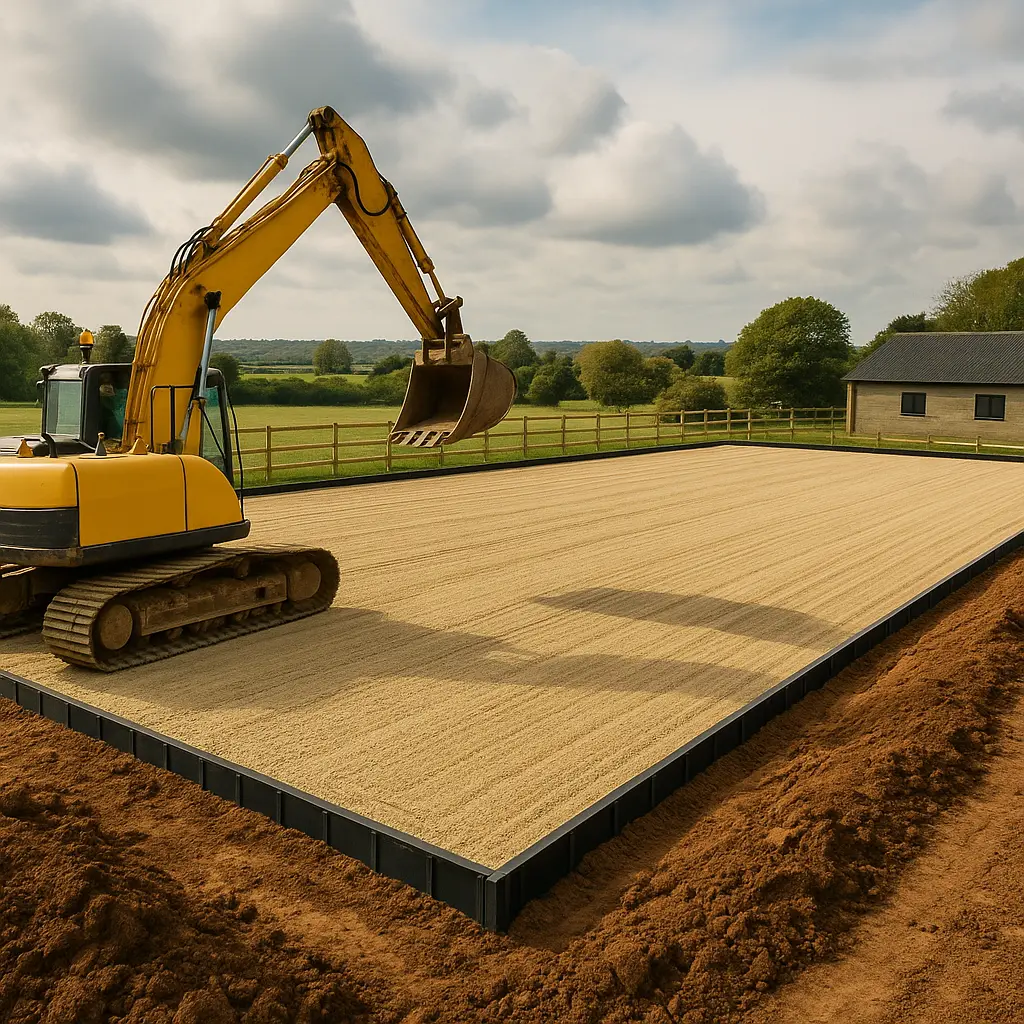
Thinking about putting in a sand school at home? Before you price up surfaces and boards, get clear on planning. In the UK, an arena is treated as development — and the rules are stricter than many riders expect.
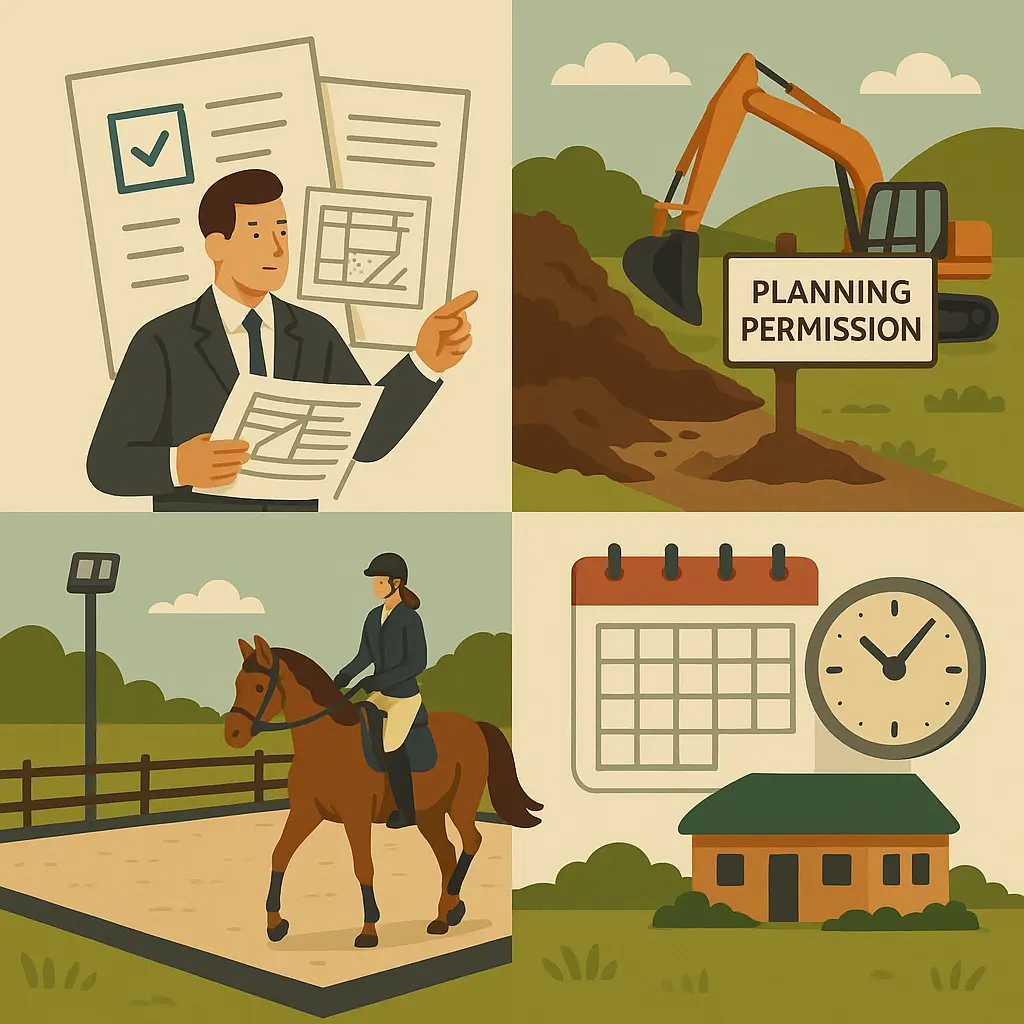
Key takeaway: In the UK, you almost always need planning permission for a sand school (outdoor or indoor). Approval typically takes 6–8 weeks, and construction, once approved, takes 2–4 weeks.
Do you need planning permission for a sand school in the UK?
Yes. In almost all cases, building a sand school counts as an “engineering operation” and requires planning permission from your local council. This applies to outdoor and indoor arenas, whether or not they’re lit.
Local authorities view the excavation, drainage changes and import of materials as operational development. Multiple planning specialists confirm this is not covered by standard permitted development rights for domestic properties or agricultural land used for equestrian purposes. As The Rural Planning Practice puts it: “Equestrian development does not come under permitted developments and any works to take place on private land outside the curtilage of a house will require planning permission.”
“You will need planning permission from your local council to build an equestrian arena. Unless you have great contacts and construction knowledge, it is a very good idea to work with an experienced contractor from the get-go. They can guide you through the planning application process.” — KBIS
Expect scrutiny around visibility in the landscape and any change to surface permeability. As Whickr notes, “Even simple surfaced schooling areas typically need consent, especially if they alter drainage or landscape.”
How long do planning approval and construction take?
Planning consent typically takes 6–8 weeks from submission, and once approved, construction usually takes 2–4 weeks depending on access, weather and specification.
After your application is validated, most councils consult neighbours and statutory bodies in the first 3–4 weeks. A case officer may visit the site to assess access, visual impact, and drainage proposals. If all information is clear and complete, a decision is commonly issued within 6–8 weeks.
Build time depends on the season, ground conditions, and how remote your site is. Good access for plant and aggregates can cut days off the schedule. Poor weather can extend the programme, particularly if drainage trenches and sub-base layers cannot be compacted properly.
Quick tip: If you’ll need evening use in winter, plan lighting as part of your initial application — it requires separate consent and can add weeks to the timeline.
While you wait for approval, keep your horse’s fitness ticking over safely with visible kit for darker evenings if you’re hacking to other facilities. Our hi-vis for riders helps you stay seen on the roads.
What designs get approved: size, surface and drainage
Councils look for clear, scaled plans with typical sizes of 20×40m or 20×60m, a defined surface type, and robust drainage proposals that protect neighbouring land and watercourses.
Popular UK arena footprints are:
- 20×40m — versatile for general schooling and dressage basics
- 20×60m — suits advanced flatwork and higher-level dressage test dimensions
Surface options typically balance budget against performance and maintenance:
- Sand only — cheapest to lay, but can be mobile and higher maintenance
- Sand + fibre — added stability and energy return, improved moisture management
- Waxed mixes — premium feel and reduced maintenance, but higher upfront cost
Drainage is often the deciding factor. Provide cross-sections showing the sub-base (e.g., stone depth), geotextile membranes, fall across the arena, perimeter drains, and outfalls to soakaways or approved discharge points. Surface run-off and changes to soil permeability are material planning concerns; show how your design prevents water shedding onto neighbouring land.
Quick tip: Submit a simple Drainage Strategy with calculations, plans of land drains, and outfall details. It speeds validation and avoids requests for further information.
Safety and schooling comfort matter too. For consistent training sessions, pair your surface with protective support for your horse and rider:
- Protect limbs during schooling with our horse boots and bandages.
- Don’t forget head protection: browse certified riding helmets for every budget.
Do you also need change of use permission?
Yes, often. If the land is currently agricultural or you plan commercial use (e.g., livery or a riding school), you’ll typically need both change of use permission and permission for the arena itself.
Equestrian use is not the same as agriculture in planning law. If your paddock is recorded as agricultural, your application may need to cover change of use to equestrian as well as the operational development of the arena. Councils may also condition hours of use, vehicle movements, and coaching or competition activity if the proposal has a commercial element.
Permitted development rights (PD) are narrow here. Even fencing can become a planning matter if it’s associated with a new, unconsented equestrian use of the land. The Whickr guidance stresses that surfaced areas which alter run-off almost always require consent.
Mobile field shelters are a limited exception if they are genuinely mobile (moved regularly), have no permanent base or services, and fronts are not fenced in. The moment a shelter gains hard standings, ties into services, or effectively becomes fixed, seek planning advice.
What’s different about indoor vs outdoor arenas — and do lights need separate consent?
Both indoor and outdoor arenas require permission; indoor arenas often also need change of use for the building, and floodlights always require separate approval.
If you’re converting an agricultural building to an indoor school, expect a change of use application alongside structural works. Your authority will assess visual impact, traffic, and any intensification of use. For outdoor schools, the main focus is often visual integration, surface drainage, and protecting neighbouring amenity.
Lighting is almost always a separate application. You’ll need lux levels, column heights, spill diagrams, and timers. In dark-sky or sensitive landscapes, councils may restrict hours or require baffles to prevent glare. If evening riding is important to you, integrate lighting into your strategy early to avoid a second planning round.
What happens if you build without consent?
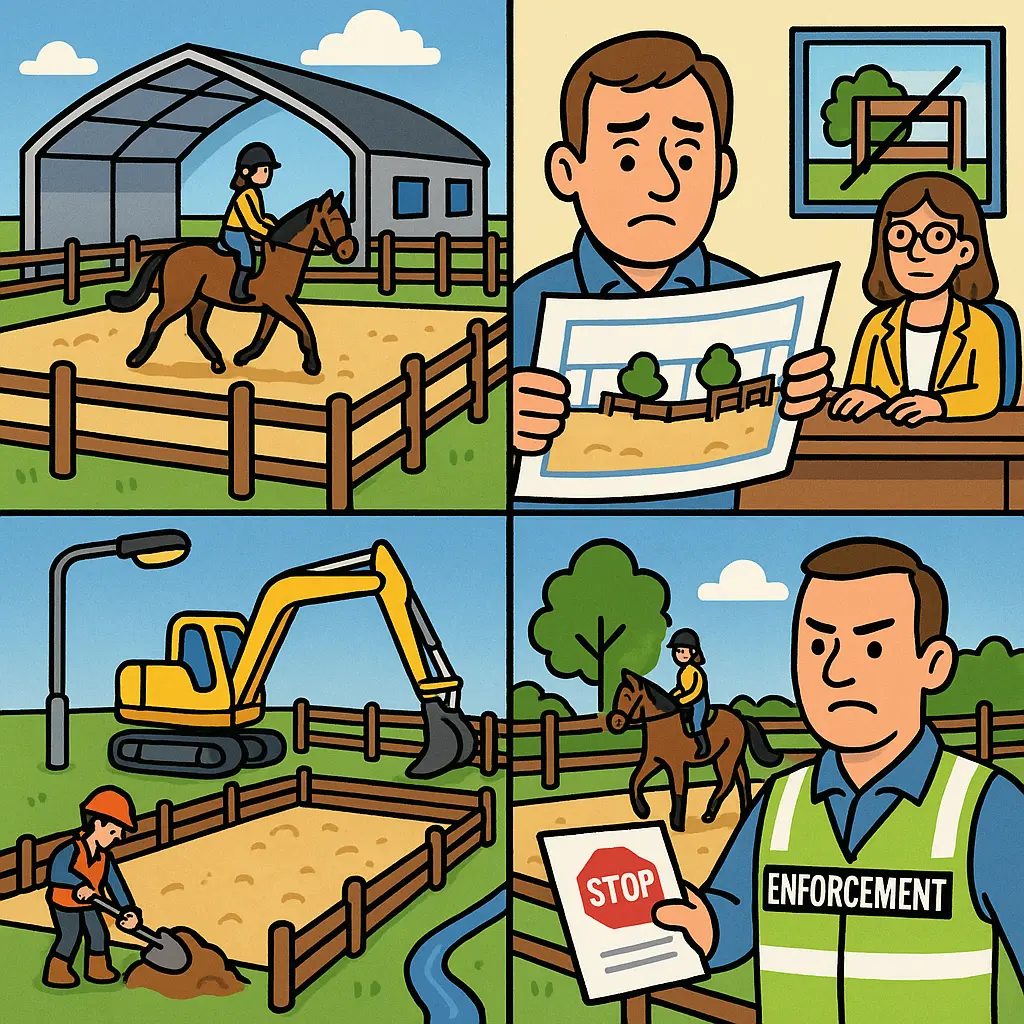
You risk enforcement action, including a notice to remove the arena at your cost; retrospective permission is possible but not guaranteed and can complicate sales and mortgages.
Building first and asking later is a gamble. Councils can serve an enforcement notice requiring restoration of the land. Even if you submit a retrospective application, approval is not automatic, and enforcement may proceed if harm is identified. Unauthorised works can also stall conveyancing or refinancing until the breach is regularised.
As Whickr notes, even “simple” surfaced areas attract scrutiny if they alter drainage or the landscape, so proceed through the formal route.
How do you get your arena approved first time?
Start by speaking to your local planning department, then submit a clear, detailed application with drawings and drainage — and involve an experienced contractor or planning consultant from day one.
Follow this sequence:
- Initial enquiry: Call/email your Local Planning Authority (LPA) early. Ask about local design guides, landscape character areas, ecology requirements, and validation checklists.
- Survey and concept: Record levels, access routes, nearby dwellings, trees, ditches and watercourses. Sketch preferred sizes (20×40m or 20×60m) and orientations that reduce visual impact and solar glare.
- Drainage strategy: Design falls (commonly 1:100–1:200), perimeter drains, soakaways or approved outfalls. Include geotextiles and sub-base layers in your sections.
- Drawings pack: Site location plan, block plan, levels, cross-sections, construction details, fencing/landscaping. Show vehicle access for aggregate delivery and construction plant.
- Environmental documents: Increasingly, LPAs request a Biodiversity Net Gain (BNG) statement and a Construction Environmental Management Plan (CEMP). Prepare habitat notes and simple method statements to control run-off and protect ditches during works.
- Pre-application check: Some councils offer a paid pre-app service. It can de-risk design issues and shorten the determination stage.
- Submit and engage: File your application. Neighbours will be notified in the first 3–4 weeks — consider speaking to them in advance about drainage and screening to reduce objections.
- Respond fast: If the case officer requests clarifications, reply promptly with marked-up drawings or calculations to keep the determination on track for 6–8 weeks.
- Condition management: Permissions often include conditions (e.g., material samples, landscape planting, lighting hours). Discharge these in writing before starting works that rely on them.
- Build and sign-off: With conditions discharged, book your contractor. Most arenas take 2–4 weeks to build in fair weather and with good access.
Pro tip: Hire a contractor who regularly builds equestrian arenas and has planning experience. As KBIS advises, a good contractor will guide your application and specification choices.
Budgeting — and kit you’ll actually use in your new arena
Budget for the application fee, drawings, surveys and potential ecology or drainage reports, plus the arena build and ongoing maintenance. Fees vary by council and complexity — check your LPA’s schedule before you start.
Surfaces differ in upfront and lifetime costs. A sand-only arena has a lower initial spend but more routine maintenance; sand + fibre or waxed mixes cost more but improve stability and consistency. Include allowances for harrowing, rolling and occasional top-ups as part of your annual running costs.
Once your arena is live, the right kit keeps you and your horse comfortable and consistent in training:
- Comfortable, grippy legwear: explore our women’s jodhpurs and breeches and children’s jodhpurs and breeches for reliable everyday schooling wear.
- Look and feel competition-ready: upgrade essentials in our women’s competition clothing collection.
- Protect and support your horse: schooling boots from our horse boots and bandages range help guard against knocks and brush injuries.
- Essential safety: choose a certified fit from our riding helmets.
- Keep coats and tack cleaner around dusty surfaces: stock up from our grooming range for quick post-schooling brush-downs.
At Just Horse Riders, we help thousands of UK riders gear up for year-round schooling — from wet winter evenings to bright summer flatwork — with fast delivery and proven brands.
FAQs
Can I build a sand school on my land without planning permission?
No. A sand school is considered an engineering operation and needs planning permission. This applies to both outdoor and indoor arenas, regardless of lighting or surface. See guidance from The Rural Planning Practice and Whickr.
What if I’ve already built an arena and the council finds out?
You could receive an enforcement notice requiring removal. Retrospective applications are possible but not guaranteed. Unauthorised works often complicate sales and mortgage applications.
How do neighbour objections affect my application?
Neighbours are consulted in the first 3–4 weeks. Objections are considered but do not automatically stop approval. The council will weigh material planning issues such as drainage impacts, visual harm, traffic, and lighting.
Do I need different permissions for an indoor arena?
Indoor and outdoor arenas both need permission. An indoor arena that converts an agricultural building usually requires a change of use application as well as approval for any structural changes.
Can I add floodlights later without further permission?
No. Floodlighting requires a separate planning application with lighting specifications and spill diagrams. Consider including lighting in your initial strategy if evening use is essential.
How much does a planning application cost?
Fees vary by local authority and application type. Check your LPA’s fee schedule and factor in the cost of drawings and any surveys (e.g., drainage or ecology) when budgeting.
How long will the whole project take from first enquiry to riding?
Allow 6–8 weeks for planning once you’ve submitted a complete application, plus 2–4 weeks for construction after approval. Build times depend on access, weather and specification.
Ready to progress? Speak to your local planning team, line up an experienced contractor, and start assembling your drawings and drainage details. When your arena is approved, we’re here with the schooling essentials — from helmets to breeches — to make every session count.