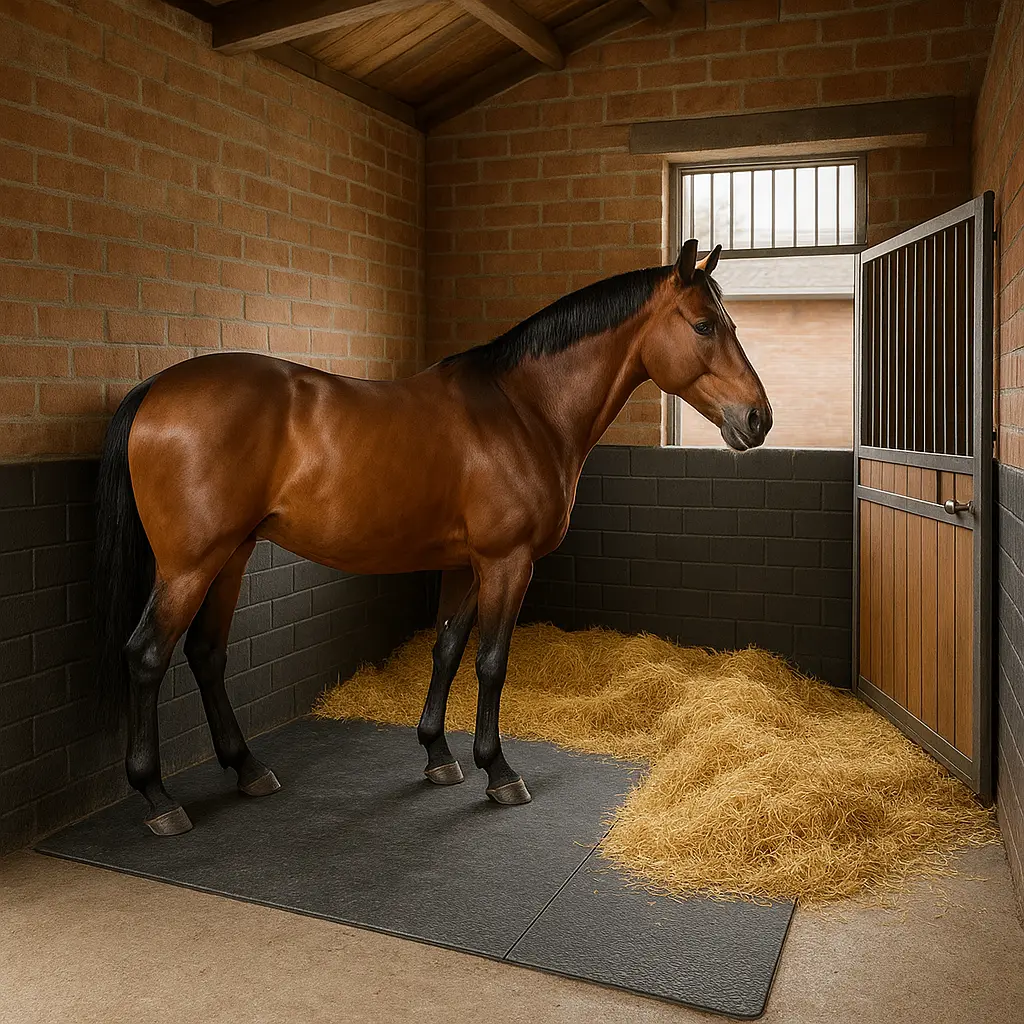
Your horse spends a big part of life in the stable — especially through a wet UK winter — so the size, layout and air quality directly affect welfare, behaviour and health. Get the dimensions right, then fine‑tune bedding and ventilation to give your horse space to turn, lie down, and breathe easy.
Key takeaway: In the UK, a 12ft x 12ft (3.65m x 3.65m) box is the British Horse Society (BHS) minimum for horses up to 17hh. Go bigger for 17hh+, full‑time stabling, box rest, or shared barns, and always maintain 60–90cm (2–3ft) of head clearance for ventilation.
What size stable does a horse need in the UK?
The UK minimum for horses up to 17hh is 12ft x 12ft (3.65m x 3.65m), set by the British Horse Society to allow turning, lying down and getting up comfortably. Larger horses (17hh+) need at least 12ft x 14ft (3.65m x 4.25m); large ponies (13.2hh+) need 10ft x 12ft (3.05m x 3.65m); and ponies need 10ft x 10ft (3.05m x 3.05m).
These are welfare baselines, not “nice to haves”. Under the Animal Welfare Act 2006 and DEFRA licensing guidance, boxes below the BHS minima can breach welfare standards. A 9ft x 10ft box, for example, is below minimum for a 16.2hh and risks enforcement action at a livery yard.
“As a minimum, stables must be big enough to allow your horse to turn around and lie down and get up comfortably. All passageways should provide sufficient room to enable horses to be led safely past others.” — British Horse Society (BHS)
Stable height matters too. UK guidance recommends 60–90cm (2–3ft) of clear space above the horse’s ears in a normal standing position. That headroom is essential for ventilation and comfort, especially for larger horses and those who like to stretch to look over the door.
DEFRA’s licensing guidance adds a practical test that’s easy to apply:
“In stables, each horse must have enough room to lie down in a normal resting posture, stand with the head fully raised, walk forward and turn around with ease.” — UK Government/DEFRA guidance
Quick tip: Mark out 3.65m x 3.65m on your yard with poles or tape, walk your horse through a turn on a circle inside it, then simulate lying down/rolling space with your bedding banks. If you’re tight on any of these movements, size up or rearrange.
When should you go bigger than the minimum?
Go larger than the BHS minimum for 17hh+ horses, full‑time stabling in winter, box rest, or shared barns where two times the single-box area is recommended per horse. More space reduces stiffness, stocking up, and stress behaviours.
UK data show stereotypies like weaving and crib‑biting occur in up to 32.5% of stabled horses — strongly associated with restricted movement and isolation. Just 3% of UK horses have no visual or physical contact with others, but they’re at higher risk of stress behaviours. If turnout is limited by rain and short days, extra floor space helps horses change posture, lie out fully, and turn without scraping banks.
In shared American-style barns, double the area per horse helps movement and reduces bullying. If you must stable for prolonged periods (e.g., winter box rest), choose larger-than-minimum boxes and monitor closely for pacing, door resentment, awkward lying or rolling, and displaced bedding banks.
Pro tip: If your horse fills a 12x12 visually and you see scuff marks around the walls, it’s a welfare clue. Size up to 12x14 (or more) and add social contact (grilles or a window) to lower stress.
Stalls vs full boxes: what is acceptable on UK livery yards?
Stalls (three-sided bays) must allow the horse to lie down but not turn; full boxes must allow turning as well as lying, standing with head raised, and walking forward. Both must meet DEFRA ventilation and bedding standards to be licensed.
Traditional stalls can work for brief periods, but they demand careful management. Horses must be able to back out with ease and have secure, non‑slip footing. Full boxes remain the standard for welfare — they offer turning, better rest, and safer handling for most horses. If a yard proposes stalls, ask how they meet ventilation, bedding depth, and supervised exercise/turnout requirements to offset movement restriction.
How to lay out bedding in a small stable
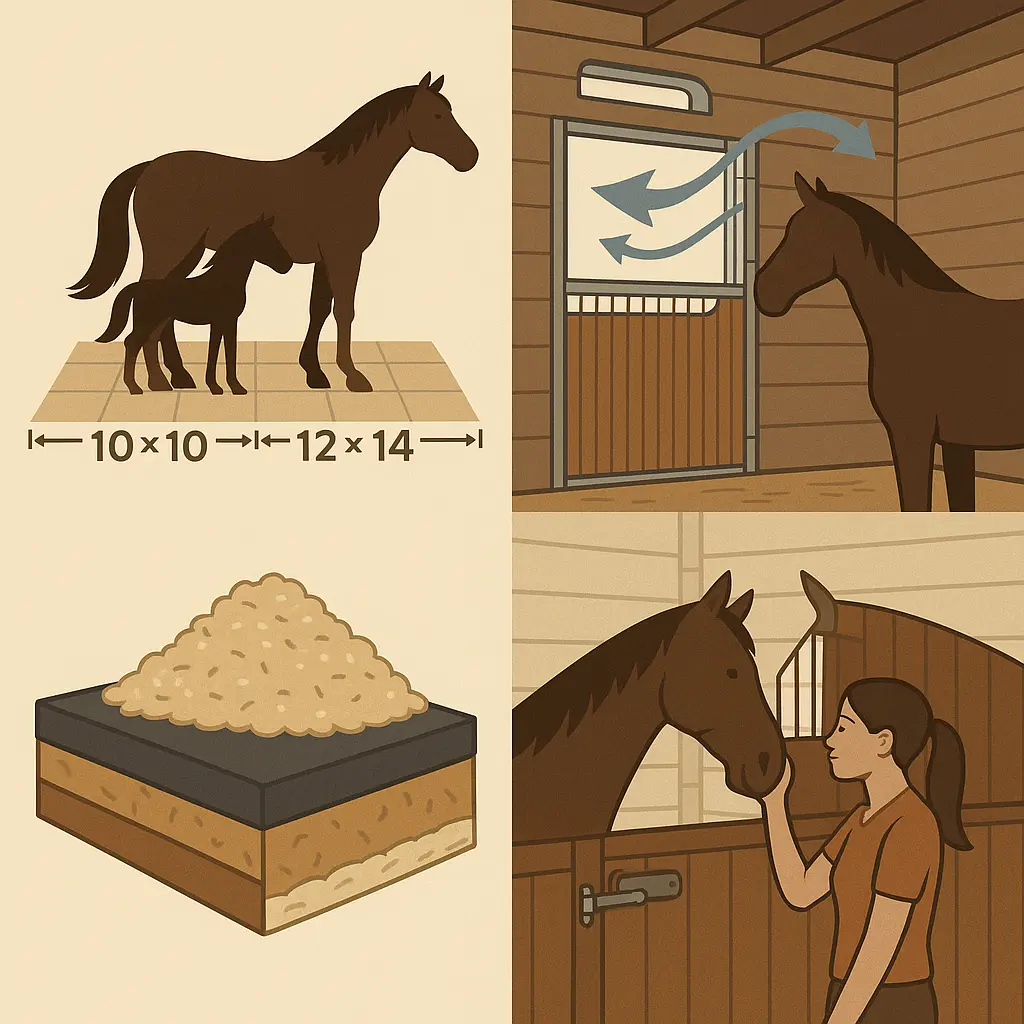
Use deep, dust‑extracted bedding with L‑shaped or corner banks to protect hips and leave a clear central area for turning and lying straight. Support underfoot with non‑slip rubber matting and a floor that drains at a 1:80 fall.
An L‑shaped or corner bed keeps the centre open, reducing scraping and making mucking out quicker. Banks should be high and firm enough to prevent casting against walls but not so bulky that they shrink the usable centre below BHS minima. Bedding must be low‑dust and deep enough to encourage horses to lie down and get up without slipping.
“Your bedding choice must provide support for your horse’s hooves while standing and for the whole body when lying down… and allows the horse to lie down and get up safely without slipping.” — British Horse Society
Shavings are typically more absorbent for smaller spaces; straw encourages longer lie‑downs but some horses over‑eat it and it can be dustier. Whatever you choose, extract dust and manage ammonia with daily wet removal. A well‑sealed, grippy floor plus rubber mats reduces bedding volumes and injuries on tight turns.
Quick tip: If your horse drags banks into the middle overnight, the centre is too tight. Increase the footprint, trim banks slightly, or re‑site feed/water to widen the turning arc.
Ventilation, doors and passageways: the non‑negotiables
Provide 60–90cm (2–3ft) of clear headroom above ears, top doors or grilles for airflow without direct draughts, and outward‑opening doors with safe, wide passageways. Check ventilation and bedding daily to keep ammonia low.
UK winters are damp and still — the perfect recipe for coughs if you close stables up tight. The goal is fresh air movement at eaves level, not cold draughts on the horse’s back. Fit top doors or stable grilles to increase air exchange, keep gutters clear, and avoid blocking inlets with hay storage. Passageways must be wide enough to lead past others safely, and all doors should open outwards with rounded fixtures to prevent knocks.
At Just Horse Riders, we recommend pairing airflow improvements with low‑dust bedding and consistent mucking out to control ammonia, which irritates airways. Daily remove droppings, lift wet, and rotate banks to dry; in cold snaps, open top doors during daytime and close at night if needed to avoid direct draughts.
“Horses and ponies who are stabled should have plenty of space to move around comfortably; plus, they should be able to lie down and turn without brushing against stable walls.” — Animal Friends
Helpful additions include anti‑weave grilles or stable mirrors to reduce fretfulness, and safe top‑door mesh to improve airflow without inviting a head over the door on narrow aisles.
Spot the red flags: signs your stable is too small
Pacing, weaving, awkward lying or rolling, scraping walls, displaced bedding banks, or resentment at the door are clear signs the box is undersized or under‑enriched. Act promptly to protect welfare under the Animal Welfare Act 2006.
Stereotypies like weaving and crib‑biting are strongly linked to restricted movement and social isolation. If you see repeated marks at hock or hip height, manure splatter showing interrupted rolling, or banks kicked into the centre, your horse is telling you space or layout needs attention. Increase stable size, add visual contact via grilles, improve air quality and bedding support, and maximise turnout and hand‑walking where possible.
Supportive add‑ons can help while you change the set‑up. For horses that stock up on longer stable time, consider gentle movement and leg protection during exercise with support boots and stable bandages. For anxious types, review routine and forage first, then consider targeted calming and joint supplements as part of a wider welfare plan.
Winter in the UK: managing horses on more stable time
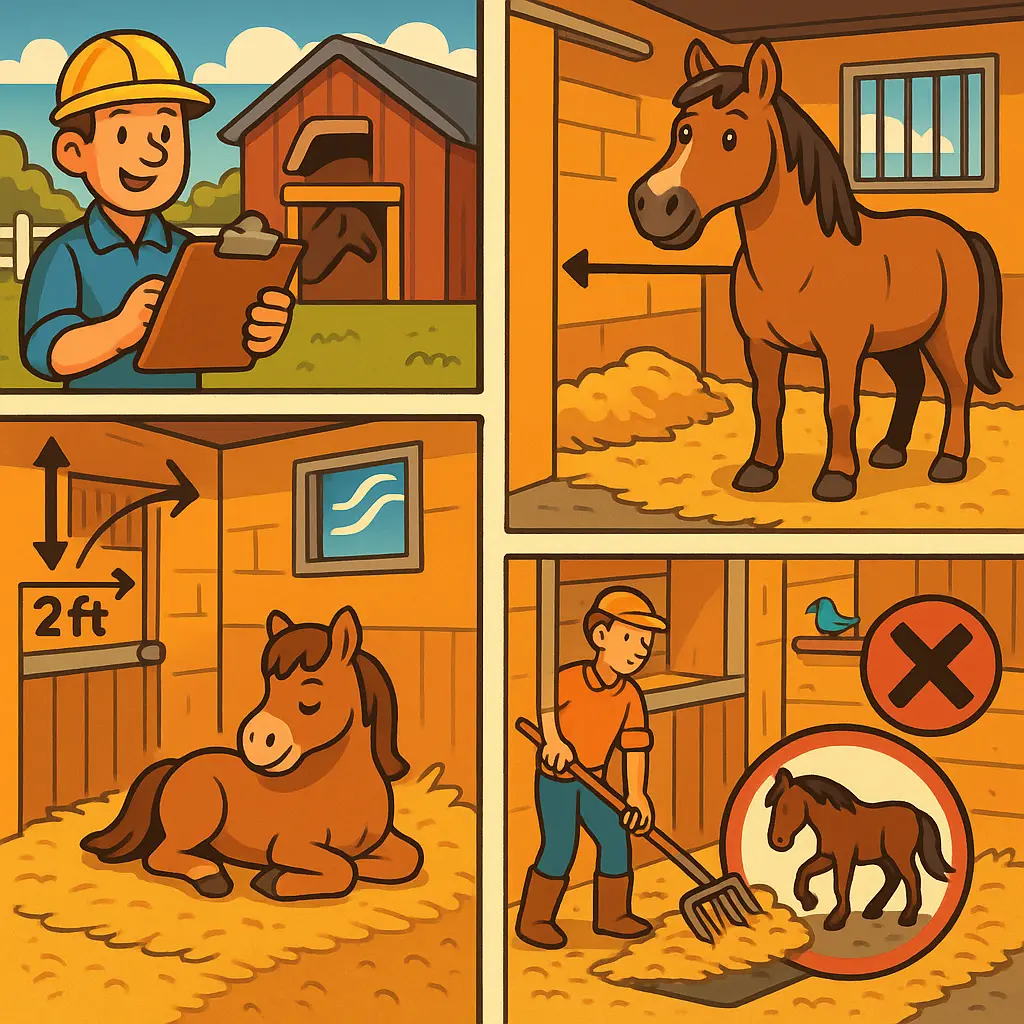
In wet UK winters, choose larger boxes than the minimum, use deep, absorbent, dust‑extracted bedding, and prioritise ventilation and regular turnout or exercise to mimic natural movement. Protect warmth with rugs suited to conditions, not stable size.
Winter brings rain, mud and short daylight, often cutting turnout. Counter this by maximising in‑stable comfort: deep corner banks, rubber matting, and clean air. Keep horses moving with in‑hand walks, ridden hacks in daylight, or arena sessions. For outdoor sessions, stay safe and visible with hi‑vis for dark evenings and a well‑fitted riding helmet.
Match rugs to weather and metabolism, not the size of the box. For field time in cold, wet spells, browse our winter turnout rugs; for stabled hours, switch to breathable stable rugs that avoid overheating while keeping muscles warm. Many of our customers trust WeatherBeeta rugs for reliable insulation through changeable weather.
Quick tip: A daily five‑minute leg check and a brisk brush with a good daily grooming kit helps you spot stocking up, rubs or damp patches early — common side effects of more stable time.
Make your existing stable work: a quick checklist
Hit the BHS size minima, ensure 1:80 floor drainage and non‑slip footing, use deep dust‑extracted bedding with clear central space, and maintain draught‑free ventilation with 60–90cm headroom. Then fine‑tune based on your horse’s behaviour.
- Space and height: 12x12ft for horses up to 17hh; 12x14ft for 17hh+; 10x12ft for large ponies; 10x10ft for ponies. Keep 60–90cm above ears for airflow.
- Flooring: Non‑slip surface with a 1:80 drainage fall; rubber mats reduce slips and bedding use.
- Bedding layout: L‑shaped/corner banks for hip protection; deep, low‑dust material; remove droppings and wet daily to limit ammonia.
- Ventilation: Top doors/grilles open when safe; no direct draughts on the back; clean gutters and air inlets.
- Doors and aisles: Outward‑opening doors, rounded fixtures; passageways wide enough to lead past other horses safely.
- Behaviour watchlist: Pacing, weaving, awkward lying/rolling, scraped walls, or bank displacement — upgrade space or layout immediately.
- Routine: Maximise turnout/exercise; use visible, safe gear for hacks (hi‑vis clothing) and keep horses comfortable with the right stable rugs or turnout rugs.
- Extras: For those prone to filling or knocks, fit appropriate boots and bandages; check ranges from brands like Shires for reliable yard staples.
Pro tip: If your horse is on box rest, set a timer to assess air quality twice daily. If ammonia stings the nose or your eyes water when you enter, the ventilation and mucking-out schedule need upgrading immediately.
Conclusion: make space your welfare foundation
Stable size isn’t a luxury — it’s the foundation for comfort, behaviour and respiratory health. Start with the BHS minimums, then choose bigger for larger horses or longer stabling, lay bedding to keep the centre clear, and keep air fresh without chilling. If your horse tells you the box isn’t working — by pacing, scraping or struggling to lie out — act fast. Our team is here to help you match stable management with the right gear, from turnout rugs and stable rugs to grooming essentials and support boots and bandages.
FAQs
Is a small corner bed enough space for my horse in a 12x12ft?
Yes — if the central area still allows your horse to turn freely, lie down fully, and stand with the head raised, as required by BHS and DEFRA guidance. If you see weaving, resentment at the door, or banks dragged into the centre, the layout or box size needs upgrading. For UK horses on more winter stable time, larger‑than‑minimum boxes are kinder.
What are the signs my stable is too small for welfare?
Red flags include pacing, weaving, awkward or reluctant lying/rolling, scuff marks and scrapes on walls, and bedding banks displaced into the centre. These behaviours align with research linking restricted movement to stereotypies in up to 32.5% of stabled horses. Increase space, improve social contact and airflow, and maximise turnout.
Can I use stalls instead of full boxes at a UK livery yard?
Stalls must allow the horse to lie down but not turn; full boxes must allow turning, lying, standing with head raised, and walking forward. Licensed premises must meet DEFRA requirements for ventilation and bedding depth. Full boxes are generally preferred for welfare and handling safety.
What is the minimum height clearance in UK stables?
Provide 60–90cm (2–3ft) of clear space above your horse’s ears in a normal standing position. This headroom improves ventilation and comfort, especially for larger horses and those who raise the head to look out.
How does winter stabling affect horses in the UK?
More stable time in wet, dark months increases risks of stiffness, stocking up and stress behaviours. Use deep, low‑dust bedding, keep air moving without draughts, and prioritise turnout or hand‑walking. For outdoor exercise, add hi‑vis gear and a safe riding helmet.
Does bedding type change how much space my horse has?
Indirectly, yes. Bulky banks can eat into the turning area if the box is marginal. Shavings absorb better in small boxes, while straw can encourage longer lying but may be dustier and tempting to eat. Whatever you choose, keep the centre clear and deep enough for safe lying and rising, and remove wet daily to control ammonia.
What floor and drainage spec should I aim for?
A non‑slip surface with a 1:80 fall to drain, ideally topped with rubber mats and deep, dust‑extracted bedding. This combination reduces slips, bedding use and ammonia, and helps keep the central area stable and dry for lying out.