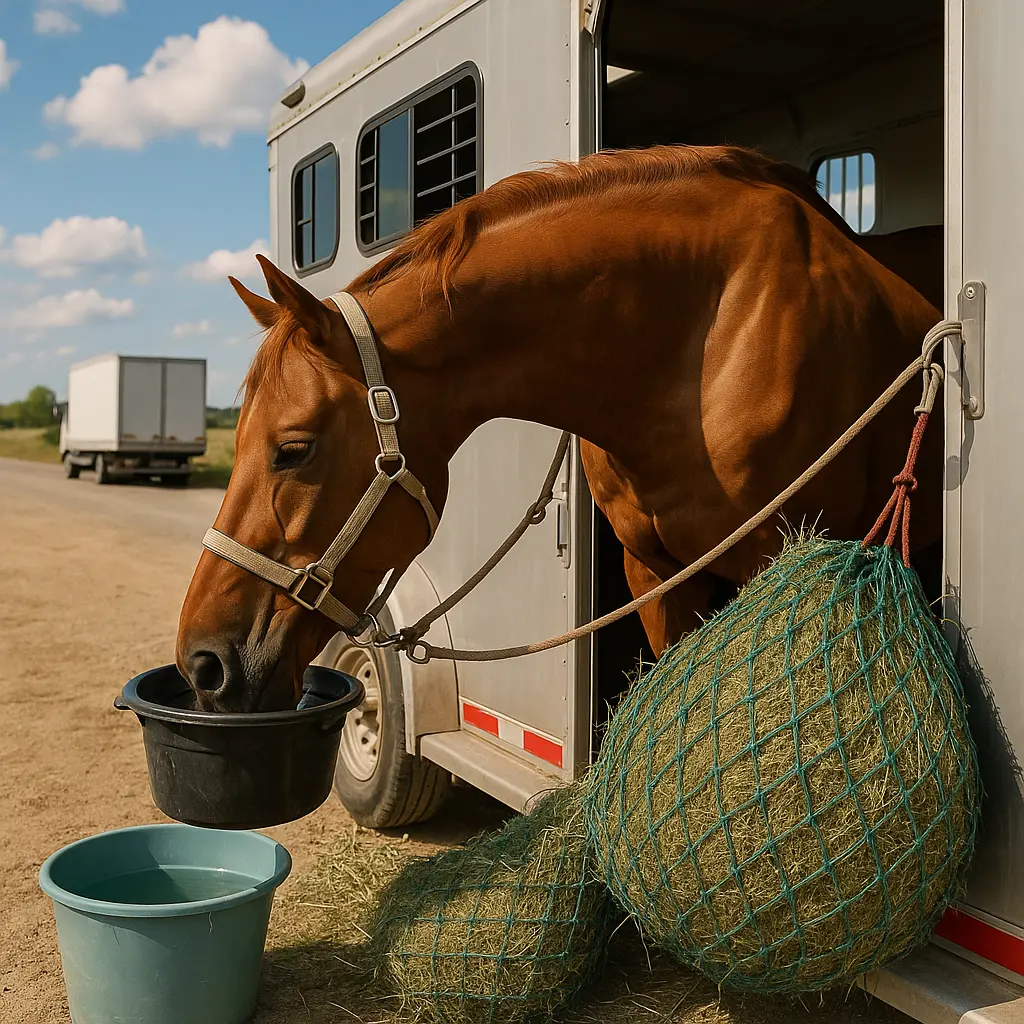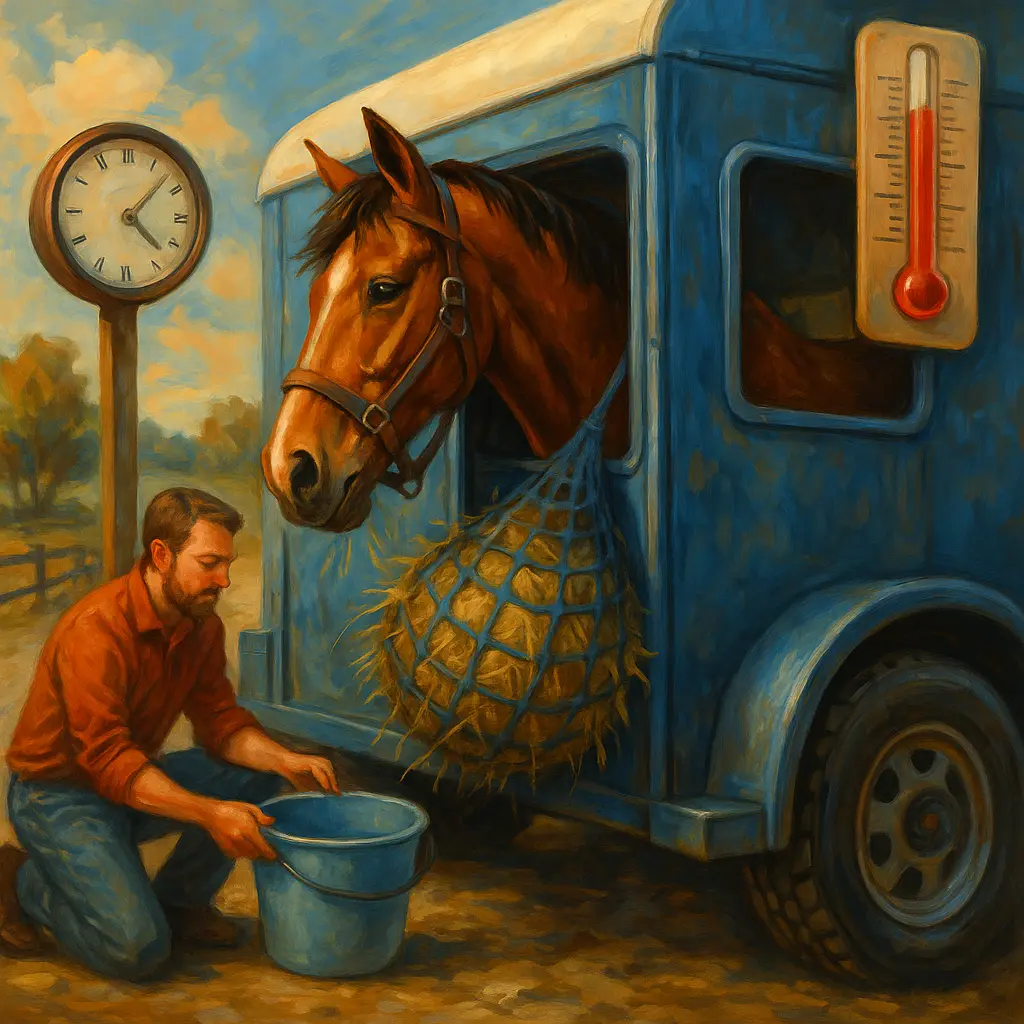
Planning a 14-hour horse journey takes more than fuel and a sat nav. It demands meticulous welfare planning, legal compliance, and a hydration/feeding strategy that keeps your horse healthy from first mile to last.
Key takeaway: In the UK, plan within a 12-hour maximum journey time (8 hours in temperature extremes) unless you qualify for an exemption — and use every stop to hydrate, feed, and check your horse.
Is a 14-hour horse haul legal in the UK?
A continuous 14-hour horse journey exceeds the Government’s proposed 12-hour maximum, unless you qualify for an exemption for competition, racing, or breeding horses under the 2025 measures progressing through Parliament. These measures also reduce the journey limit to 8 hours when external temperature is ≥25°C or ≤0°C, and prohibit transport at ≥30°C unless the vehicle has thermoregulation.
The measures, announced and progressing through Parliament in August 2025, set a clear welfare-first framework for long-distance transport. If your route would take 14 hours, you should either apply for a qualifying exemption or split the journey into two legal legs with an extended rest at a suitable premises. For the latest legal status and how it applies to your circumstances, monitor Horse & Hound’s summary of the Government proposals, DVSA transport guidance, and the BHS transport resources.
Remember that the new framework sits alongside existing goods vehicle drivers’ rules (for vehicles over 3,500kg or used commercially): maximum 9 hours’ driving per day (extendable to 10 hours twice a week) with a 45-minute break for every 4.5 hours of driving. Use these stops to check and care for your horse, not just to tick a compliance box.
How often should you stop on a long horse journey?
Stop for at least 45 minutes every 4.5 hours of driving to meet drivers’ hours rules, and use each stop to offer water, check your horse, and allow head-down eating. On hot or humid days, add shorter “micro-stops” to cool, water, and reassess, even if you’ve not reached the 4.5-hour driving mark.
Structured stops protect both horse welfare and driver alertness. Across a legal 12-hour journey window, this typically means two or three planned breaks. Build your route around safe, quiet locations (service stations with horse-friendly parking, showgrounds, or pre-booked yards), and factor the extra time needed to unload or drop partitions safely if you’ll allow ground-level grazing.
Quick tip: Drivers’ hours rules apply to vehicles over 3.5 tonnes or used for commercial purposes. If you’re in this category, plan your welfare stops to coincide with the mandatory 45-minute break blocks so you’re compliant and consistent with horse care at the same time. See DVSA guidance for the full rules.
Hydration on the road: how much and how often?
Offer water at least every 6–8 hours, and more frequently in warm or humid weather; bring familiar or pre-flavoured water so your horse actually drinks. Reduced intake is the biggest risk factor for dehydration, impaction colic and heat stress on long journeys.
The nutrition experts are unequivocal:
“Reducing water intake is one of the biggest concerns with hauling horses on long trips because lower water intake can increase the risk for impaction colic, dehydration, heat stress and reduced performance.” — Purina Mills Equine Nutrition
Water tastes and smells different from place to place, and fussy drinkers can refuse it when away from home. The Horse recommends training to a flavour one to two weeks before departure, then using the same flavour on the road:
“Water can vary in taste and odor, which can cause a horse to drink less. To avoid this, consider bringing a water supply from home for when you're on the road and/or precondition your horse to drink water containing a flavored additive.” — The Horse
At Just Horse Riders, we recommend packing enough containers to carry “home” water for the first day and a trusted flavouring or electrolyte your horse already accepts. Our supplements selection includes electrolyte options and plain salt to support thirst and fluid balance.
- Precondition 1–2 weeks out: add your chosen flavour or electrolyte to every bucket at home so the taste is familiar on the road.
- Use salt strategically: add 1 tablespoon of plain white salt per 500 lb of body weight daily for several days pre-travel to stimulate thirst (as per nutrition guidance). Keep offering both plain and flavoured water en route.
- Offer water at each stop and monitor intake. If you suspect dehydration at any point, call your vet — intravenous fluids may be required for severe cases.
Pro tip: Bring two labelled buckets — one for plain water and one for flavoured — and offer both at every rest stop. Many horses will switch between them across a long day if they have the choice.
What should you feed during a long haul?
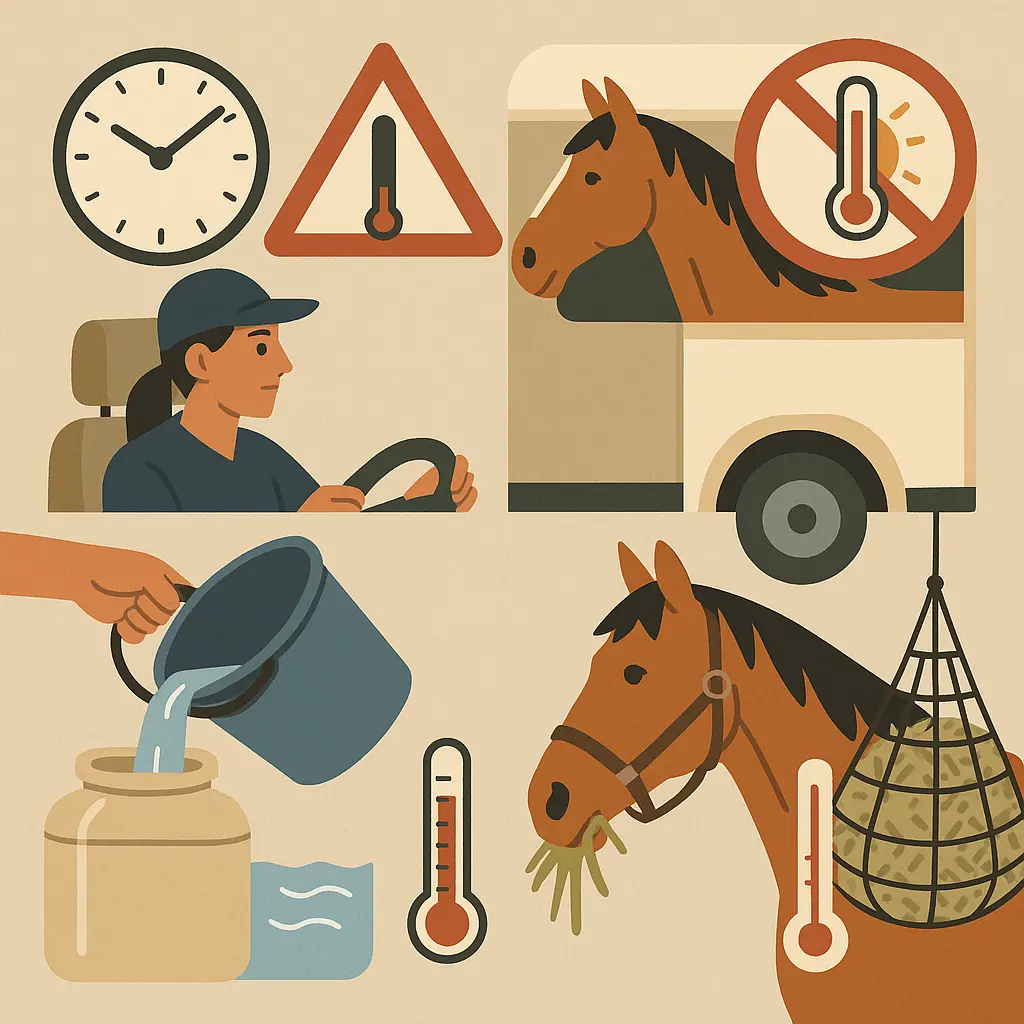
Feed continuous high-quality forage at 1.5–2% of bodyweight per day (15–20 lb for a 1,000 lb horse), with small amounts of concentrates (~3.3 lb/day) and soaked beet pulp (~5.4 lb) if needed to maintain intake and gut motility. Prioritise dust-free hay and allow head-down eating during stops to protect the respiratory tract and stomach.
Forage is your horse’s stabiliser during travel. Keep hay available at all times (slow feeders help manage waste), and consider wetting dusty hay to reduce airway irritation. Ride+Climb’s rule of thumb is clear:
“All forages should be fed at a rate of 1.5–2% of a horse's body weight, which translates to 15–20 pounds per day for a 1000 pound horse.” — Ride+Climb
Ground-level eating matters for airways and sinuses during a long day upright:
“Allowing the horse to drop its head to eat from the ground whenever possible allows the nasal passages to drain and could prevent respiratory disease.” — OnCourse Equine Nutrition
In practice:
- Keep hay nets topped so there’s no gap in fibre intake; use slow nets to prevent bolting and waste.
- At safe stops, offer a small hay pile at ground level inside the box or in a secure pen so the horse can lower its head fully.
- If you feed concentrates, split into very small meals and avoid big starchy feeds on the move; soaked beet pulp is a useful, hydrating fibre source.
- Use consistent fibre sources such as alfalfa cubes or timothy pellets to offset regional hay variability, and consider introducing alfalfa pre-trip for its acid-buffering effect to reduce ulcer risk.
Quick tip: If your horse is prone to travel stress or sensitive digestion, consider a gut-support supplement you’ve trialled at home. Explore proven options in our horse supplements range and start 7–14 days before the journey.
Temperature, rugging and ventilation: what’s safe?
Do not transport at 30°C or hotter unless your vehicle has a thermoregulation system; if it’s 25°C or above (or 0°C or below), your journey limit drops to 8 hours under the proposed UK measures. Good airflow, shade from direct sun, and appropriate rugging are non-negotiable for welfare.
British weather is famously changeable, so plan around the forecast: depart early in summer to avoid peak heat; in winter, avoid the coldest hours. Keep windows, roof vents and fans working to maintain airflow without creating a draught. In warm months, travel light — only use a cool, breathable sheet if needed for protection from flies or rubbing. In cooler or wet conditions, choose the lightest rug that keeps the horse comfortable without sweating.
- Summer protection without overheating: a breathable sheet from our fly rugs and sheets can add a layer of defence against flies and sun while maintaining airflow.
- Cooler UK days: if your horse chills when standing, opt for a lightweight turnout from our turnout rug collection before and after loading, then reassess once the vehicle is at temperature.
- Always reassess at each stop: if the coat is damp under a rug, remove it and cool the horse with shade, airflow, and small sips of water.
Pro tip: Pack a sweat scraper and sponge so you can cool efficiently at stops without soaking the coat. Our grooming collection has compact options that live neatly in your travel kit.
Vehicle and legal readiness: what must you have?
For journeys over 8 hours, the driver needs a Certificate of Competence; if your horsebox exceeds 3.5 tonnes, you also need an Operator’s Licence and a working tachograph, with at least 20 cm headroom and halters on horses over 8 months. These requirements are enforced by DVSA and supported by BHS guidance.
Before you book the route, confirm your paperwork and vehicle set-up:
- Driver and operator compliance: Certificate of Competence for long hauls; Operator’s Licence and tachograph if over 3.5t (DVSA: transporting horses in horseboxes and trailers).
- Journey plan within time limits: 12-hour general maximum (8 hours if ≥25°C or ≤0°C), with travel at ≥30°C only if your vehicle can thermoregulate (see Horse & Hound’s breakdown of the proposals).
- Vehicle and fit: minimum 20 cm headroom above the tallest horse’s head, secure partitions, safe tying points, and non-slip flooring (summarised by Richard Nelson LLP guide).
- Haltering and loading: horses over 8 months must wear a halter during transport (BHS: transporting your horse).
Protection and comfort kit matter too. Travel boots reduce knocks and scrapes in transit — explore options in our horse travel boots and bandages. For roadside visibility when checking or hand-walking, add rider and handler high-vis from our hi-vis collection.
How to turn a 14-hour route into a compliant, horse-friendly plan
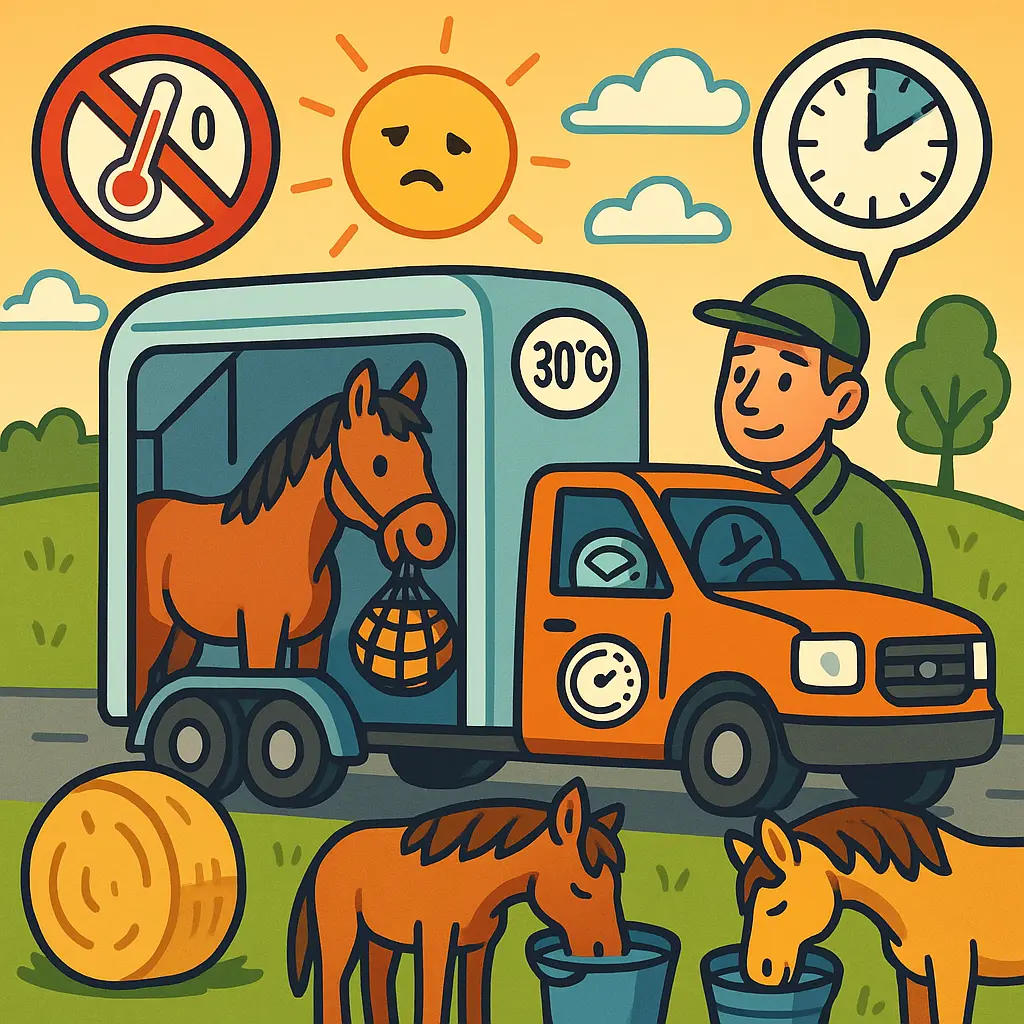
Split the trip into two legal legs with an overnight rest at a suitable premises, or confirm you meet exemption criteria; never exceed the applicable 12-hour (or 8-hour in temperature extremes) journey limit. Build your day around driver break blocks so every stop supports welfare.
Here’s a simple framework you can adapt to your map and season:
- Pre-travel (1–2 weeks out): train to flavoured water; add daily plain salt to feed; introduce any gut support you’ll use on the day; line up consistent fibre sources (alfalfa cubes/timothy pellets) and dust-free hay. Choose breathable protection from a trusted brand such as WeatherBeeta if your horse needs a sheet.
- Day 1 (Leg A — up to 12 hours within limits): build in a 45-minute stop after each 4.5 hours of driving. At every stop: offer plain and flavoured water; top up hay; allow head-down eating on the ground where safe; check temperature/respiration and adjust rugging; sponge/scrape if warm.
- Overnight: stable or secure pen turnout. Keep forage free-choice, offer plenty of water (flavoured and plain), a small concentrate meal if you usually feed it, and a short in-hand stretch if appropriate.
- Day 2 (Leg B — remaining distance): repeat the Day 1 stop routine and keep a close eye on hydration. If the forecast pushes you into the 8-hour limit (≥25°C or ≤0°C), tighten your plan and reduce total journey time accordingly.
Pro tip: Even in spring and autumn, UK humidity can spike. If your horse is sweating under a sheet at a stop, remove the rug, increase airflow, and re-offer water. Your horse will travel better slightly cooler than slightly warm.
On-the-road essentials to keep within easy reach:
- Two labelled water buckets (plain and flavoured) and enough “home” water for the day.
- Hay in slow nets plus extra for ground-level eating at stops.
- Electrolyte/flavouring you’ve preconditioned at home — shop proven choices in our supplements.
- Travel boots and tail guard for protection — see our horse boots & bandages.
- Breathable fly sheet or light rug if needed — explore fly rugs and sheets and weather-ready turnout rugs.
- Sponge and scraper to cool quickly — compact options in grooming.
- Handler high-visibility for roadside checks — browse hi-vis essentials.
FAQs
Is a 14-hour haul ever allowed under UK rules?
Under the Government’s 2025 measures, most horses are limited to 12 hours, reduced to 8 hours in temperature extremes; exemptions may be available for competition, racing, and breeding horses if extra criteria are met. Check the latest via Horse & Hound’s legislative coverage and DVSA guidance.
How many stops should I plan for a 12-hour journey?
Plan at least two 45-minute breaks (every 4.5 hours of driving) to meet drivers’ hours and use each one to water, feed, and check your horse. In hot or humid weather, add shorter cooling stops so you can re-offer water more frequently than the 6–8 hour guideline.
What should I feed while travelling?
Keep hay available continuously and aim for 1.5–2% of bodyweight across 24 hours (15–20 lb for a 1,000 lb horse). If needed, offer small concentrate feeds totalling around 3.3 lb per day and consider soaked beet pulp (~5.4 lb) for extra fibre and moisture. Introduce or increase alfalfa beforehand for its acid-buffering effect.
How do I encourage a fussy drinker to hydrate on the road?
Precondition with a flavour at home for 1–2 weeks, bring “home” water for day one, and offer both plain and flavoured water at every stop. Add plain salt to feed for several days before departure to stimulate thirst, and consider a familiar electrolyte from our supplements range.
What temperatures make travel unsafe or illegal?
At 25°C or above (or 0°C or below), the proposed rules cap journeys at 8 hours; at 30°C or above you must not transport horses unless the vehicle has a thermoregulation system. Aim to travel in the coolest part of the day in summer and the warmest in winter, and reassess rugging at every stop.
Should I tie my horse or let it travel loose?
The research here doesn’t provide a specific tying versus loose recommendation; however, horses over 8 months must wear a halter during transport. For tying set-up and partition design, follow BHS transport guidance and consult a qualified transporter with a Certificate of Competence for detailed advice.
What legal documents do I need for long journeys?
For trips over 8 hours, the driver needs a Certificate of Competence. If your horsebox weighs over 3.5 tonnes, you also need an Operator’s Licence and a working tachograph, and you must follow drivers’ hours. Ensure at least 20 cm headroom and suitable tying points — see DVSA and the BHS for full details.
With a clear legal plan, a hydration-first mindset, and well-timed stops, you’ll turn a daunting distance into a smooth, welfare-led journey. If you need help kitting out your horse for the road, our team at Just Horse Riders is here to help you choose the right travel boots, breathable fly sheets or turnout rugs, and proven electrolytes and gut supports for confident, compliant long hauls.