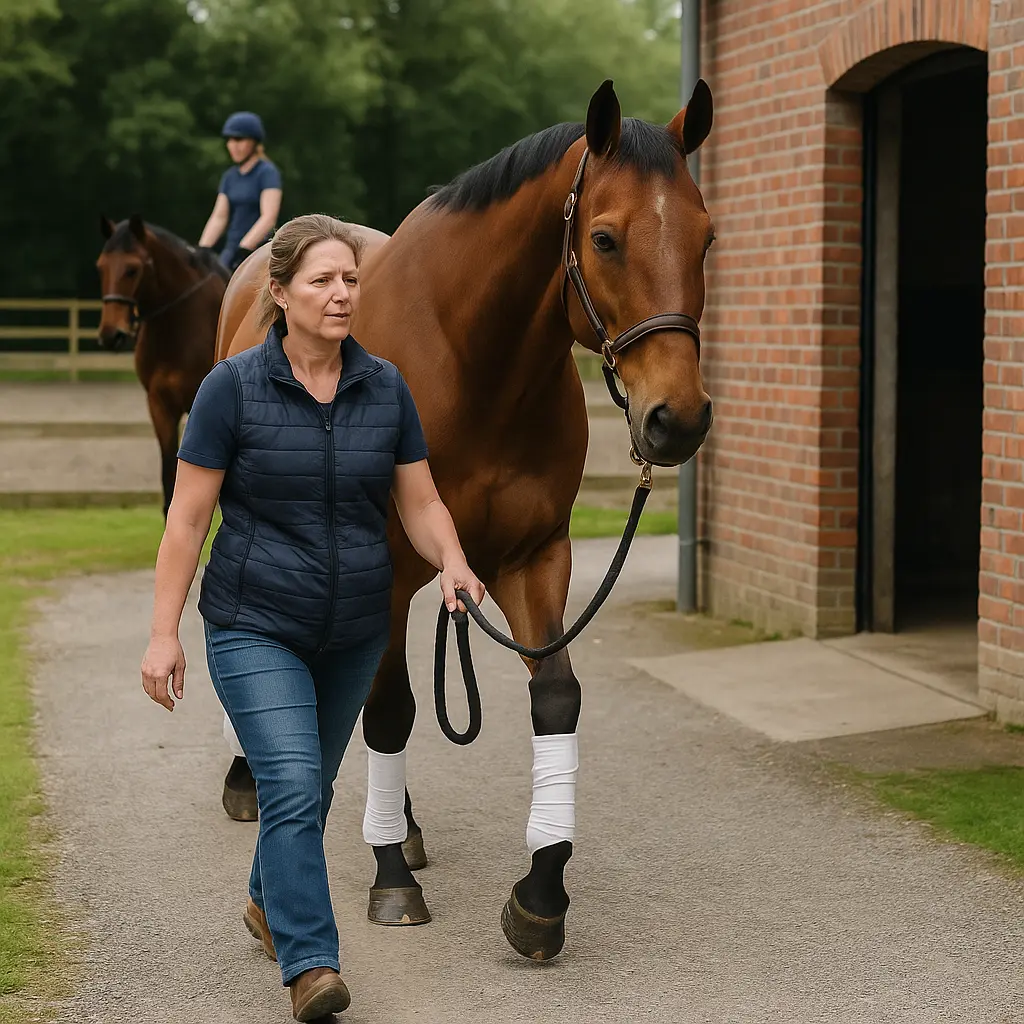
Bringing a horse back from injury or time off isn’t guesswork — it’s a structured, steady climb that protects healing tissues and rebuilds fitness safely. With UK weather and surfaces to contend with, a clear plan matters even more.
Key takeaway: Most horses return to work safely by progressing from controlled hand-walking to walk under saddle, then adding short trot and light schooling over 12–24 weeks — only increasing work if every step stays sound.
The three phases of equine rehabilitation
Equine rehab follows three phases: initial recovery (rest and stabilisation), rehabilitation (controlled exercise such as tack walking), and return to work (gradual reintroduction of activity with close monitoring).
In the initial recovery phase, your vet stabilises the injury with rest, bandaging, and medical care; movement is minimal and purposeful. The rehabilitation phase starts when your vet clears you to begin controlled exercise — typically hand-walking at set durations on even ground. The return-to-work phase builds on this foundation: walk under saddle first, then carefully layer in trot, hill work, schooling, and finally canter, always stepping back if you see any heat, swelling, or lameness. Rechecks every 2–3 weeks (e.g. lameness exam or ultrasound for soft tissue injuries) help you adjust the plan.
Weeks 0–12: a proven hand-walking plan
For soft tissue injuries, begin with 5–10 minutes of hand-walking two to three times daily in weeks 0–4, progress to 10–15 minutes three times daily in weeks 5–8, and aim for 30–35 minutes per session by week 12.
This steady schedule allows collagen fibres to align along lines of stress. On flat, consistent footing, watch for gait symmetry — even steps, equal stride length, and no head bob. Increase by roughly five minutes per session each week only if the horse stays sound and cool-limbed afterwards.
- Weeks 0–4: 5–10 minutes, 2–3x daily on level, non-slippery footing
- Weeks 5–8: 10–15 minutes, 3x daily; introduce gentle straight-line transitions (halt–walk) to wake up the core
- Weeks 9–12: Build to 30–35 minutes per session; include short stretches on different level surfaces if sound
Quick tip: UK winter ground can be soft and slippery; choose safe lines in the arena or on sound hardstanding. If you’re hand-walking in the dark, wear hi-vis for riders and consider reflective leg bands so drivers can see you on yard roads.
From week 3, the British Horse Society (BHS) suggests you can add gentle hill walking to strengthen the hindquarters, keeping downhill work to walk only to limit forelimb concussion on healing tissues.
When and how to start ridden work
Start ridden work with 5–10 minutes of walk under saddle five to seven days a week and increase duration before intensity; for each extra month out of work beyond one, add 2–4 weeks to your timeline back to pre-injury fitness.
Begin once your vet approves and your horse can hand-walk comfortably at 30+ minutes without heat or swelling. The first mounted sessions are quiet walk on straight lines, reins long enough to encourage a relaxed, marching stride. Build time in walk before any trot.
“Start ridden exercise with a low exercise load, such as walking under saddle five to seven days a week for 5–10 minutes at a time... Slowly progressive increases in work volume on a weekly basis by incrementally increasing distance or duration before amplifying intensity.” — Hilary Clayton, equine sports medicine researcher (source)
Practical progression often looks like this:
- Weeks 13–16: Ride at walk 20–25 minutes daily, adding 5 minutes per week if sound
- Weeks 17–20: After a 10–15 minute walk warm-up, introduce trot in 1–1.5 minute segments on soft, even surfaces; aim for 3–5 minutes total trot if sound
- Beyond week 20: Lengthen trot sets gradually before adding short, steady canter; keep circles large and transitions smooth
Always add time before speed or schooling intensity. If your horse had three months off, expect to add roughly 6–12 extra weeks to reach pre-injury workload. In UK winters, be prepared to extend timelines when wet, frosty, or dark conditions limit safe work.
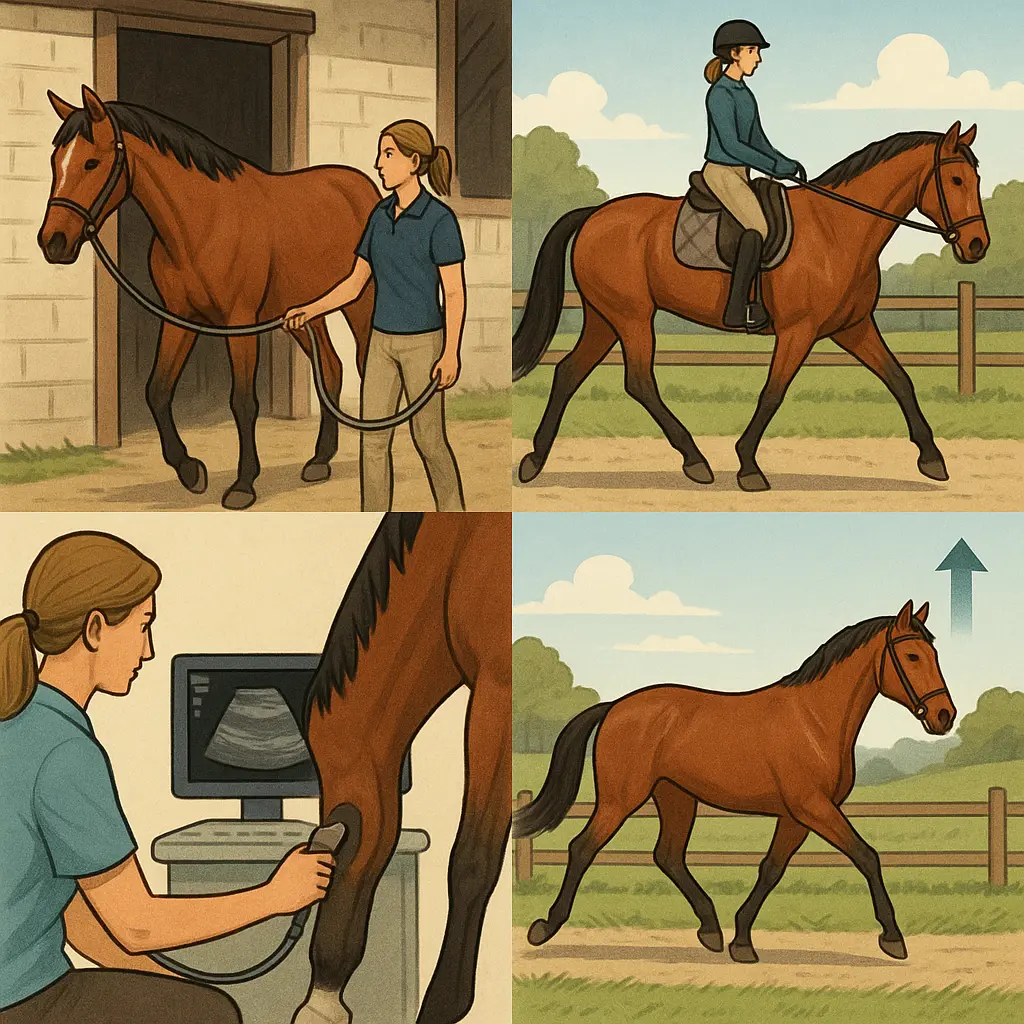
Surfaces, hills and the UK weather
Work your horse on varied surfaces — arena, roads and grass — and add gentle hills from week 3; avoid sudden surface changes and skip hard, frosty or slippery ground common in the UK winter.
Each surface has unique loading patterns: firm but forgiving arenas can reduce slip, tarmac encourages rhythm at walk, and good grass builds soft tissue resilience. The BHS advises mixing surfaces carefully.
“Work on varied surfaces such as arenas, roads and grass. Each surface gives slightly different benefits to the development of the horse’s soft tissue... Avoid sudden changes of surface as this can increase the risk of injury.” — British Horse Society (source)
UK-specific tips:
- Below about 5°C, joints and muscles can stiffen; warm up longer at walk and consider a lightweight rug before/after work to prevent chilling.
- Avoid hard, frosty ground and heavy, rutted mud; choose arena lines or quiet roads for early walk work.
- On wet or very soft turf, stick to straight lines to minimise tendon strain from slipping or deep going.
- If outdoor footing is unreliable, prioritise indoor schools or controlled options such as water treadmill sessions where available.
Pro tip: Hill work is potent — use gentle uphill in walk from week 3 to recruit hindquarters, but keep downhill to walk and short durations to reduce forelimb impact.
Spotting ‘off’ steps and when to slow down
Slow down or stop immediately if you see lameness over 1/5, heat, swelling, marked asymmetry, or shortened steps that don’t improve after 48 hours’ rest; drop back a level and call your vet.
In early rehab, brief stiffness or slightly shortened strides can appear as muscles adapt to controlled walking — these should resolve quickly with rest and a proper warm-up. True overload shows as persistent asymmetry, heat, regional swelling, a head nod, or an unwillingness to weight-bear. Video your horse in-hand from the front, side and behind to compare each limb’s range and timing.
What to do if you spot an issue:
- Stop the session and cold-hose if advised for the original injury
- Check digital pulses and limb temperature; note any swelling
- Rest 24–48 hours, then resume at the last comfortable step, not the current one
- If signs persist or worsen, arrange a recheck; many protocols recommend reassessment every 2–3 weeks to guide progression
Quick tip: Grooming before and after work helps you detect subtle heat or fill early. Keep a tidy kit — a simple curry comb and body brush from our grooming collection makes daily checks faster and more thorough.
In-hand exercises, lungeing and poles
Use in-hand work, long-reining and large-circle lungeing early in rehab to build posture and control without rider weight, keeping circles large and sessions limited to protect healing tissues.
In-hand exercises let you assess movement up close while encouraging correct mechanics. World Horse Welfare highlights their value in tailored rehab:
“In-hand work can also be hugely useful for horses on a rehab programme – a chartered physiotherapist will be able to advise on exactly what exercises your horse will benefit from most... When you reach the stage of starting ridden work again, make sure you give your horse as much time at each stage as they need.” — World Horse Welfare (source)
Guidelines to keep it safe:
- Stick to straight lines or very large circles; limit lunge sessions to around 20 minutes to reduce soft tissue strain
- Use a well-fitted cavesson for precision; avoid tight gadgets unless prescribed by your physiotherapist
- Introduce raised poles only once walk is solid — start with a single pole, then two to three, to stimulate core engagement without overloading limbs
- Layer simple transitions (halt–walk–halt; walk–trot–walk in-hand if approved) to build strength without speed
Pro tip: Many ‘nappy’ or resistant moments are behavioural, not lameness — but true lameness repeats on the same limb and shows a consistent head nod or hip hike. Use video from multiple angles to decide.
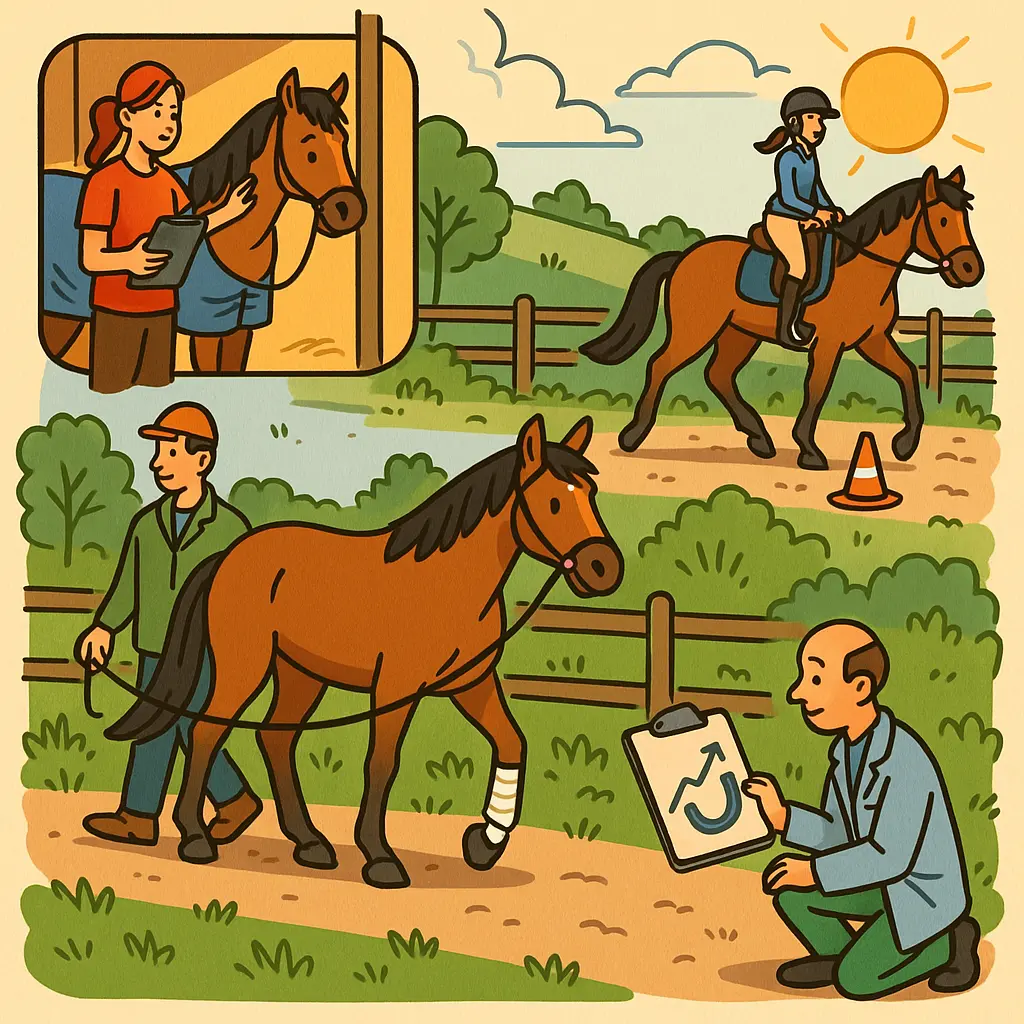
A simple 6–8 week UK return-to-hacking plan
A practical 6–8 week plan starts with walk-only hacks for two weeks, adds short slow trot in weeks 3–4, introduces light schooling in weeks 4–5, and includes steady canter by weeks 5–6 if every step remains sound.
This framework adapts BHS and World Horse Welfare guidance to typical UK yards and bridleways. Use it once your horse is comfortably walking under saddle for 20–30 minutes.
- Week 1: 20–30 minutes hacking in walk on level surfaces, 5–6 days
- Week 2: 30–40 minutes walk, add gentle hills, still 5–6 days
- Week 3: Maintain 30–40 minutes; after a 15-minute walk warm-up, add 2–3 trot sets of 1–1.5 minutes on soft, even footing
- Week 4: 40–50 minutes total; increase trot to 4–6 minutes total across sets if sound; keep circles large
- Week 5: Introduce 10–15 minutes of light schooling (walk–trot transitions, figures of eight on large diameters); add a few short, steady canter strides if trot work is consistently sound
- Week 6: 50–60 minutes; steady canter in short sets on good going; begin pole work at walk if approved
If your horse had longer time off or you’re limited by winter footing, extend each step by one to two weeks. On wet or icy days, swap hacking for indoor walking or in-hand work. Cool down at the end of every session by gradually reducing paces until breathing normalises — this helps reduce lactic acid build-up and inflammation risk.
Your rehab toolkit: gear that helps
The right kit — support boots, appropriate rugs, safety wear and simple monitoring tools — makes rehab smoother, safer and more consistent in UK conditions.
- Support and protection: For hand-walking and early ridden work on mixed surfaces, consider supportive or cushioned boots from our horse boots & bandages collection to protect from knocks and help prevent re-injury.
- Warmth without weight: Prevent post-exercise chills and stiffness with correctly weighted winter turnout rugs for wet days outside and breathable stable rugs on box rest.
- Safety on roads and in low light: Early rehab often means lots of walking; stay seen with our range of hi-vis rider gear and protect your head with certified riding helmets.
- Daily checks: Use items from our grooming range to spot heat, swelling or rubs — consistent hands-on care is your best early-warning system.
- Inside–out support: Discuss targeted nutrition with your vet; our supplements collection includes options commonly used alongside professional rehab plans.
At Just Horse Riders, we recommend logging every session — time, surface, any ‘off’ steps — and matching your kit to the day’s conditions. For example, swap to lighter boots on very soft going to limit water-logging, and always remove boots promptly post-exercise to check legs are cool and tight.
FAQs
What are normal ‘off’ steps in early rehab?
Shortened strides or mild stiffness can appear during the first 5–10 minute walking sessions as muscles re-adapt, but they should resolve quickly with rest and a longer warm-up. Persistent asymmetry, a head nod, heat or swelling signals overload and needs you to slow down and consult your vet.
When should I slow down the programme?
Immediately slow or stop if you see lameness over 1/5, heat, swelling, or no improvement after two days’ rest. Drop back to the last comfortable level and arrange a recheck; many protocols suggest reassessment every 2–3 weeks to guide safe progression.
How long until I can introduce trot in UK conditions?
After 2–4 weeks of solid walking — typically following BHS Phase One — introduce 1–1.5 minute trot sets after a 10–15 minute walk warm-up, on soft, even surfaces like an arena or good grass. In wet, slippery or frosty conditions, delay until footing is safe.
Is hill work safe early in rehab?
Yes, from week 3 add gentle uphill in walk to strengthen the hindquarters; keep downhill to walk only to reduce forelimb concussion, and avoid steep or slippery slopes.
How do I tell behaviour from lameness?
Video in-hand from multiple angles. Behavioural resistance is inconsistent and improves with calm repetition; true lameness is consistent on the same limb and shows head bob or shortened stride. If in doubt, step down your plan and seek a vet or physiotherapist’s opinion.
What’s a typical soft tissue rehab timeline?
Expect 12–24 weeks to rebuild to ridden trot and canter, starting with stall rest, then controlled hand-walking, then walk under saddle, and gradual trot sets. For each extra month off work beyond one, add 2–4 weeks to return to pre-injury fitness, and allow more time in winter when UK footing limits progress.
How should I cool down after exercise?
Reduce pace gradually back to a marching walk until respiration and muscle tone return to baseline, then dismount and hand-walk a few minutes. This helps clear lactic acid and reduce inflammation. Rug appropriately if it’s cold or wet to prevent chilling.
Bringing a horse back into work is a marathon, not a sprint — but with a clear plan, careful monitoring and the right kit, you’ll make steady, confident progress. If you’d like help choosing supportive boots, winter rugs or visibility gear for your programme, our team at Just Horse Riders is here to help and our curated ranges are ready when you are.