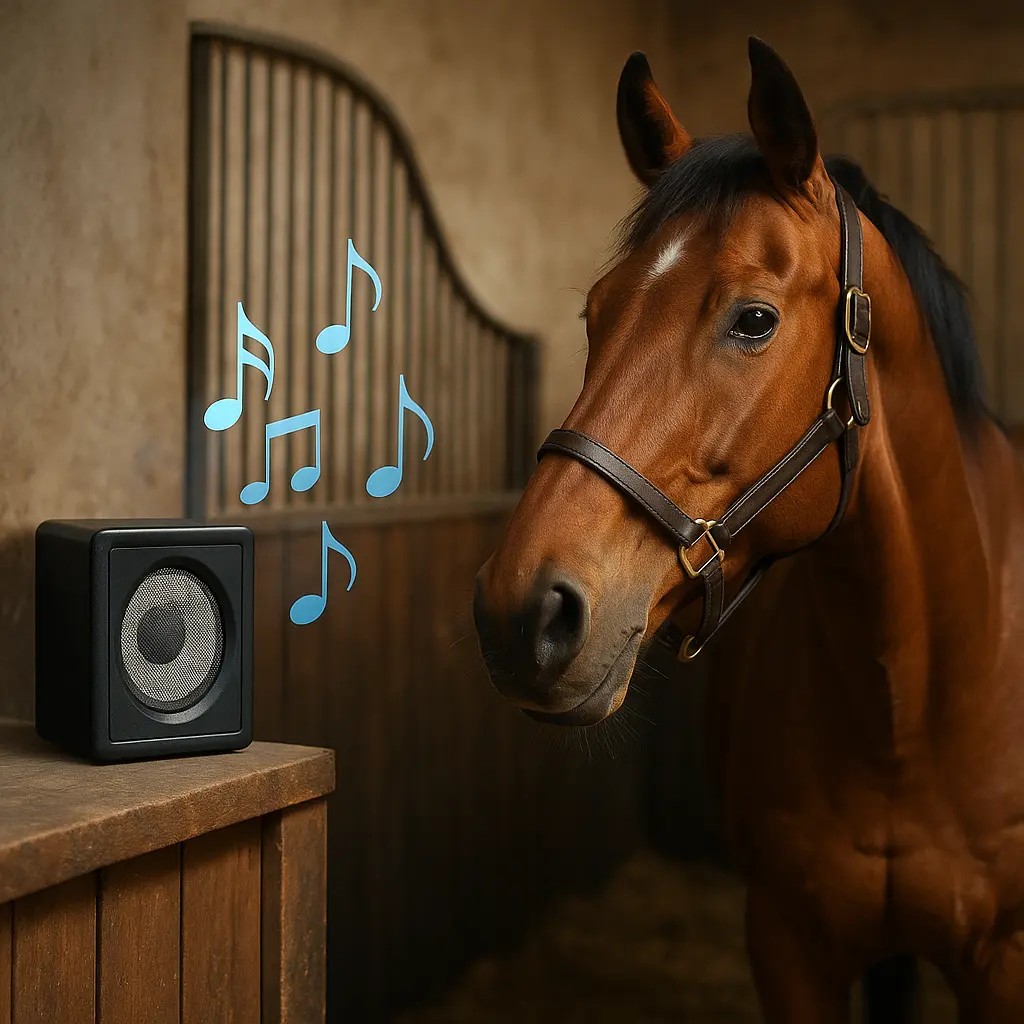
Busy yards, winter stabling and travel can all raise your horse’s stress levels — but the right music can dial it back. Multiple UK and international studies now show that carefully chosen tracks reduce heart rate, cut stress behaviours and even lift serotonin.
Key takeaway: Play classical or country music at a moderate tempo for 60 minutes daily to start, building to up to 5 hours on heavily stabled days — you should see calmer behaviour within a week and measurable heart-rate changes by one month.
Does music really calm horses?
Yes — classical and moderate-tempo music reduces heart rate, lowers stress behaviours and increases serotonin in stabled and training horses. Repeated exposure also helps horses cope better with unexpected stimuli on the yard.
Across controlled studies, horses listening to moderate-tempo classical music showed physiological changes linked to relaxation: increased serum calcium, higher mean corpuscular haemoglobin (MCH), higher total haemoglobin concentration, and reduced lymphocytes. Crucially, both slow- and moderate-tempo music raised serotonin after one week — a clear marker of improved mood and lower stress (peer‑reviewed veterinary science study).
Behaviourally, British researchers at Hartpury College observed that classical and country music produced calmer horses, with fewer stress actions like stamping and head tossing, compared to jazz and rock (Hartpury summary). Another study of 12 horses found that playing the same track daily helped them handle surprises more calmly after seven exposures — their overt stress behaviours dropped as they habituated to the predictable soundscape.
There’s also performance upside. In a large cohort of 70 Polish racehorses, playing music for five hours daily over six months reduced heart rate and heart rate variability after just one month, with the effect strongest in months two and three — and those horses went on to perform better on the track (study overview).
“Classical music is associated with reduced occurrence of alertness behavior, increased state of relaxation, lower psychophysiological stress in horses and positive emotional states for race horses.” — PMC‑indexed research on musical rhythm effects
Music also masks yard clatter and vibrations — useful in busy UK livery environments — which helps balance equine behaviour and promote relaxation, a principle used in clinical veterinary settings and barns (Horse Journals).
What music should you play for stabled horses?
Choose classical or country music at a moderate tempo and avoid fast jazz or rock. Horses consistently show calmer responses — fewer head tosses, less stamping — to these genres in UK research.
Hartpury College’s work is clear: “Horses seem to prefer classical music and country music,” while jazz and rock tend to provoke agitation (Hartpury researchers). For stabled horses — especially during dark, wet UK winters with limited turnout — line up a classical or gentle country playlist and keep tempo and transitions smooth.
Start at a low, comfortable volume, just loud enough to mask background yard noises without dominating the stable. Horses hear a wider frequency range than we do, so avoid shrill highs and heavy bass. Purpose-composed tracks tailored to equine hearing can be particularly effective:
“It’s all about composing music and modifying the decibel and frequency levels of each note for the comfortable hearing range of the animal… we have tested music through clinical studies… to see the music elicit a release of physical tensions and stress behaviours.” — Janet Marlow, sound behaviourist, Pet Acoustics Inc.
Quick tip: If your yard plays a radio, switch to calm classical or mellow country blocks during stabling hours to keep the soundscape consistent.
How long and how often should you play music to see results?
Play 60 minutes daily to raise serotonin within a week, and extend to up to five hours on heavily stabled days to reduce heart rate within one month — with the strongest effects typically in months two and three. Maintain a consistent daily routine for stability.
Here’s a practical schedule that fits typical UK yard routines:
- Week 1: 60 minutes daily of classical or country music during the quietest stabling period — many yards choose early afternoon. Observe for calmer postures (lower head carriage, soft eyes) and reduced startle responses. Serotonin benefits have been measured by day seven in controlled trials.
- Weeks 2-4: Increase to 2–3 hours daily if your horse is in for longer; racehorse data shows heart rate improvements within a month when exposure reaches around five hours per day on stabled days.
- Months 2–3: Keep daily music sessions during prolonged stabling (wet, short winter days) to consolidate gains; this is when the biggest drops in heart rate and variability were recorded in the racehorse cohort.
At Just Horse Riders, we recommend pairing music with a set stable routine — consistent feed, forage and turnout windows — to amplify the calming effect.
How can you use music for stress on the yard, during travel and handling?
Repeated daily exposure to the same track reduces startle reactions after about seven plays, and targeted sound (music or pink noise) can help during handling and travel. Use the same calm track for predictable cues, then rotate playlists after a week to avoid over‑habituation.
For yard work and “spooky” routes (e.g., past clanging gates, traffic or busy arenas), play a single, familiar classical track for 10–15 minutes before and during exposure for seven days. This builds a “safe soundtrack” association. Then introduce a second and third track to keep the effect fresh while maintaining the same tempo and tone.
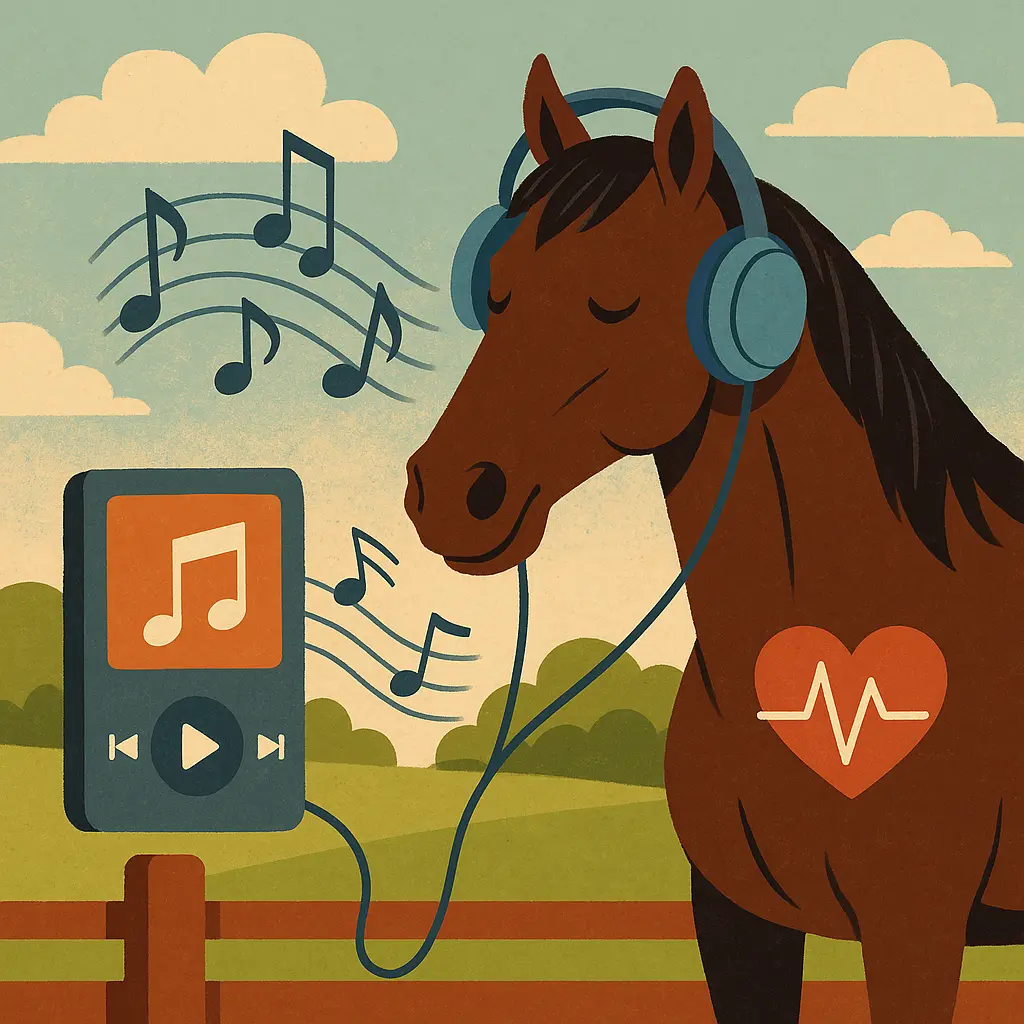
For loading and transport, horse‑safe headphones or headcollars with embedded speakers can provide consistent sound closer to the ear, masking rattles and road noise. Expect to invest around £50–£150 for equine headphones. Always fit in a calm area first, at low volume, and build up gradually.
Safety first: when you’re schooling near music or introducing new kit, wear a well‑fitting riding helmet certified for current standards. Keep lines, cables and devices out of reach and never compromise handler awareness with personal earbuds.
Pro tip: Use the same “calm track” as a pre‑ride cue. Play it while grooming and tacking up so your horse associates it with relaxed handling before you step into the arena.
How do you build an effective enrichment plan with music?
Music counts as environmental enrichment, but it works best alongside movement, forage variety and stable toys. Vary the stimuli to meet mental needs and prevent boredom or over‑reliance on one input.
The British Horse Society defines enrichment as adding choice, variety and stimulation to fulfil physical and mental needs (BHS guidance). For UK horses facing wet, muddy fields and curtailed turnout in autumn/winter, a considered plan makes a noticeable difference:
- Daily music windows: 60 minutes minimum, up to five hours on heavy stabling days. Choose classical/country playlists at moderate tempo.
- Forage variety: Offer ad‑lib hay/haylage where appropriate, use small‑mesh nets or dual nets to slow intake, and scatter fibre‑based treats for foraging behaviour.
- Stable toys and puzzles: Rotating toys prevents boredom. Our customers often pair music with boredom busters from our gifts and stable toys range and low‑sugar horse treats for mental engagement.
- Comfortable housing: A warm, breathable stable rug keeps muscles relaxed so horses can truly rest while the music plays.
- Turnout when weather allows: On cold, dry days, get them out and comfortable in appropriate winter turnout rugs to balance stabling hours.
- Routine grooming: Calm grooming sessions pair well with music and reinforce relaxation. Stock up on yard‑ready kits from our grooming collection.
“Enrichment refers to adding more choice, variety and stimulation to a horse’s environment. This helps to fulfil their physical and mental needs.” — British Horse Society
Quick tip: Rotate stimuli weekly — new toy Monday, different hay placement Wednesday, alternate playlist Friday — while keeping core routines steady.
How do you measure whether the music is working?
Track heart rate at rest, during saddling and in early warm‑up, and keep a simple behaviour log; you should see calmer trendlines after one week and clearer heart‑rate improvements by one month. Use the same times each day for consistent comparisons.
Practical yard metrics:
- Heart rate: Note resting HR before music, after 15 minutes of music, during tacking up and five minutes into warm‑up. Many owners use equine heart‑rate monitors (£200–£400), but a consistent manual count works too.
- Behaviour log: Record startle responses, head tosses, pawing, weaving, cribbing, recumbent resting time and foraging. Stereotypies often decrease over three weeks with targeted acoustic sessions, while resting and foraging increase.
- Routine markers: Time to halter, time to load, and recovery time post‑exercise are easy, telling KPIs.
At Just Horse Riders, we recommend weekly reviews. If you see little change by day seven, confirm genre and tempo (classical/country, moderate), extend session length, and double‑check volume is low and consistent.

How do you set up a safe, yard‑proof sound system?
Use horse‑safe speakers or a stable radio placed out of reach, start at low volume, and secure all cables. Budget £20–£100 for a reliable yard unit; choose splash‑resistant gear for UK winters.
Set‑up checklist:
- Placement: Mount speakers high on a beam or outside the door grille, never within chewing distance.
- Volume: Low and even; you should speak comfortably over it at normal volume.
- Cables and power: Route away from the box, enclose in trunking, and use RCD‑protected sockets.
- Playlists: Pre‑download classical/country lists to avoid adverts or sudden volume spikes.
- Headphones: For travel or handling, introduce gradually in a quiet space first at very low volume.
- Comfort: Keep your horse snug in quality rugs so muscles can relax during sessions; browse proven brands like WeatherBeeta rugs and accessories for durable, weather‑ready comfort.
Pro tip: If your yard is echoey, aim speakers towards absorbent surfaces (hay, bedding) to soften the sound. Hard walls can make audio feel “sharper” to sensitive ears.
FAQs
Does music actually relax horses or just mask noise?
It does both. Studies show real physiological and behavioural changes — lower heart rate, reduced stress behaviours and higher serotonin — beyond simple masking, especially with classical and moderate‑tempo tracks (veterinary study).
What genres work best for stabled horses?
Classical and country. Hartpury College researchers reported calmer behaviour with these genres, and more agitation with jazz and rock (Hartpury summary).
How long before I’ll see results?
Serotonin rises after one week of daily sessions, and heart rate reductions are typically seen after one month, with the strongest effects in months two and three of consistent use.
Will my horse get bored of the same track?
Not immediately. Repeating the same track for around seven daily exposures can reduce startle reactions, but rotate playlists thereafter to maintain effectiveness.
Is music useful during UK winter stabling?
Yes. With wet weather and short days curtailing turnout, music offers BHS‑aligned enrichment that reduces stress from restricted movement and social isolation (BHS guidance).
Can music improve performance?
Yes in training settings. Racehorses exposed to daily music showed calmer physiology and better race outcomes over six months, particularly after the first 2–3 months of use.
What volume should I use?
Low and even — just enough to soften yard noise while you can still talk normally. Avoid sudden changes, heavy bass and shrill highs; keep tone and tempo consistent.
Ready to try it? Start with 60 minutes of calm classical or country this week, pair it with good forage, movement and a cosy stable rug, and track a few simple metrics. If you need winter‑ready kit to support calmer routines — from turnout rugs to grooming essentials and engaging stable toys — we’re here to help.