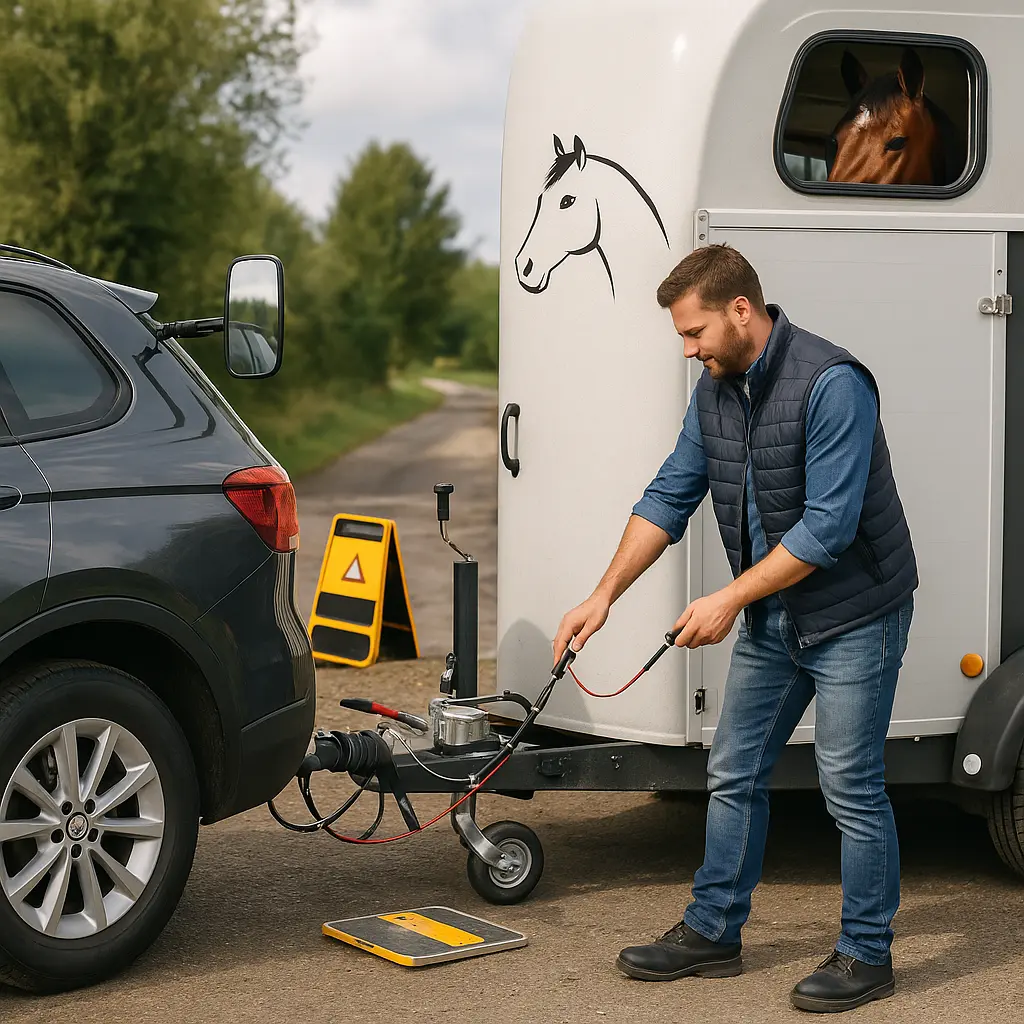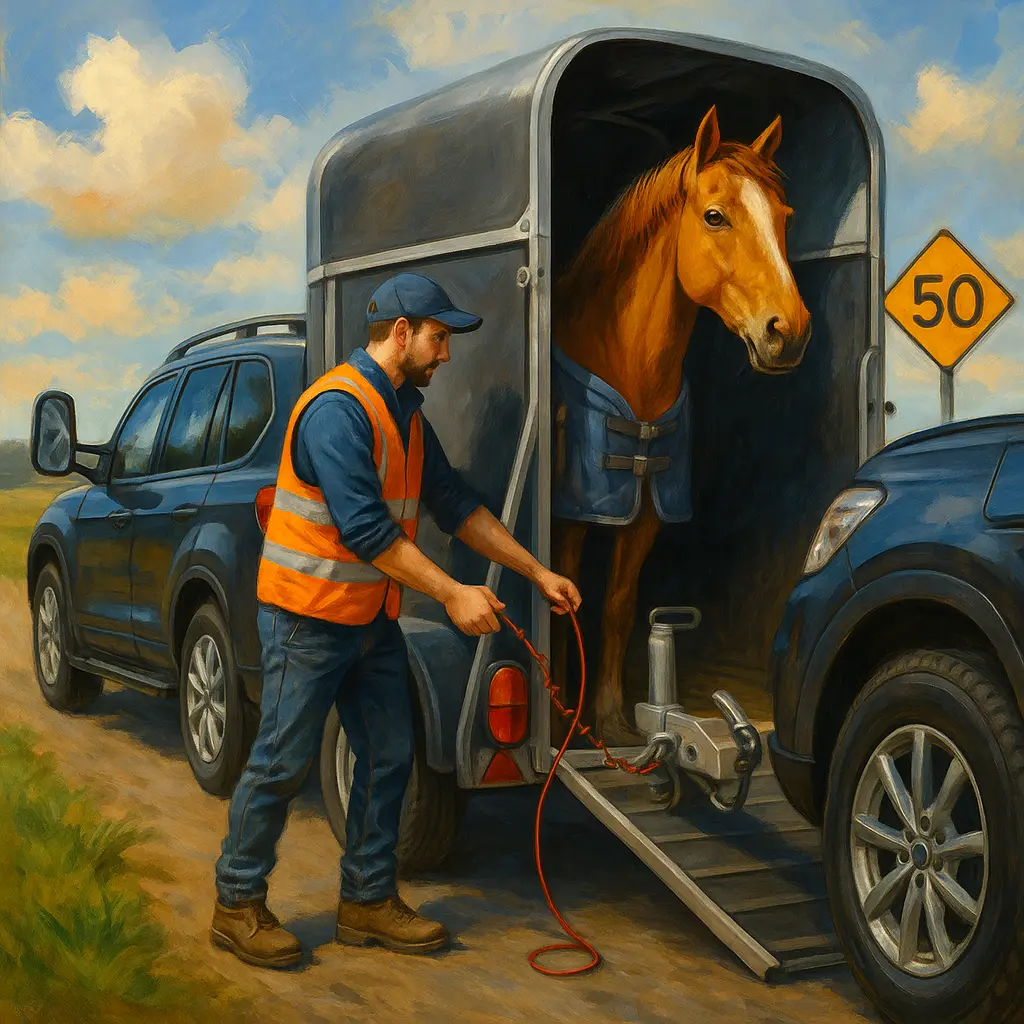
Heading out to a show or the beach with your pony should feel exciting, not stressful. Get your towing right and you’ll protect your horse, your licence and your wallet — in all weathers the UK throws at you.
Key takeaway: If you passed your car test on or after 1 January 1997, you can tow trailers up to 3,500kg MAM without an extra test — but you must still match weights correctly, obey UK towing speeds (50/60mph), and keep your trailer roadworthy, insured and well serviced.
What you can legally tow after 2021
If you passed your car test on or after 1 January 1997, you can tow a trailer up to 3,500kg Maximum Authorised Mass (MAM) without taking a B+E test; this change took effect on 16 December 2021. You must still stay within your vehicle’s towing limits and all normal road rules apply.
MAM (sometimes called GVW) is the maximum permitted weight of the vehicle or trailer when fully loaded. For horse owners, this means many single- and some double-horse trailers fall within scope of a Category B car licence — provided the towing vehicle is rated appropriately. Always check both the car’s braked towing limit and the trailer’s plated MAM, and remember the law is only your starting point; safe practice demands a margin.
Finally, never carry passengers in the trailer, and always load your horse thoughtfully (balanced, secured with a quick-release tie, and with a breast/breeching bar correctly set).
Match your car, trailer and pony weights safely (the 80/20 rule)
Use the 80/20 rule: keep your loaded trailer at or below 80% of your car’s braked towing limit, and never exceed any plated MAM, axle or noseweight ratings. This safety margin reduces sway and stress on your vehicle.
Here’s how to work it out step by step:
- Find your car’s braked towing limit in the handbook or on the manufacturer’s plate.
- Weigh your horse and everything you’ll carry. A typical 14hh pony is around 350–450kg; add tack, water, hay, partitions, travel boots and the ramp weight.
- Add the trailer’s unladen weight to your total payload to get the actual loaded trailer weight.
- Keep that actual loaded trailer weight ≤ 80% of the car’s braked towing limit. For example, with a 2,000kg tow limit, aim to keep the loaded trailer ≤ 1,600kg.
- Also check Gross Train Weight (GTW) — the total of tow vehicle + trailer + load. Going over 3.5t can draw in additional operator-licence rules if used commercially.
Quick tip: Use a weighbridge or a weight tape to keep your sums honest — you can pick up weigh tapes in our grooming collection. It’s easy to creep over limits once you add water, kit and a companion pony.
At Just Horse Riders, we recommend keeping a written record of your numbers in the glovebox so you’re never guessing at show-time.
UK towing speeds, lanes and mirrors
The legal towing speed limits are 50mph on single carriageways and 60mph on dual carriageways and motorways; you must not use the outside lane of a three-plus-lane motorway when towing. Fit towing mirrors if your trailer is wider than the tow vehicle — it’s a legal requirement and a big safety win.
Allow extra braking distance and pull away smoothly to keep your horse settled. Plan rest stops for checks and water, especially on summer days or after hill climbs. In poor UK winter weather, increase your following distance further and be gentle over standing water, wind-blown stretches and farm-gate mud at junctions.
For roadside emergencies in low light or rain, keep you and your helper visible with hi-vis rider gear, and step well away from live traffic while phoning for assistance.
Safety checks, servicing and testing: what’s required
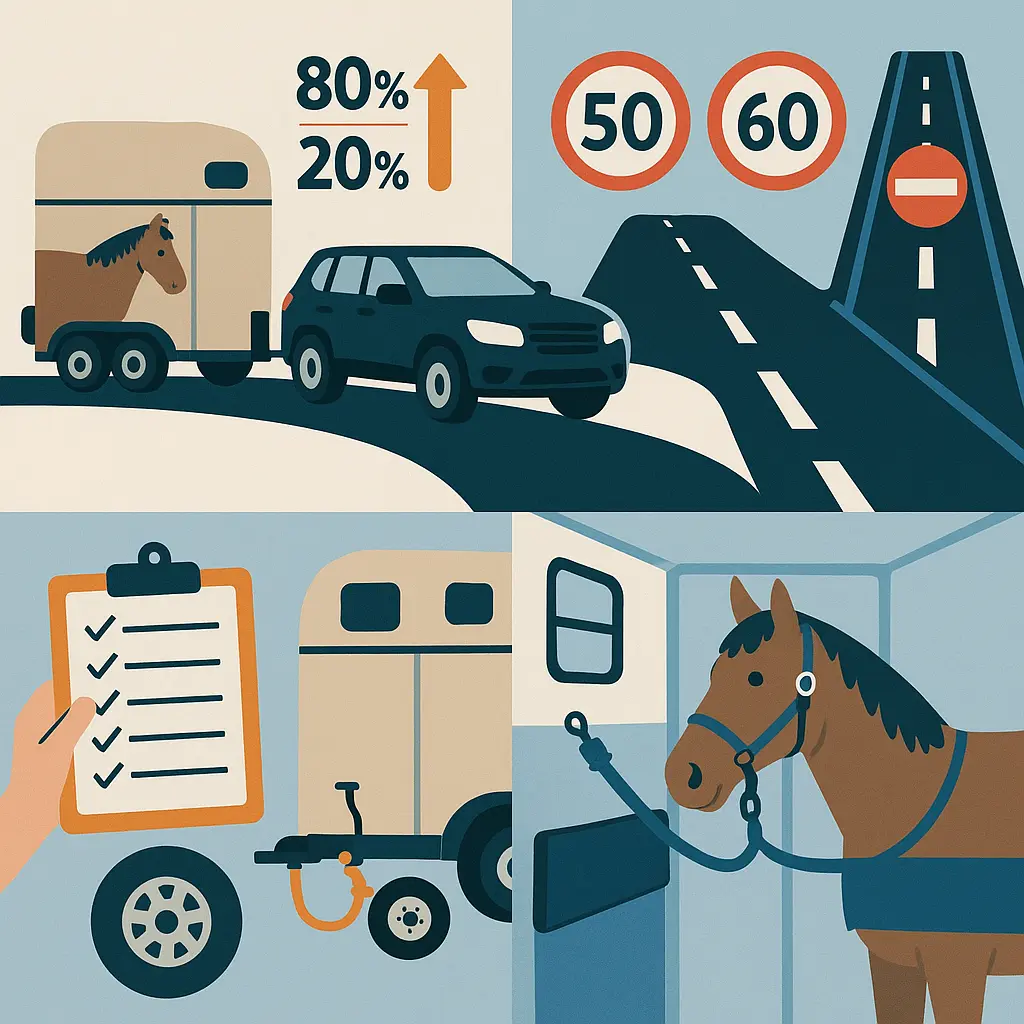
Your trailer must have working lights, effective brakes, a serviceable breakaway cable and road-legal tyres; regular safety checks are mandatory, and professional servicing annually is recommended by the British Horse Society. Larger horseboxes/trailers over 3,500kg MAM are subject to HGV-style annual testing; light trailers must still be kept in a safe, roadworthy condition and can be checked at the roadside.
Build a routine around three layers of checks:
- Before every trip: electrics, brake-away cable clip, break efficiency, hitch latch locked, jockey wheel up, tyre pressures and tread (including the spare), ramp locks and floor integrity, interior partitions, clean windows/vents, number plate match, and mirrors fitted.
- Weekly in-use: handbrake operation, wheel nuts torque, hitch head wear, emergency equipment, and a full walk-round for leaks or chafing cables.
- Annually: book a professional service focused on brakes, bearings, tyres, electrics, flooring and ramp hinges. The BHS guidance is clear: a qualified technician once a year significantly reduces failures on the road.
Wet UK winters demand extra caution: check rubber matting and ramp surfaces for grip, and make sure drainage and ventilation prevent damp, ammonia and condensation that can irritate airways. See the BHS advice on transporting at the BHS Transporting Your Horse page.
Pro tip: Fit a temperature/vent monitor in the horse area; it’s a small spend that can flag overheating in summer slow traffic and cold drafts in winter.
Do you still need training now the B+E test has gone?
Training isn’t legally required for trailers up to 3,500kg MAM, but both the DVSA and the BHS strongly recommend professional instruction — and so do we. Good coaching shortens your learning curve on reversing, snaking prevention and emergency drills.
“Professional training is still important for car drivers who want to tow a trailer, so we will continue to encourage those wanting to tow to seek training before towing a trailer.” — Driver and Vehicle Standards Agency (DVSA)
Source: Horse & Hound coverage of DVSA changes
“The BHS strongly recommends that anyone new to towing a trailer, or who has not towed in a while, should take training from a qualified driving instructor.” — British Horse Society
Source: BHS Transporting Your Horse
Book a session that includes loading practice, controlled braking, motorway lane discipline and what to do if the breakaway cable deploys. Practise with the actual rig you’ll use (e.g. an Ifor Williams 506 or Bateson Ascot) and gradually build from empty to realistic loads.
Insurance and breakdown: are you and your horse really covered?
Most standard car insurance and breakdown policies exclude horse trailers and livestock; you need specialist equine breakdown cover for trailer recovery and onward horse transport. Without it, you could be stranded with a loaded trailer on the hard shoulder.
“It is recommended that horsebox or trailer recovery insurance is in place.” — The Showing Council / British Equestrian Federation guidance
Source: BEF/Showing Council Welfare Guidance
Look for a policy that includes: roadside repair, trailer recovery, horse transport to a safe yard or vet, overnight stabling if needed, and rider transport. Keep the emergency number on your phone and printed in the glovebox.
Quick tip: Pack hi-vis, a power bank, head torch and a couple of hay nets; the little things make stressy situations calmer for both of you.
Commercial transport: certificates, operator licences and tachographs
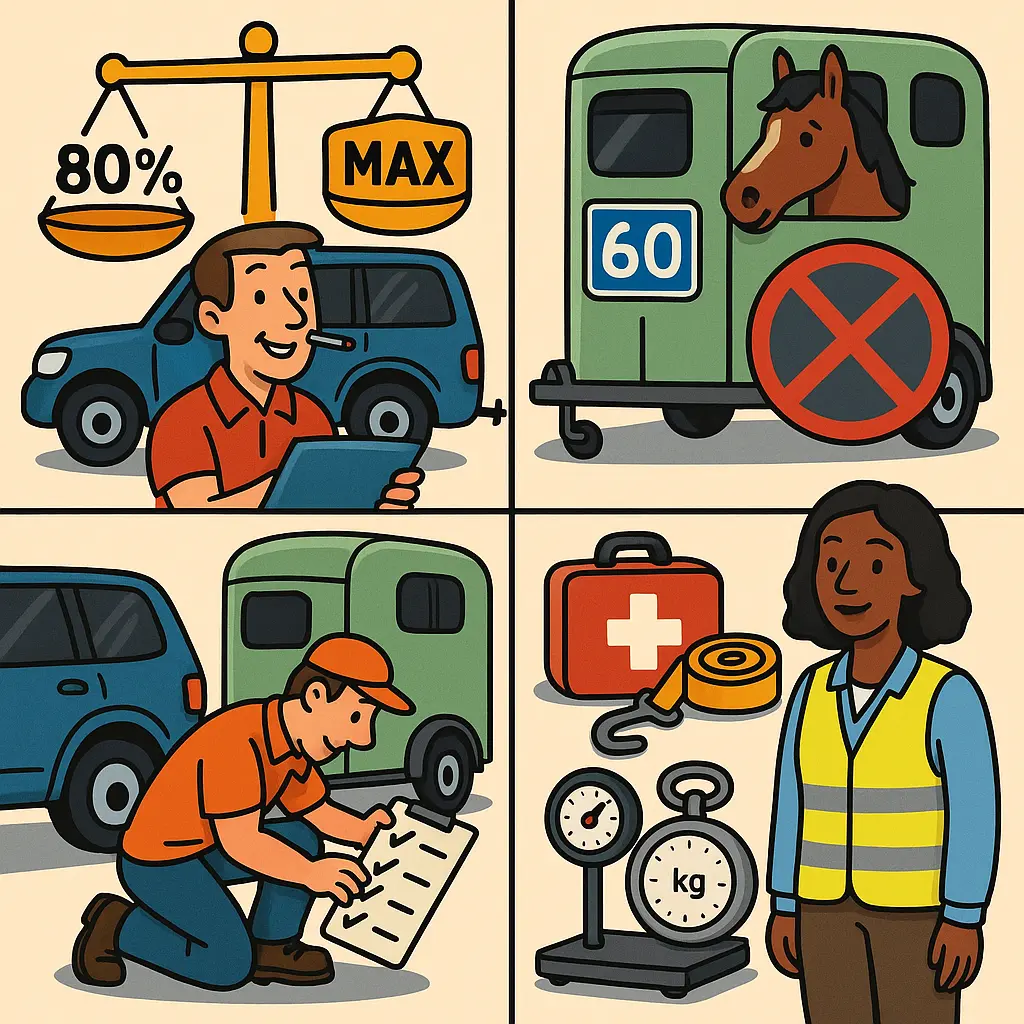
If you transport horses commercially or for reward, journeys over 65km or over 8 hours require a Certificate of Competence in animal transport. Vehicle-and-trailer combinations over 3,500kg MAM used commercially typically need an operator’s licence and, in many cases, a tachograph.
This includes professional transporters, producing yards moving client horses, and activities where you’re paid or the horse isn’t owned by you. Depending on your operation, you may need a restricted or standard operator licence, and you must keep within your vehicle’s plated GTW at all times. If in doubt, speak to DVSA or a transport compliance specialist before you travel — “I didn’t know” won’t wash at a roadside check.
Welfare, loading and the travel kit that makes life easier
Use quick-release ties, give forage and water on longer journeys, and watch for stress signs such as sweating, pawing or reluctance to load. Good ventilation and non-slip flooring keep your horse comfortable in changeable UK weather.
Make loading positive. Reward calm steps and never rush on a slick, muddy yard. In winter, consider a light travel rug if your horse is fully clipped and the horse area is draughty; in summer, prioritise airflow and avoid over-rugging in stationary traffic.
Recommended kit:
- Travel protection: well-fitting travel boots or bandages and a tail guard. See our horse boots and bandages.
- Seasonal layers: breathable travel sheets or waterproof options for British showers — explore turnout rugs and shop trusted brands like WeatherBeeta.
- Loading confidence: high-value rewards can help — stock up on horse treats for training sessions.
- Aftercare: a quick brush-down and sweat scrape when you arrive keeps skin healthy; check out grooming essentials.
- Support from the inside: discuss calmers or electrolyte support with your vet or coach if appropriate and browse our horse care supplements.
- For you: if you need to unload or handle roadside in low light, wear hi-vis so other drivers see you early.
FAQs
Can I tow a single-pony trailer like a Bateson Ascot or Ifor Williams 506 with a 2,000kg limit and a post-1997 licence?
Yes. The post-2021 rules allow towing up to 3,500kg MAM on a Category B car licence, and a 2,000kg braked towing limit covers many single-pony trailers — provided your loaded trailer stays within that limit and, for safety, follows the 80/20 rule.
Do I need extra training after the 2021 towing law change?
No, not legally for trailers up to 3,500kg MAM — but both the DVSA and the BHS strongly advise professional training because it improves safety, confidence and horse comfort. See the DVSA statement via Horse & Hound and the BHS guidance.
What speed limits apply when I’m towing on UK roads?
It’s 50mph on single carriageways and 60mph on dual carriageways and motorways. You must not use the outside lane of a three-plus-lane motorway while towing.
Does my car insurance or breakdown cover include my horse and trailer?
Usually not. Most standard policies exclude trailers and livestock, so arrange specialist equine breakdown cover that will recover the trailer and transport your horse to safety. The BEF/Showing Council explicitly recommend having horsebox or trailer recovery insurance in place.
Is an MOT or annual test required for my horse trailer?
Large horseboxes/trailers over 3,500kg MAM require annual HGV-style testing. Light horse trailers aren’t subject to a routine MOT but must be kept roadworthy; the BHS recommends a professional service every year.
Can I transport my pony commercially without extra qualifications?
No. For paid or commercial journeys, a Certificate of Competence in animal transport is required for distances over 65km or journeys over 8 hours, and vehicle/trailer combinations over 3,500kg MAM generally bring operator licence and tachograph rules into play.
What essential safety checks should I do before every trip?
Check towball engagement and breakaway cable, tyres and wheel nuts, lights and indicators, mirrors, floor and ramp integrity, ventilation, number plate, and that your horse is secured with a quick-release tie. Carry water, a first aid kit, hi-vis, and your emergency breakdown details.
At Just Horse Riders, we want every journey to be as safe and smooth as possible for you and your horse. Match your weights carefully, respect the UK towing limits, keep your trailer in top condition, and invest in the training and kit that make travel calmer and kinder.