Are UK eventing scoreboards getting tighter? With fuller early-season start lists and better data tools, many riders are feeling the step up. Here’s what the latest UK evidence shows—and how to ride smarter in 2025.
Key takeaway: Early-season British Eventing participation jumped 38% in March 2025 and 62% in April, signalling deeper fields at many fixtures. Use data-led benchmarking, target the calendar cleverly, and double down on preparation to keep your results competitive.
Is UK eventing getting more competitive?
Yes—fields are fuller in early 2025 and federation memberships are rising, but definitive year-on-year scoring trends aren’t publicly available yet, so ride as if fixtures will be deeper and faster to place. British Eventing’s latest participation report shows significant early-season growth (38% more unique athletes in March, 62% in April), and British Equestrian’s member body registrations rose 11.7% from 2023 to 2024—two strong signals of broader engagement.
Competitiveness is more than headcount—it’s about standards across dressage, show jumping, and cross-country. While a substantial UK dataset spanning 75,000+ eventing horses (2008–2018) exists, the published materials we have don’t yet map how average dressage marks, show jumping clears, or cross-country speeds have shifted over time. What we can say with confidence is that early-season demand is high, calendar supply has expanded, and you now have better tools—like Opposition Beaten Percentage (OBP)—to benchmark where you stand in a given field.
Given these signals, the practical stance for riders in 2025 is straightforward: assume busier sections at popular venues, expect fewer cheap time-faults, and prioritise preparation that converts near-misses into rosettes.
What does the latest participation data tell us?
British Eventing reports a 38% rise in unique athletes in March 2025 and a 62% rise in April, driven by more events and better weather—clear signs of early-season appetite. That uptick aligns with a broader participation lift across British Equestrian’s 19 member bodies, where federation memberships increased 11.7% between 2023 and 2024.
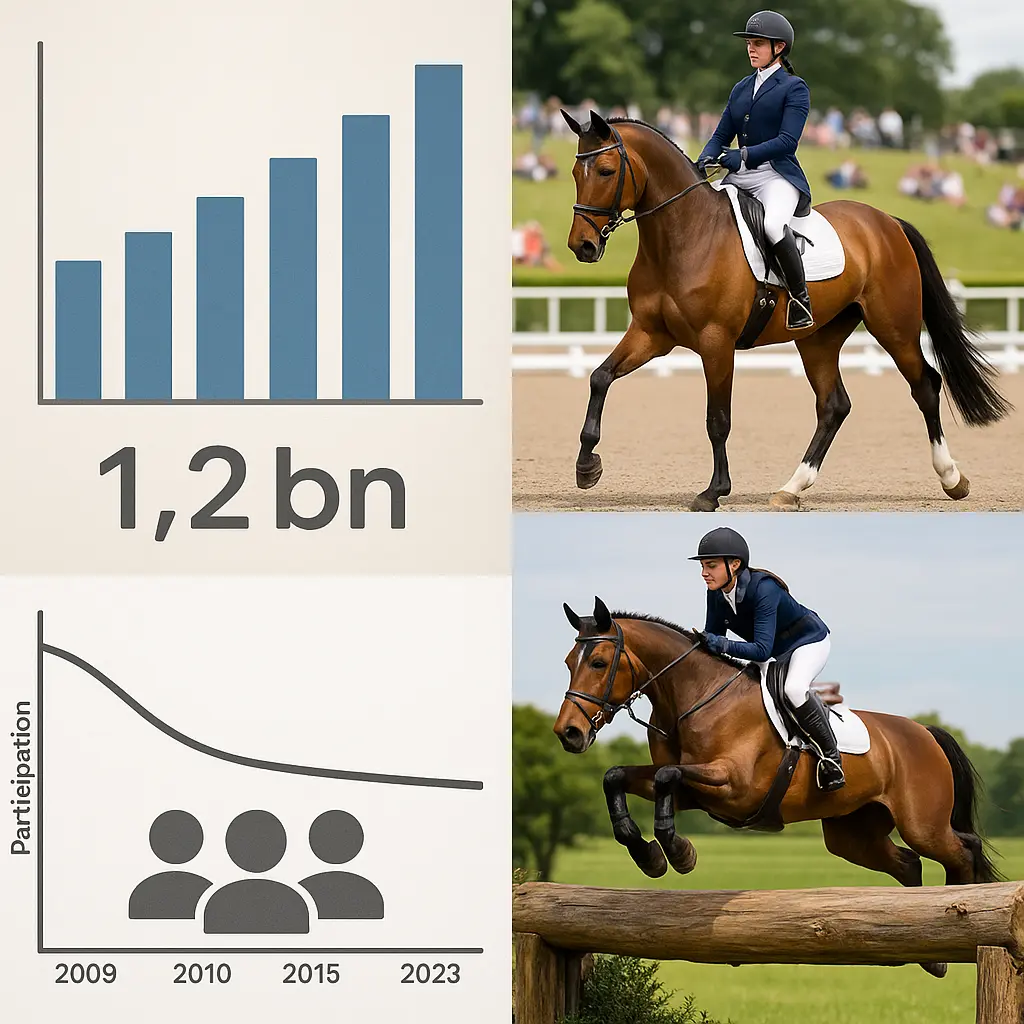
British Eventing attributes the April surge to “more events + better weather,” underscoring how supply (calendar capacity) and climate shape entries week to week. While overall equestrian participation in England declined from 425,900 in 2009 to 352,900 in 2016 and around 286,000 by 2023, sector data indicates renewed energy, especially among affiliated participants and enthusiasts who stay engaged year-round through training and competition.
Sector leaders emphasise using data to make smart, targeted improvements. As Mandana Mehran Pour, British Equestrian’s Head of Participation and Development, notes:
“Data-driven insight gives us the foundation to take meaningful action. The findings provide a clear direction of how we can better support the people, horses and organisations that define our sector.” British Equestrian State of the Nation 2024
Meanwhile, public support for horse sport remains resilient despite recent challenges. Jim Eyre, Chief Executive of British Equestrian, welcomed the findings of the UK’s largest attitudes study:
“We welcome the findings of this research, which is one of the biggest of its kind in the UK and covers our whole sector... The confirmation that we still have public acceptance, despite the difficulties that equestrianism has faced in recent years, is very positive.” World Horse Welfare
For riders, the takeaway is practical: popular spring fixtures will fill; late entries may be harder; and sections can feel “tighter” even before you look at scoreboards. Plan early, pick dates strategically, and benchmark your performance against the field, not just your personal bests.
Where are the pressures and limits on competitive fields?
Capacity at riding centres is tight—70% want to expand but can’t—so supply constraints can cap entries even as demand grows. These limits are felt most in the southeast and southwest of England, with the cost-of-living squeeze (insurance, feed, energy) and workforce shortages making it harder to increase capacity or run more activities.
Seasonal weather amplifies these pressures. Spring’s improved conditions and expanded calendars attract riders keen to get early runs; summer hard ground can require more conditioning and careful footing choices; and a wet autumn can re-shape cross-country form. All of this influences which fixtures sell out fast and how “deep” a section feels by the time you trot down the centre line.
Practical ways to navigate these pressure points include: booking coaching blocks and venue hires well ahead of busy months; choosing events that suit your horse’s way of going and your logistics; and maintaining a flexible plan so you can pivot if a primary target becomes oversubscribed.

How to measure your competitiveness now
Use British Eventing’s Stats Centre and Opposition Beaten Percentage to benchmark your results against the field. OBP shows what share of the competition you’ve finished ahead of—cutting through section size and giving you a clear, comparable indicator of competitiveness across venues and dates.
Pair OBP with three discipline-specific checks after every run:
- Dressage: Compare your score against the section median, not just the winner. If you’re within 3–4 marks of the median, incremental gains in accuracy, relaxation, and transitions will lift your OBP.
- Show jumping: Track clear rounds versus section clear rate. If the field’s clear rate is high, a single rail can drop your OBP dramatically—course-walk detail and canter control become decisive.
- Cross-country: Watch time relative to class norms. When calendars are busy and ground is good, sections often run quicker; practicing efficient lines and rhythm over schooling fences pays off in time saved without over-riding.
The UK’s 2008–2018 dataset of 75,000+ eventing horses highlights how much insight longitudinal analysis can yield. While publicly available materials don’t yet chart discipline standards year by year, you can create your own time series: log OBP per outing, plus dressage deltas to the section median, show jumping rails, and XC time deltas to optimum. After 4–6 events, you’ll see where to focus for maximum OBP lift.
Quick tip: Video every phase and review with your coach. Ten minutes spent tagging where you lose soft seconds (wide turns, over-set-ups) can unlock measurable gains at your very next start.
Practical ways to stay ahead as fields deepen
Focus on marginal gains you can control: preparation, welfare, kit, and cost management. When sections tighten, the riders who arrive calm, well-organised, and properly turned out tend to keep penalties off the sheet.
- Dress for performance and confidence: Well-fitted show wear supports focus and movement. Explore tailored looks in our women’s competition clothing and ensure your hat meets the latest standards from our curated riding helmets range.
- Protect legs for jumping efforts: Reliable boots reduce risk and help horses recover between runs. See our horse boots and bandages for XC, show jumping, and schooling.
- Plan for British weather: Layer smartly to keep muscles warm pre- and post-ride. For changeable spring, have a lightweight turnout rug ready; as flies arrive, switch to breathable fly rugs to minimise irritation and wasted energy.
- Conditioning and recovery: Electrolytes and joint support are staples for busy calendars—browse proven options in our horse supplements and trusted formulas from NAF.
- Everyday performance basics: Good grooming improves circulation and helps you spot niggles early. Stock up from our grooming collection and streamline your pre-ring routine.
- Footwork and stability: Your position under pressure starts with secure footwear. Choose supportive soles and spur-friendly heels from our riding boots.
- Warm-up and walk courses safely: Dawn course-walks and late finishes demand visibility—keep yourself seen with hi-vis rider gear.
- Brands eventers trust: For durability and fit, see seasonal picks from WeatherBeeta and performance basics from LeMieux.
Pro tip: Build a “competition crate” that lives in your lorry—spare gloves, studs, tape, plasters, numbers, safety pins, a spare rein, and a clean numnah. Small snags cost rosettes when fields are tight.
At Just Horse Riders, we recommend scheduling a mid-season kit check. A 20-minute once-over (hat dates, boot stitching, rug fittings) often prevents avoidable penalties on the day.
Seasonal strategy: target the calendar, not just the level
Align your competition plan with the UK calendar—spring spikes as weather improves and events multiply, while summer heat and ground conditions demand different prep. Thoughtful fixture selection can keep your OBP climbing even if you don’t change levels.
Spring (March–April): With British Eventing reporting 38–62% more unique athletes early in 2025, expect busy sections and keen time across country. Book entries early, target courses that suit your horse, and prioritise accuracy in the dressage to stay competitive when the time is gettable for many.
Summer: When ground firms up, fitness and efficient lines decide placings. Plan sets to build “cruise canter” without overloading limbs, and consider stud patterns that enhance traction but don’t over-torque. If your horse thrives on flowy tracks, hand-pick venues known for rhythm and forwardness.
Autumn: Wet going and trickier lines can shuffle leaderboards. Focus on adjustability and clarity at combinations; a cool, balanced round often beats raw speed as errors rise across the field.
Winter: Use quieter months for dressage polish, show jumping sharpness, and gymnastic XC schools. Keep muscle tone with appropriate stable layering and occasional outdoor movement—browse warm, breathable options in our turnout rugs and snug stable rugs to match your yard’s routine.
Quick tip: If you’re balancing family calendars, aim your peak performance windows for when you can give full focus—consistency of preparation often matters more than adding an extra class.

What research still needs to be done?
To confirm competitiveness trends, the UK needs time‑series data on field sizes, scores, and course difficulty from 2015–2025. That means aligning entry numbers with dressage score distributions, show jumping clear-round rates, cross-country speed profiles, and course technicality by level.
Five high-impact steps would answer the “is it more competitive?” question conclusively:
- Time-series metrics: Track average section sizes, balloting rates, and entry demand by region and level.
- Performance standards: Chart dressage median and winning scores, show jumping clear percentages, and XC time trends by month and footing.
- Course evolution: Capture changes in technicality (e.g., combinations, related distances) and their effect on penalties.
- Pipeline health: Monitor first-to-second-year retention and breadth of youth team activities to gauge sustainability.
- Transparency tools: Expand adoption of Opposition Beaten Percentage and field-strength indicators in the BE Stats Centre so riders can compare fixtures like-for-like.
For sector-wide context and methodology, consult British Equestrian’s ongoing State of the Nation work and public attitudes reporting via World Horse Welfare. Both underscore the value of rigorous, transparent data:
- British Equestrian State of the Nation 2024
- UK public attitudes to horse sport (World Horse Welfare)
If you’re a rider or organiser, consider engaging directly with British Eventing to access deeper Stats Centre insights and contribute to the evidence base. The more we measure, the better we all plan.
FAQs
Has eventing participation grown or declined recently in the UK?
British Eventing reported strong early-season participation in 2025—unique athletes were up 38% in March and 62% in April compared to the previous year. That sits alongside an 11.7% rise in federation memberships across British Equestrian’s member bodies from 2023 to 2024. While long-term entry trends by level aren’t fully published, the current picture suggests busier spring fixtures and deeper fields.
What’s the best way to tell if my section was “more competitive”?
Use Opposition Beaten Percentage (OBP) to see what proportion of the field you finished ahead of. Then compare your dressage mark to the section median, your show jumping outcome to the section clear rate, and your cross-country time versus the pattern for that day. Together, these give a truer read on competitiveness than placings alone.
Are UK riding centres able to handle more aspiring eventers?
Many want to, but capacity is tight. About 70% of centres report wanting to expand but facing constraints, with pressure most acute in the southeast and southwest. Rising operational costs and staffing challenges are common bottlenecks, which can indirectly cap competitive field growth.
Why did April 2025 entries jump so much?
British Eventing cites “more events + better weather” as the main drivers. When the calendar expands and the going improves, more riders take the opportunity to get early-season runs, which fills sections and sharpens competition for placings.
What kit upgrades most reliably protect my results on busy days?
Prioritise safety and performance essentials: a current-standard hat from our riding helmets, secure footwear from riding boots, reliable leg protection from horse boots and bandages, and weather-ready layers such as turnout rugs or fly rugs. A tidy, comfortable partnership reduces avoidable penalties.
How can I prepare cost-effectively if fixtures feel more competitive?
Double down on planning and prevention: nail down entries early, school efficiently with clear session goals, and keep your horse feeling great with core supplements and consistent grooming. Keep an eye on value in our Secret Tack Room clearance for seasonal savings.
What one change will most improve my Opposition Beaten Percentage this spring?
Clean jumping rounds move OBP fastest when fields are full. Invest time in canter quality and line-riding in your show jumping, then rehearse efficient, balanced XC turns so you bank time without taking risks. Combine that with early entries at courses that suit your horse, and you’ll feel the lift quickly.
If you’re planning your next run, give yourself every advantage—set your season goals, map the fixtures that suit your horse, and fine-tune the details. And if you need help choosing the right gear, our team at Just Horse Riders is here to help you pick out the essentials that keep penalties off the board.