Share the road, save a life: the Highway Code now puts horses and riders near the top of the safety hierarchy, and a few clear rules and habits make road hacking far safer. Whether you ride quiet lanes or London streets, here’s how to stay seen, stay polite, and stay in control.
Key takeaway: Drivers must pass horses at no more than 10mph and give at least 2 metres of space; riders should wear hi-vis and ride defensively under the Highway Code hierarchy.
The UK road rule: 10mph and 2 metres
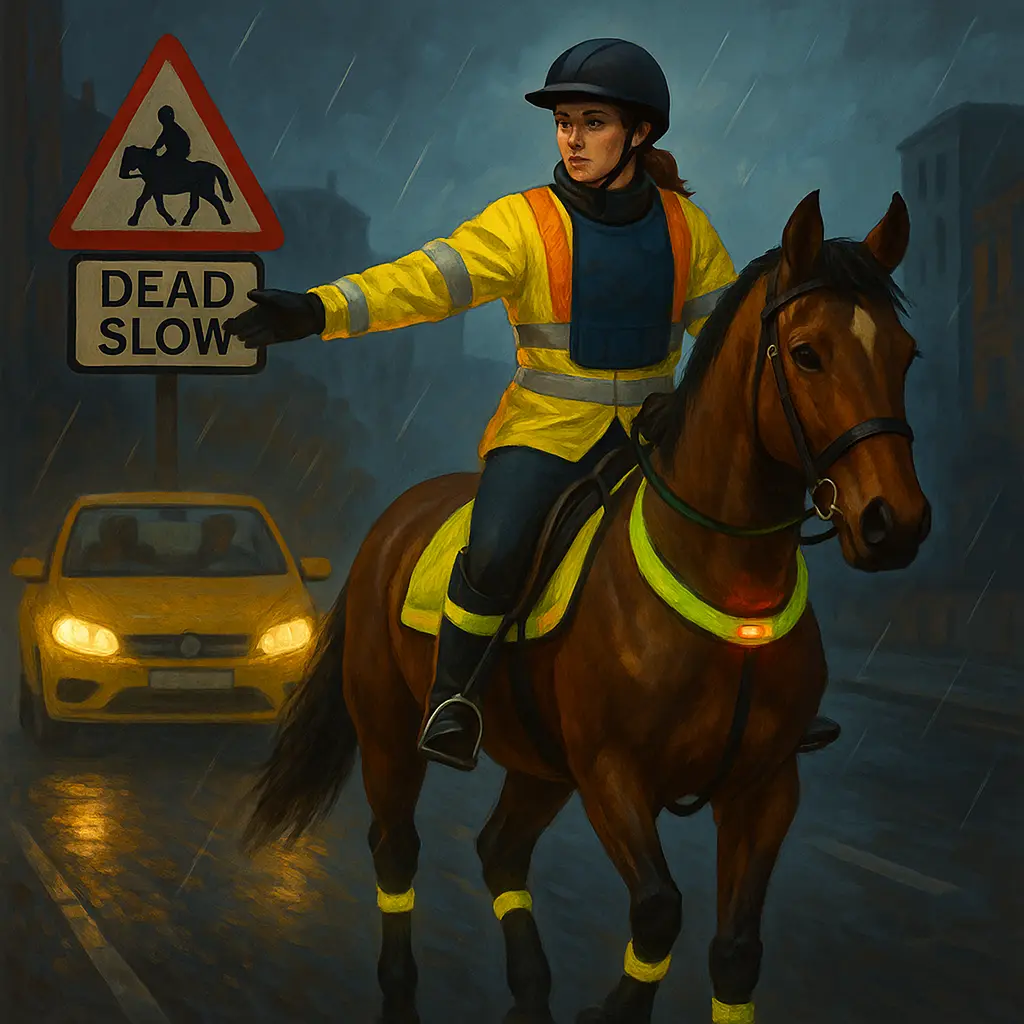
On UK roads, drivers must slow to 10mph and pass horses with a minimum 2 metres of lateral space. Horses and riders are classed as vulnerable road users, second only to pedestrians, so motor vehicles carry greater responsibility around them.
This “Dead Slow” rule is now embedded in the Highway Code, championed by the British Horse Society (BHS). It applies everywhere in the UK—rural lanes, town centres and major cities—covering ridden horses, driven horses, and even feral or semi‑feral animals on Exmoor, Dartmoor and the New Forest. If a driver cannot give 2 metres, they must wait. If your horse becomes anxious, signal drivers to hold back and let the situation settle before inviting them to pass.
“Dead Slow messaging is now incorporated within the Highway Code.” — British Horse Society
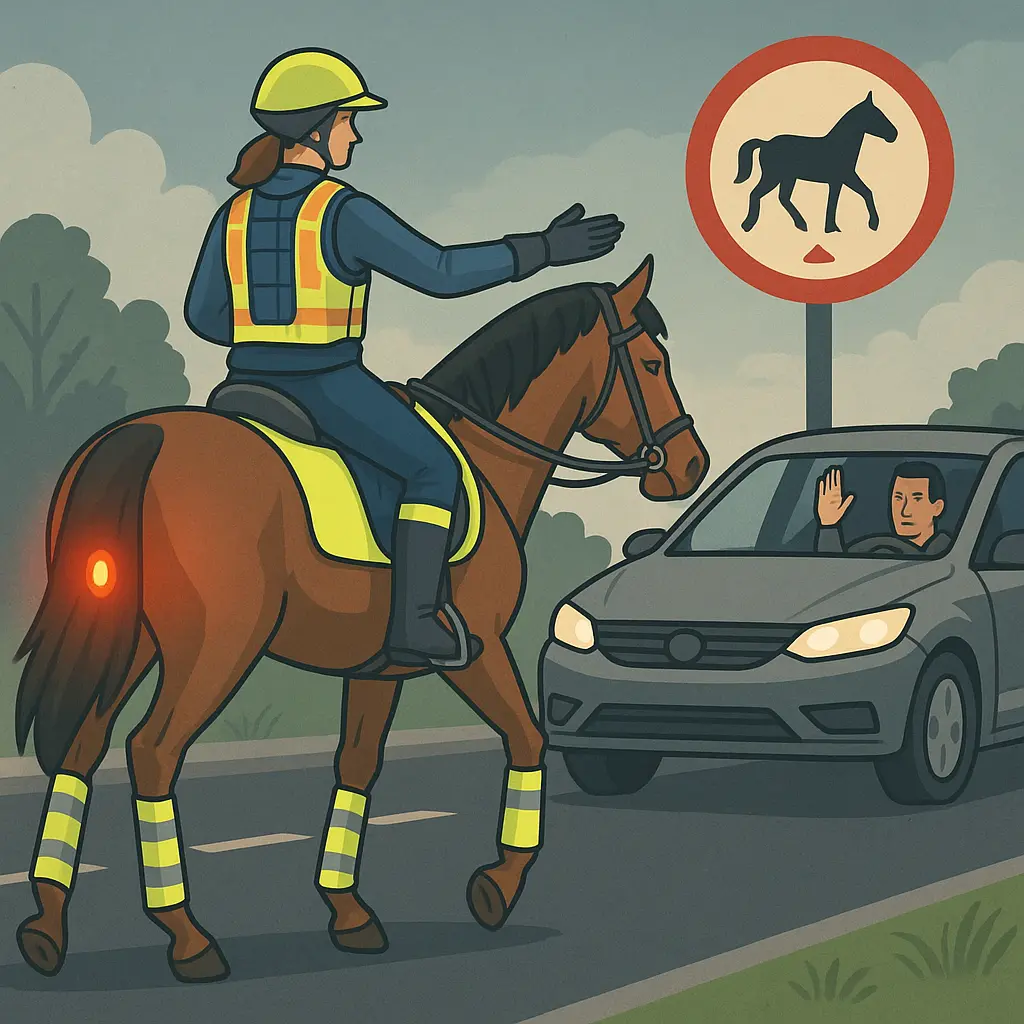
Quick tip: A clear, firm palm-down signal to “slow/stop” is understood by most drivers and buys you those vital few seconds to regain control or create a safe passing point.
What to wear: BHS‑recommended hi‑vis and protective kit
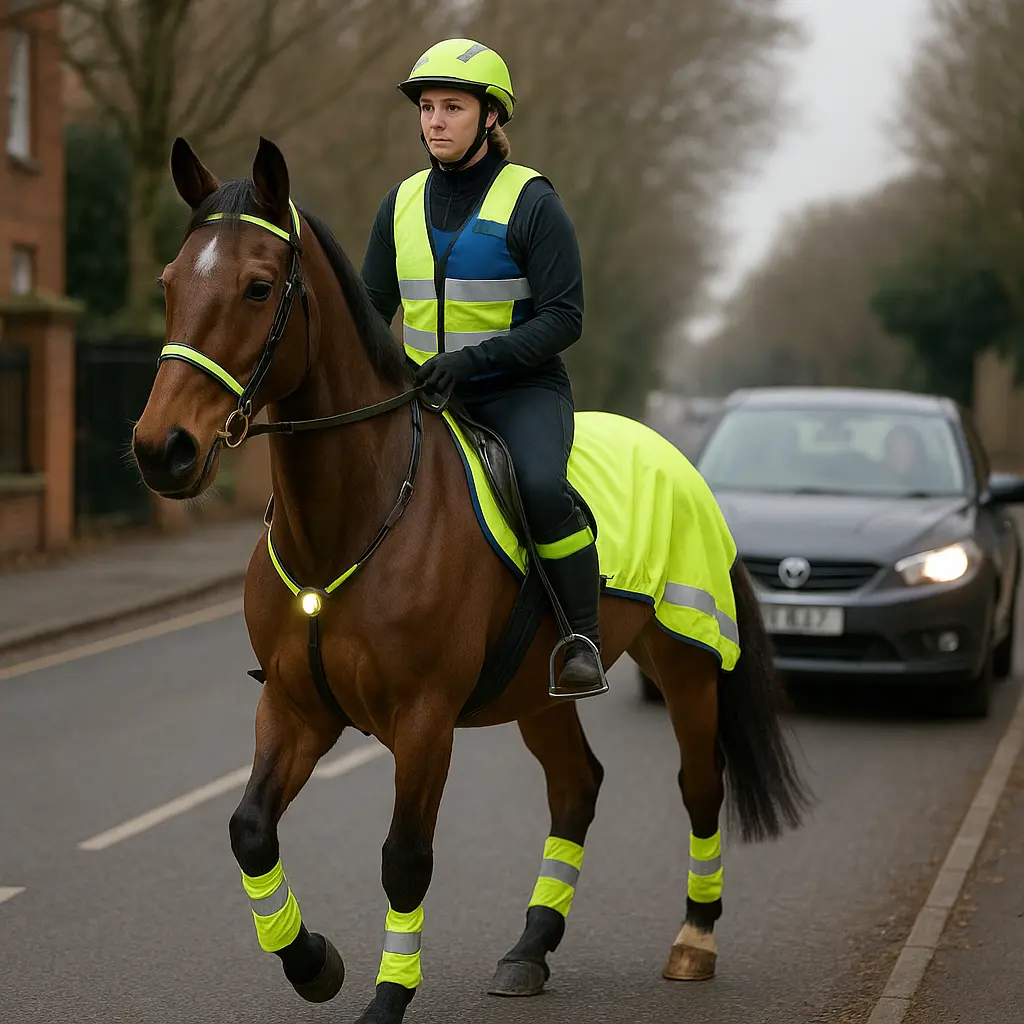
Wear hi‑vis on both rider and horse as a minimum—tabard or jacket for you, leg bands for your horse—adding LED lights in low light. A correctly fitted helmet is essential; a Level 3 BETA 2018 body protector adds proven impact protection.
Visibility is non‑negotiable in the UK’s short winter days, wet roads and low sun glare. The BHS’s guidance is clear:
“Wear hi‑vis and reflective equipment, ideally on both you and on the horse, which could be seen from above as well as from the front, rear and side. We recommend a minimum of a tabard or jacket for the rider, and leg bands for the horse. Consider wearing LED lights.” — BHS Safety Guidelines
For head protection, choose a certified helmet and replace it after any impact. From 1 January 2024, British Eventing requires the Level 3 blue BETA 2018 standard for body protectors, replacing the older purple BETA 2009, to increase safety at speed and over obstacles—many riders sensibly use the same standard for road hacking. See the rule update from British Eventing.
At Just Horse Riders, we recommend pairing a high‑contrast hi‑vis jacket with reflective leg bands and an exercise sheet with reflective panels for full 360‑degree visibility. Explore:
- Rider hi‑vis tabards, jackets and LED accessories
- Certified riding helmets
- Horse boots and bandages (including reflective options)
- WeatherBeeta exercise sheets and reflective gear
Pro tip: Add a small red LED on the tail flap and a white LED on your right shoulder or hat silk to help drivers read your direction quickly at dawn and dusk.
Plan safer routes: width, heights and where horses can go
Choose routes with good verges, clear visibility and appropriate equestrian dimensions: bridleways should be at least 3m wide with 3.7m clearance height, and bridges 3.4–3.7m wide; avoid overhanging vegetation below 3.7m.
The BHS Specifications and Standards for Equestrian Routes set practical thresholds that keep mounted riders safe. A mounted rider’s minimum height above ground is about 2.55m; anything hanging below 3.7m risks catching a rider or spooking a horse. On bridleways, look for a minimum 3m width so two riders can pass safely; bridges should offer 3.4–3.7m, and byways/roads ideally 10 feet (about 3.05m) or more. If your local route falls short—overhanging branches, pinched gateways or blind bends—flag it with your council or the BHS access team.
Legal note: Under S.164 of the Highways Act 1980, barbed wire or electric fencing must not be within 2m of gates on bridleways. If you see non‑compliant fencing, report it to your local authority; narrow, hazardous pinch‑points force riders into the carriageway and create avoidable risk.
Planning basics that save lives:
- Tell someone your route and ETA; carry a charged mobile (for emergencies only).
- Prefer quiet times: early weekend mornings typically beat weekday rush hours.
- Use circular routes that avoid repeated right turns across traffic.
- Consider the BHS Ride Safe Award to sharpen roadcraft and hazard anticipation.
- Where suitable and designated, towpaths and active travel routes can be shared; the BHS Access Strategy urges inclusion unless proven unsuitable. See the BHS 2025 Equestrian Access Strategy.
Quick tip: If hedges hang low after storms, carry a small hi‑vis lead rope; you can dismount and lead safely under obstruction without losing control.
Signals, positioning and passing etiquette
Use standard Highway Code hand signals for slowing, stopping and turning, and ride in a clear, visible road position that discourages unsafe overtakes. Be courteous but firm: your signals guide drivers to pass only when safe.
The Highway Code’s hierarchy places horses and riders as vulnerable road users. That means motorised vehicles bear greater responsibility, but you still set the tone. Make eye contact with drivers, thank patient ones, and be decisive with your indicators—hand out early, steady pace, shoulder checks before moving out. If you hear fast traffic behind on a narrow lane, move to a central position to prevent a squeeze‑past and wave drivers by only when you have a safe line of sight.
“Treat others as you’d want to be treated yourself... Use the appropriate hand signals to make other road users aware of your intentions to manoeuvre.” — BHS Responsible Riding Advice
Group hacks are safest in single file on narrow roads, double file only when it aids visibility and you can return to single file swiftly. Leave an extra horse length between mounts in case of spooks. If you must turn right across traffic, signal early, take a strong road position and wait for a clear, slow gap—don’t be pressured into a risky manoeuvre.
Pro tip: Teach your horse a calm “stand” cue at home; on the road, it buys you time at junctions and when a bus air brake hisses nearby.
Urban and London riding tactics
In heavy traffic or at junctions, dismount if your horse shows stress and lead past hazards; a controlled lead is safer than a mounted spook in tight spaces. Time your rides to avoid peak hours and complex junctions.
City riding adds noise bursts, reflective glass, cyclists filtering and multiple lanes. Choose simpler tack for quick control—many riders prefer a straightforward snaffle and well‑fitted bridle for clear aids. Use pedestrian phases where permitted, cross in straight lines, and avoid box junctions if your horse hesitates. At temporary roadworks, ask a site marshal to hold plant movement while you pass. On bus corridors, wave drivers to wait until you’re fully through a pinch point, then thank them with a clear nod.
If your horse fixes, backs off or plants at lights, step down, loosen one rein, and lead with your body between horse and traffic. Once calm, remount from a safe gateway or mounting block—never from the live carriageway.
Quick tip: Plan urban loops with parks or quiet cut‑throughs where you can decompress for five minutes before re‑entering busier roads.
Winter and low‑light visibility
In the UK’s short winter days, combine fluorescent hi‑vis for daylight and reflective materials plus LEDs for dusk, dawn and darkness. Put hi‑vis on you and your horse for 360‑degree coverage.
Fluorescent colours pop in low sun and overcast conditions; reflective strips and piping bounce headlight beams back to drivers. Fit leg bands on the forelegs (moving parts catch the eye), a reflective breastplate or martingale, and an exercise sheet with large reflective panels. Add white LEDs front and red LEDs rear; check batteries before every ride. Build redundancy—if one item fails, others keep you visible.
Explore rider and horse visibility essentials:
- Hi‑vis clothing and accessories for riders
- Reflective exercise sheets and accessories from WeatherBeeta
Pro tip: Mud kills reflectivity. Wipe reflective panels and bands with a damp cloth before you leave the yard; pack a microfibre in your pocket for on‑route touch‑ups.
Report near‑misses and improve access
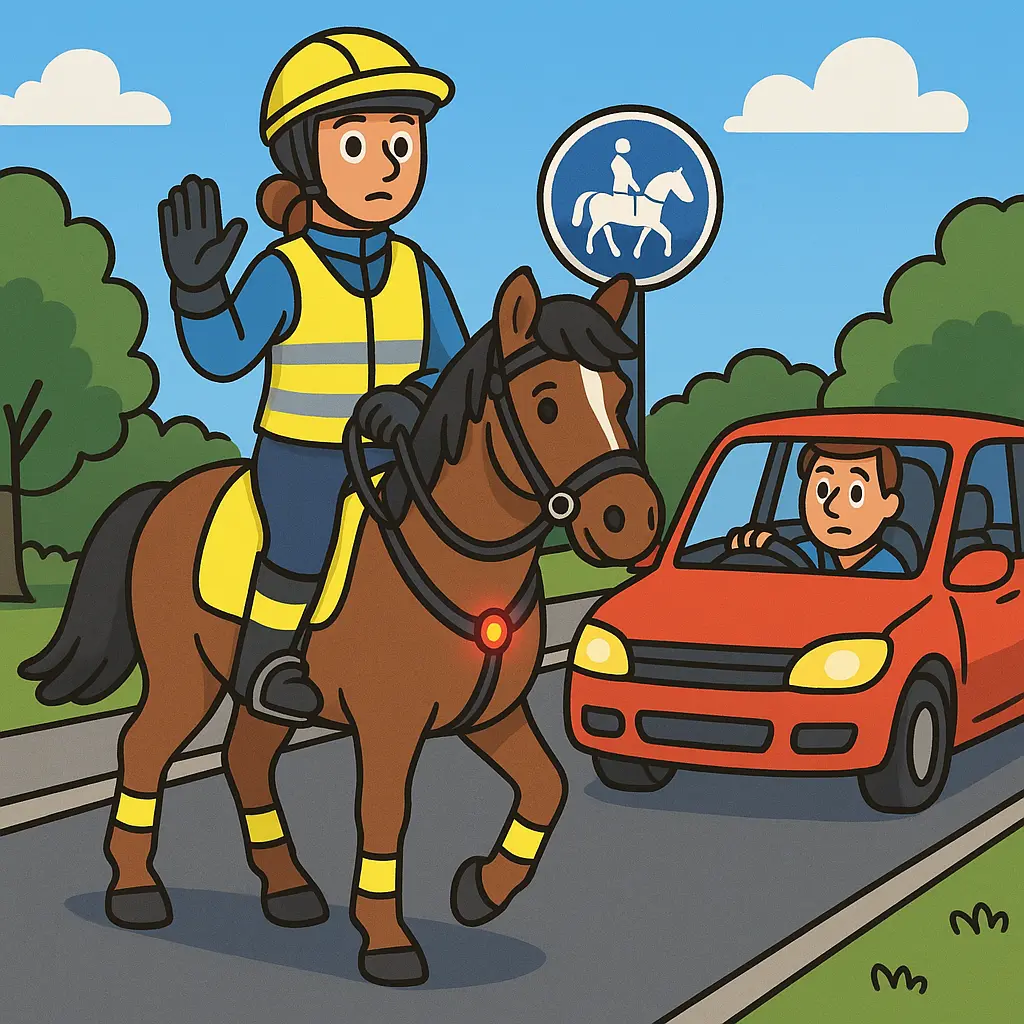
Report dangerous driving or near‑misses to the police and the BHS immediately; your data drives enforcement and safer infrastructure. Log route hazards like low branches or tight gates with your council.
Timely reporting builds the evidence policymakers and police need to protect vulnerable road users. If a driver passes too fast or too close, note the registration, location, time and any dashcam or phone footage (from witnesses). Report to the police via their online portal and to the BHS incident hub; patterns of behaviour and hotspot mapping lead to targeted patrols and signage. For physical route hazards, include photos and measurements—overhanging vegetation below 3.7m, bridleways under 3m wide, or non‑compliant fencing within 2m of gates.
The BHS’s Access Strategy calls for equestrian inclusion in Local Transport Plans and on multi‑user routes like towpaths unless there’s clear evidence of unsuitability. Riders who report issues and suggest pragmatic fixes—cutting back vegetation, adding verge refuges, resurfacing slippery sections—often see results.
Your safety kit checklist
Equip yourself and your horse so you’re seen, protected and comfortable from yard to road and back. Here’s a practical checklist built around BHS guidance and UK conditions:
- Hi‑vis for rider: tabard or jacket with large reflective panels; add LEDs in low light. See rider hi‑vis.
- Hi‑vis for horse: leg bands, reflective breastplate, and an exercise sheet with reflective strips. Browse WeatherBeeta reflective sheets.
- Helmet: certified and correctly fitted; replace after impact. Explore riding helmets.
- Body protection: Level 3 BETA 2018 body protector (the current British Eventing standard) for extra impact protection.
- Footwear: supportive boots with safe heels for stirrups and good grip on wet verges—see riding boots.
- Clothing: weather‑appropriate, non‑slip fabrics; consider grippy knees or full‑seat options for stability—see women’s jodhpurs & breeches and children’s jodhpurs.
- Horse legs: protective boots or bandages for knocks and to anchor hi‑vis—see horse boots & bandages.
- Tack choices: simple, road‑safe bridle and reins with reflective covers; consider a neck strap for extra security.
- Seasonal extras: in winter, keep your horse warm and dry before and after rides with suitable turnout rugs.
- Training aids: treats for positive reinforcement during traffic‑proofing—see horse treats.
- Savvy savings: check our clearance in The Secret Tack Room for hi‑vis and seasonal kit deals.
At Just Horse Riders, we road‑test what we stock and listen to rider feedback. Our customers often pair a bright gilet over a reflective softshell with an LED browband and hi‑vis leg wraps—maximum visibility, minimal faff.
Practical ride‑planning steps
Before every road hack, tell someone your route and ETA, carry a charged mobile for emergencies, and choose quieter times and wider, better‑surfaced lanes. If in doubt, take the BHS Ride Safe Award to sharpen your roadcraft.
Five-minute plan that pays off every time:
- Check kit: helmet secure, hi‑vis clean and bright, LEDs working, girth snug, reins grippy.
- Route check: avoid blind bends and narrow bridges; prefer bridleways with 3m+ width and 3.7m clearance height.
- Weather and light: if visibility is poor, add lights or reschedule.
- Horse readiness: a quick groom removes mud that dulls reflectivity; a few minutes of groundwork sharpens your “stand” and “walk on”.
- Brief a buddy: share your route and expected return; keep your phone accessible but ride hands‑free.
Quick tip: If your horse is fresh, do a five‑minute school in the arena before you leave—transitions, circles, halt—so you start the road section focused and supple.
FAQs
What speed must drivers use when passing horses on UK roads?
Drivers must slow to no more than 10mph and give at least 2 metres of space when passing. This applies on all UK public roads and is embedded in the Highway Code. See the BHS guidance.
Is hi‑vis clothing mandatory for road riding in the UK?
It’s not a legal requirement, but the BHS strongly recommends it as a minimum: a hi‑vis tabard or jacket for the rider and leg bands for the horse, plus LEDs in low light. Find rider options in our hi‑vis collection.
How should riders signal their intentions on the road?
Use standard Highway Code hand signals for slowing, stopping and turning. Signal early, ride a clear road position and make eye contact with drivers before manoeuvring.
What body protector standard is required for British Eventing—and should I use it on the road?
From 1 January 2024, British Eventing requires Level 3 BETA 2018 (blue label). While not compulsory on the road, many riders choose it for added protection. Read the BE update.
Can I ride on towpaths with my horse?
Yes, where towpaths are designated as bridleways and judged suitable. The BHS advocates inclusion of equestrians on multi‑user routes unless there’s evidence of unsuitability. Check the BHS Access Strategy and local signage.
What are the minimum widths and heights for safe equestrian routes?
The BHS specifies minimums of 3m width for bridleways, 3.4–3.7m for bridges, and 3.7m overhead clearance to accommodate mounted riders (who sit at roughly 2.55m). Report substandard sections to your council or the BHS.
What should I do after a near‑miss or dangerous pass?
Record the vehicle’s registration, time and location, and report immediately to the police and the BHS. Your reports support enforcement and improvements to signage and infrastructure.
Ride bright, ride courteous, and ride prepared—drivers who see you clearly and understand your signals will work with you. If you need help choosing the right kit, our team is just a call or message away.