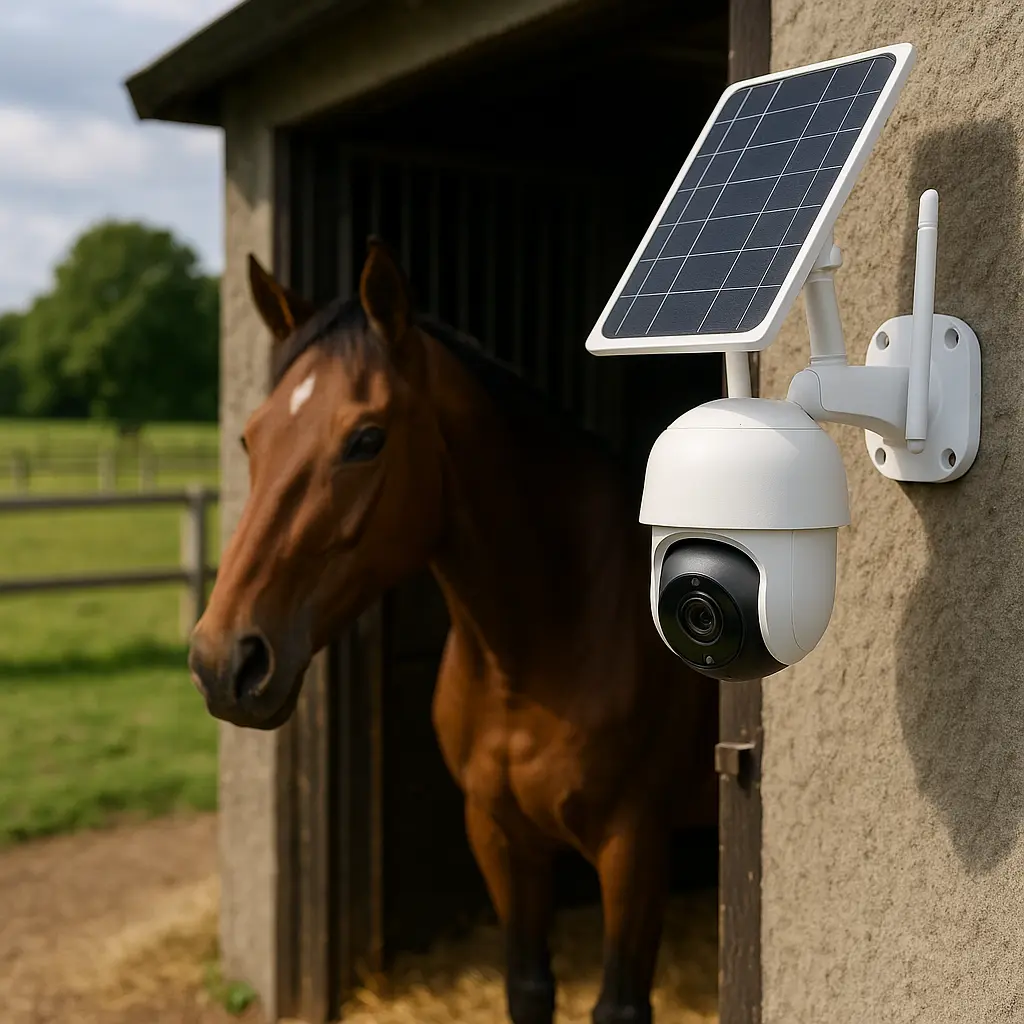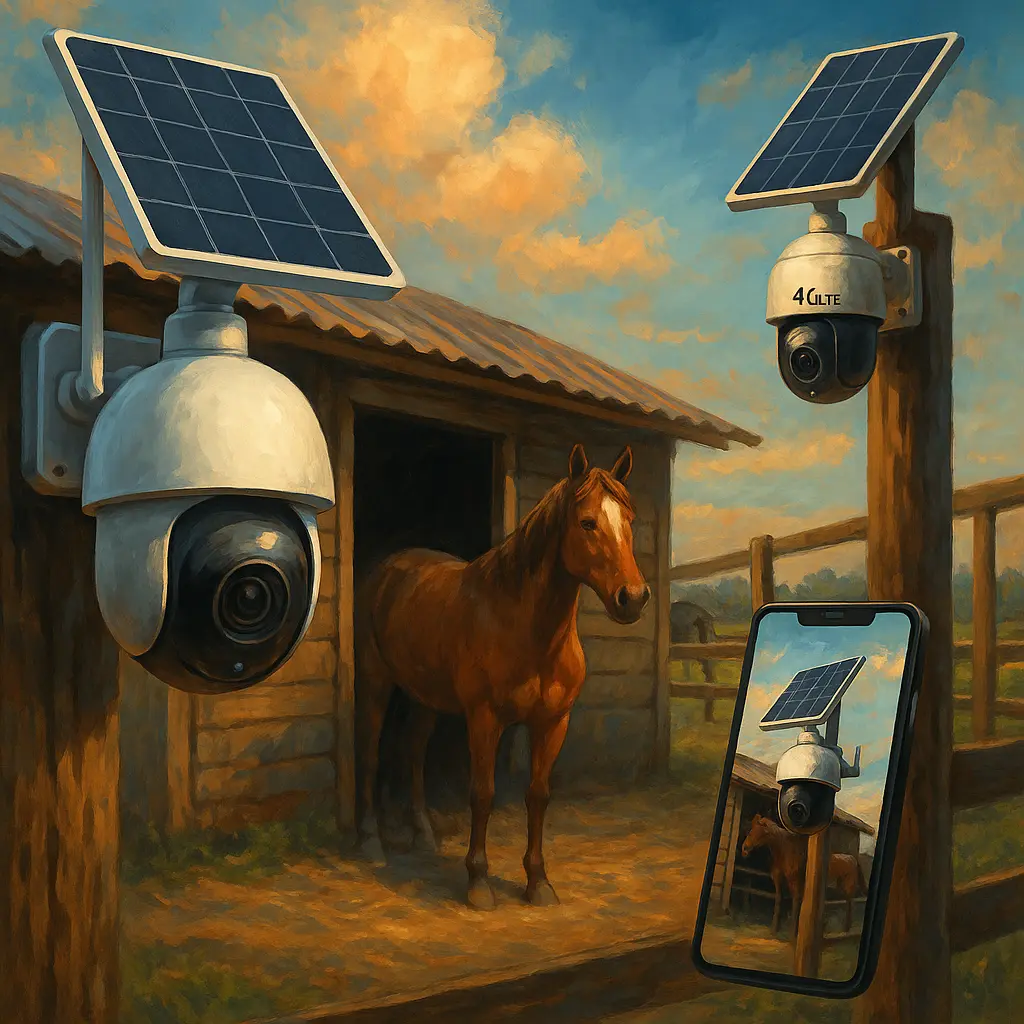
Reliable stable cameras are no longer a luxury on UK yards — they’re essential for welfare checks, security, and peace of mind when Wi‑Fi isn’t available. Solar-powered 4G models now give you HD video, two-way audio, and night vision from anywhere in the country.
Key takeaway: For UK yards without Wi‑Fi, choose a solar-powered 4G camera — Reolink Go PT Plus for top performance, or Xega 4G for best value with solar and SIM included.
Which solar 4G stable camera is best right now?
For performance, pick the Reolink Go PT Plus from £159.99; for best value, pick the Xega 4G LTE at £199.99 with solar panel and prepaid SIM included.
The Reolink Go PT Plus is Horse & Hound’s 10/10 rated, battery/solar 4G camera that runs via SIM (no Wi‑Fi needed), offers two-way audio, app control and excellent image quality. It’s priced from £159.99 for the camera only, and you’ll need to add a solar panel, SIM card, and memory card (supports up to 128GB) to complete the setup. That means the true cost is higher unless you catch a bundle deal. Source: Horse & Hound Buyers’ Guide.
“Best battery/solar-powered camera: Reolink Go PT Plus – operates via SIM card (no Wi‑Fi needed), two-way audio, app controllable; rated 10/10.” — Horse & Hound Buyers’ Guide team
The Xega 4G LTE Outdoor Camera lands as the beginner-friendly buy at £199.99 because it includes the solar panel and a prepaid 300MB SIM out of the box, and it supports 24/7 recording (not just motion-triggered). Horse & Hound highlights it as weatherproof and ideal for outdoor stable monitoring. Xega also offers a 3G/4G LTE model at £139.99 with 4x zoom, colour night vision and solar-boosted battery if you want to trim initial spend while keeping key features. Sources: Horse & Hound.
Looking at the whole picture: Xega is the stronger “all-in” starter package (solar + SIM included), while Reolink is the performance pick with PTZ, refined app control, and high-res imaging — ideal if you don’t mind adding a solar panel, SIM and SD card separately.
Do these work without Wi‑Fi on UK yards?
Yes — both Reolink and Xega run on 4G SIM cards (e.g., Vodafone, O2), so they’re built for UK livery yards and farms with no Wi‑Fi.
Reolink’s cellular range is designed specifically for remote farms and off-grid locations and can be paired with a solar panel for continuous charging in the field. Source: Reolink UK Store. Xega’s 4G cameras are compatible with UK networks including Vodafone and O2, and many units arrive with a pre-installed SIM loaded with 300MB test data so you can check coverage before committing to a plan. Source: Gattontheatre product page.
Quick tip: Pop the included test SIM (Xega) or a PAYG SIM (Reolink) into the camera and try it at your stable before drilling mounts. If signal is patchy in the stable, move the camera towards a door or external wall, or try a different network (Vodafone and O2 are commonly reliable on rural UK yards).
What features actually matter for stable monitoring?
Prioritise 4G connectivity, a solar panel, PTZ controls, strong night vision, two-way audio, and 24/7 recording if you need continuous watch (e.g., foaling).
Here’s what to look for and why:
- 4G connectivity: Essential for yards without Wi‑Fi. Both Reolink Go PT Plus and Xega 4G connect via SIM for app access anywhere.
- Solar power: Keeps batteries topped up through the year. Reolink requires a separate panel purchase; Xega includes one.
- PTZ (pan-tilt-zoom): Lets you scan a stall, barn aisle, or yard with a swipe. Reolink’s PT Plus is excellent here; Xega models also offer PT/rotation options depending on unit.
- Night vision: Infrared is a must for UK winters; colour night vision with spotlights is superb for yards and gateways. Xega’s spotlight night vision covers larger areas. Source: YouTube review.
- Two-way audio: Useful for checking horses and deterring intruders with a voice challenge.
- 24/7 recording vs motion-only: For foaling or illness watch, avoid motion-only. Xega offers 24/7 recording; Reolink is battery-limited and best on motion-triggered clips to preserve power. Source: Horse & Hound.
- Storage: Reolink supports up to 128GB microSD for local storage (no ongoing cloud fees). Xega offers a cloud recording trial for easy off-site backup. Sources: Horse & Hound, YouTube review.
At Just Horse Riders, we recommend adding a camera if you regularly make late-night yard checks for winter rug changes or box rest. Remote viewing helps you decide when to swap to winter turnout rugs for turned-out horses without repeated journeys.
How do you install a solar 4G camera for British weather?
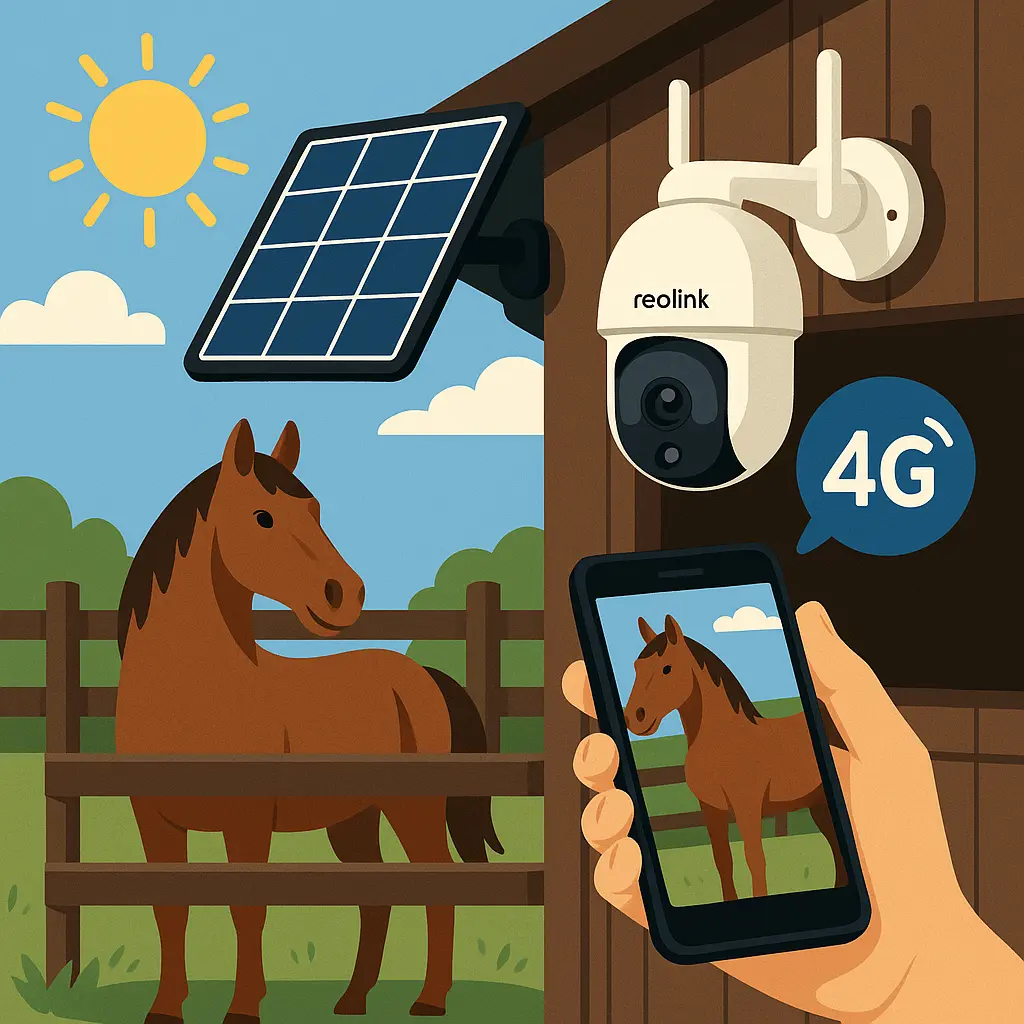
Mount the camera high for a wide view and angle a south-facing solar panel to maximise the UK’s low winter sun.
Placement matters more than you think. Install the camera high in a back corner to capture the full stable diagonally, or on a barn fascia for yard/aisle coverage. If your model has PTZ, give it enough clearance to rotate without obstruction. For fields or gateways, consider a pole mount with line of sight to your target area.
Solar is your lifeline through UK winters. December–January averages about eight hours of daylight, often with cloud and rain. A south-facing panel, tilted towards the winter sun and kept clean, preserves charge even on short days. Reolink’s solar panel is a must-have add-on for year-round power; Xega includes one in the box, so you’re good to go.
Weatherproofing is non-negotiable on British yards. Both Reolink’s cellular range and Xega’s 4G cameras are outdoor-capable with rugged construction, so they shrug off damp, wind and temperature swings. Use sturdy wall or pole fixings and route any short cable runs safely.
Quick tip: Wear supportive yard footwear when ladder-mounting and keep yourself visible if working near a lane or car park — our range of riding boots and hi‑vis rider gear keeps jobs safer and more comfortable.
How much data and power do you need?
Plan 1–5GB of 4G data per month per camera for HD streaming, and use a solar panel year-round to maintain charge.
Data usage varies with habits. Motion-triggered clips use very little; live HD streaming ramps it up. Start small: Xega’s 300MB test SIM lets you confirm coverage and typical usage, then step up to a monthly plan that matches your needs. Many UK owners find 1–5GB/month per camera covers ad‑hoc live checks and alerts without breaking the bank. Source: Horse & Hound.
Storage affects data spend. Reolink supports up to 128GB microSD for local recording, so you don’t pay ongoing cloud fees and you can still review events even if the network drops. Xega offers a cloud recording trial for off-site backup if you prefer set‑and‑forget simplicity. Sources: Horse & Hound, YouTube review.
Cold weather and batteries aren’t best friends, but both Reolink and Xega are built for outdoor farms. A correctly positioned solar panel keeps them topped up; just monitor charge levels during long, sub‑zero spells and reduce unnecessary live streaming if power runs low. Source: Reolink UK Store.
Pro tip: Dial back motion sensitivity or set “activity zones” to avoid wind-blown bedding or tarps triggering clips — it saves both power and data.
Are stable cameras legal on UK yards?
Yes — but if your cameras capture people, you must comply with UK GDPR, display notices, and control access to recordings.
In practice, that means positioning cameras to monitor your own stalls, tack rooms, gateways and yard perimeters without intruding on neighbours or public spaces. Post a sign to inform staff and visitors they’re on CCTV, restrict app access to authorised users only, and set a sensible retention period for stored footage. Using PIR human detection reduces unnecessary captures and alerts, which is both courteous and data‑efficient. Source: Horse & Hound.
Quick tip: Avoid placing cameras in areas where privacy is expected (e.g., changing rooms). When in doubt, angle the camera tighter onto stalls, doors, and gateways.
Practical set-up checklist and money-saving buys
Choose a 4G solar kit, test your SIM, mount high and south-facing, and start with value bundles to cut total cost.
Use this simple checklist to get it right first time:
- Select your camera: performance (Reolink Go PT Plus) vs value (Xega 4G LTE with solar + SIM).
- Confirm 4G signal: try the Xega test SIM (300MB) or a PAYG SIM from Vodafone/O2 before drilling.
- Add essentials: Reolink owners, include a solar panel and up to 128GB microSD; Xega owners, you’re largely covered out of the box.
- Mounting position: high corner for diagonal stable view; clear PTZ sweep; secure pole/wall fixings.
- Solar placement: south-facing, tilted to winter sun; keep panels clean for maximum output.
- App setup: define activity zones, motion sensitivity, and notifications; enable two-way audio.
- Storage choice: local SD to avoid fees, or trial cloud backup (Xega) for easy remote access.
- Test at night: check infrared/spotlight performance, adjust angles for best view of bed, water and door.
Money-savers that make sense for winter:
- Use remote checks to time rug changes precisely and reduce yard trips — keep a few weights of stable rugs ready for stabled horses and invest in durable turnout rugs for wet, windy days.
- Spot grooming or soreness needs on camera and prep your grooming kit for quick fixes after work.
- Support recovery on box rest with targeted supplements you can monitor the response to via your camera.
- Prefer trusted brands? Many owners pair smart monitoring with reliable rugs from WeatherBeeta to keep horses comfortable whatever the forecast.
As ever, choose the camera that matches how you’ll use it. If you need true 24/7 recording for foaling, Xega’s continuous mode is a strong fit. If you want the slickest PTZ experience and will mainly review motion events, Reolink’s Go PT Plus remains a top performer.
FAQs
Is Reolink or Xega better value for a solar 4G stable camera?
Xega delivers the best starter value because it includes the solar panel and a prepaid 300MB SIM at £199.99, and it supports 24/7 recording. Reolink Go PT Plus starts from £159.99 for the camera only; add a solar panel, SIM and SD card for a complete setup, but you get excellent PTZ and image quality. Source: Horse & Hound.
Will these cameras work reliably without Wi‑Fi on my livery yard?
Yes. Both brands use 4G SIM connectivity on UK networks like Vodafone and O2 and are designed for remote farms and yards without internet. Sources: Reolink UK Store, Xega compatibility.
How good is the night vision for winter checks?
Both offer strong infrared night vision; Xega’s spotlight option gives colour night vision and wide area coverage for yards and gateways. Sources: Horse & Hound, YouTube review.
Where should I place a camera in the stable?
Mount high in a back corner to cover the whole stall diagonally, and keep a clear arc if your camera has PTZ. For outdoor monitoring, a fascia or pole mount with a south-facing solar panel works well.
How much mobile data will I need?
Budget 1–5GB per month per camera if you occasionally live view in HD; motion-triggered clips use far less data. Start with Xega’s 300MB test SIM (where included) to gauge your usage. Source: Horse & Hound.
Will the batteries cope in cold UK weather?
Yes — both ranges are built for outdoor farms. A well-sited solar panel keeps charge levels healthy; just monitor levels during prolonged sub‑zero spells and limit unnecessary streaming. Sources: Reolink UK Store, Horse & Hound.
How long does installation take?
It’s quick: mount the camera, fit the solar panel, insert a SIM and follow the app prompts. Most yard owners complete basic setup and a test stream within minutes. Source: YouTube review.
Ready to modernise your yard checks? Pick your camera, pair it with practical yard essentials like supportive yard boots and a few well-chosen stable rugs, and you’ll handle winter monitoring with far fewer midnight drives and much more confidence.