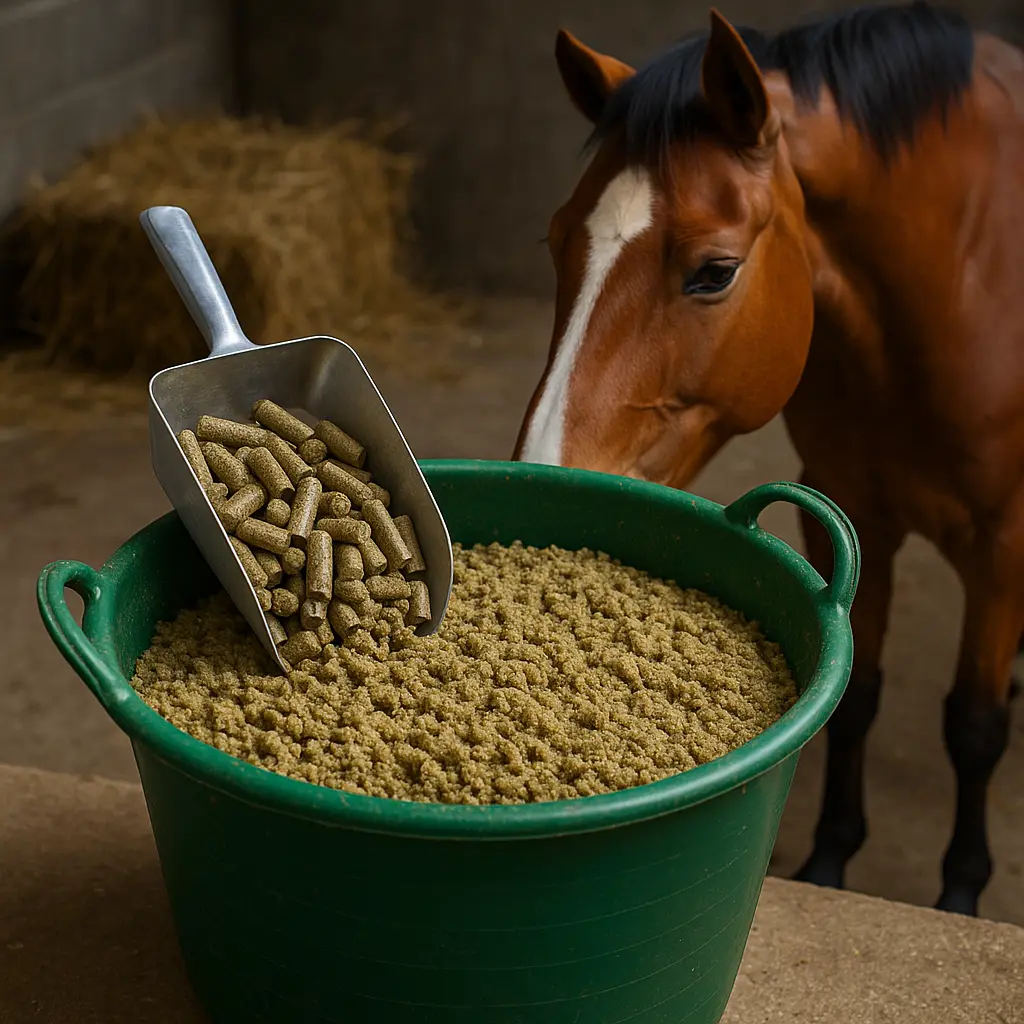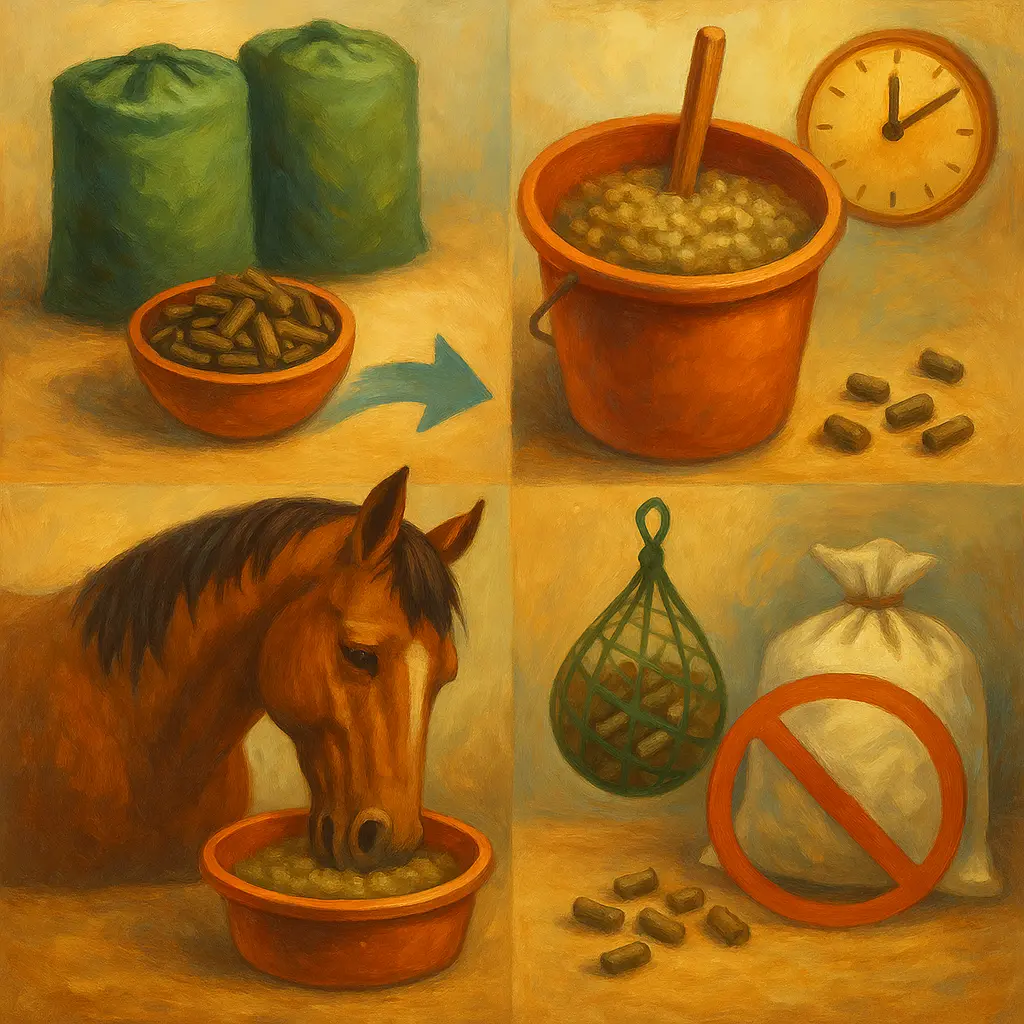
Grass pellets are a brilliantly simple way to feed fibre, but only if you prepare them correctly. Done right, they’re safe, hydrating and ideal for everything from laminitis management to older horses with poor teeth.
Key takeaway: Soak grass pellets at a 1:4 pellets-to-water ratio for 2 hours in cold water (or 15 minutes in hot), break up any hard lumps, and feed fresh—particularly for ponies, greedy eaters, seniors and dentally challenged horses.
What are grass pellets and why soak?
Grass pellets are compressed, dried forage that should be soaked before larger feeds to reduce choke risk and support hydration. Small dry quantities can be used as treats, but bucket feeds are best served soaked.
Think of grass pellets as forage in a convenient form. Because pellets can swell rapidly when moistened, feeding them dry in larger amounts increases the risk of choke—especially in foals, greedy horses, older horses and those with dental issues. UK manufacturers advise soaking to make a soft mash that’s easier and safer to swallow. As Dengie explains, grass pellets are a “pure fibre pellet” and can “absorb lots of water and swell,” so pre-soaking helps safeguard your horse’s throat.
“To soak our grass pellets for horses, you can use hot or cold water. Soaking time can vary according to the density of the pellets, but as a guide we would expect a 2 hour cold soak or 15 minute hot soak time. […] Please soak prior to feeding to reduce the risk of choke – as a pure fibre pellet, at times the Grass Pellets can absorb lots of water and swell.” — Dengie Horse Feeds
UK equine nutrition specialists at Simple System take a consistent stance: soak all forage pellets until free from hard lumps to mimic natural foraging and protect health.
Exactly how to soak grass pellets
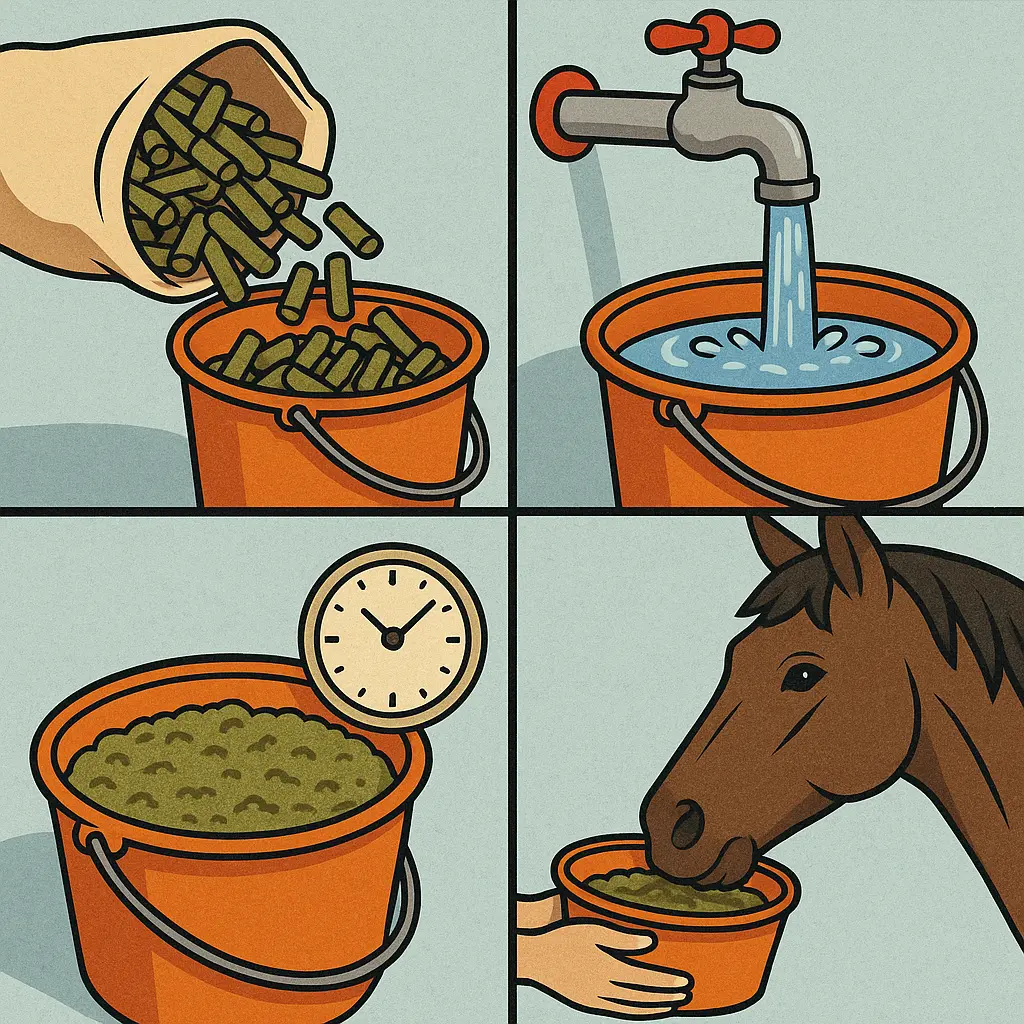
Use a 1:4 pellets-to-water ratio and soak for 2 hours in cold water or 15 minutes in hot water, then check there are no hard centres before feeding. Drain off any excess water for your horse’s preferred mash consistency.
Follow this yard-proof routine for safe, consistent results:
- Measure pellets: aim for accuracy—one large Stubbs scoop of Dengie Pure Grass Pellets is about 1.6 kg, and they come in 20 kg bags (from £18.19 plus £4.98 delivery, per Dengie).
- Add water at 1:4: for example, 1 kg pellets to ~4 litres water. Add a bit less if you prefer a firmer mash; top up as needed.
- Soak time: 2 hours in cold UK tap water, or 15 minutes in hot water if you’re in a rush—then allow to cool to a safe temperature before feeding.
- Break and check: stir well and break several pellets open—there should be no hard, dry cores.
- Serve promptly: drain if necessary and feed immediately.
Quick tip: If you’re new to a brand, always do a “crumble test” after soaking—compress a handful, then crumble it. If you feel hard granules, give it more time.
Can you feed grass nuts dry?
Yes—small dry amounts are fine for healthy adult horses as treats or in snack balls, but larger bucket feeds should be soaked to reduce the risk of choke and throat swelling.
This mirrors the guidance printed on UK feed bags and widely endorsed on UK yards. As reported by owners quoting Dengie’s bag instructions, pellets are safe fed dry in small quantities (e.g., snack balls or treats), but should be soaked when fed in larger amounts or as a sole feed because they swell. Forum consensus on New Rider is clear: dry grass nuts are a known choke risk in foals, greedy horses, the elderly, or those with dental issues—so these groups should always be fed soaked.
“We always suggest any forage pellet is soaked. This goes for all types of grass pellets […] Most of us accept that beet pulp needs soaking, so why feed dry grass pellets?” — Simple System Horse Feeds
If you like using treat balls, keep portions small and supervise. For boredom-busting rewards that complement good forage habits, see our range of stable-friendly horse treats.
How much to feed and how to weigh
Use scales and measure pellets by weight; a large Stubbs scoop of Dengie Pure Grass Pellets is ~1.6 kg, and most horses thrive on total forage intakes around 1–1.5% of bodyweight per day (split between hay/haylage and suitable fibre feeds).
Pellets are dense, so scoops can be misleading. Weigh your scoop once so you know exactly what you’re feeding—digital scales pay for themselves quickly in accuracy. As a reference from Dengie, one large Stubbs scoop of their Pure Grass Pellets is roughly 1.6 kg, sold in 20 kg bags starting from £18.19 plus £4.98 delivery (source).
For daily planning, many UK owners aim for total forage intake (hay, haylage, chopped fibre, soaked pellets) around 1–1.5% of the horse’s bodyweight. Adjust the proportion of pellets to suit your horse’s routine, dentition and workload, and always introduce changes gradually over 7–10 days. Mash consistency also matters: some horses drink better and eat more comfortably when pellets are made into a wetter, soupier mash.
Pro tip: Keep a feeding log—record scoop weights, water ratios and soak times that your horse likes. This helps you fine-tune consistency across seasons and yard helpers.
Storage and food safety
Feed soaked pellets immediately or within 24 hours in cool conditions; in UK summer heat, they can ferment in 8–24 hours, so prepare fresh daily and discard anything that smells sour or yeasty.
Soaked forage is a perfect fermenting medium in warm weather. UK owners on Horse & Hound report that soaked grass pellets turn quickly—often within a day in summer garages. To protect your horse’s gut health, do the following:
- Only soak what you’ll use that day in summer; in winter, up to 24 hours is usually acceptable if kept cool and covered.
- Smell and stir before feeding—if it’s sour, fizzy or warm to the touch, bin it and start again.
- Clean soaking buckets daily to prevent biofilm build-up. A tidy feed area also helps reduce flies—consider pairing summer feeding with appropriate fly rugs and sheets if midges are a nuisance.
At Just Horse Riders, we recommend pre-soaking daily batches rather than weekly, especially June–August. This aligns with practical UK yard practice and welfare-first feeding endorsed by the British Horse Society (BHS) where forage safety and good hygiene are central.
Which horses should always have soaked pellets?
Foals, greedy eaters, elderly and dentally challenged horses, and any horse with a history of choke should always receive pellets soaked to a soft mash.
Feeding dry, dense pellets to vulnerable horses is a known choke risk, highlighted by UK owner experience and consistent manufacturer advice. Watch for classic choke signs after any feed: coughing, drooling, nasal discharge of feed/water, neck stretching or distress. If you suspect choke, call your vet immediately; BEVA-member equine practices are your go-to for prompt care.
Soaked grass pellets are also popular for laminitis-prone horses when used correctly as a high-fibre, low-sugar option (per brand formulations under British Feedstuff Regulations). Dengie Pure Grass Pellets are positioned as a suitable fibre source; always soak as directed to reduce choke risk and feed in line with your vet or nutritionist’s plan. In colder, wet UK winters, older or rugged horses often do well with warmed mashes—just ensure the feed is cool enough to eat safely.
Quick tip: For senior horses, mash can be a brilliant carrier for medications and balancers. If you’re adding extras (electrolytes, joint support, hoof care), our curated supplements range makes it easy to keep everything in one palatable bowl.
Common mistakes to avoid with grass pellets
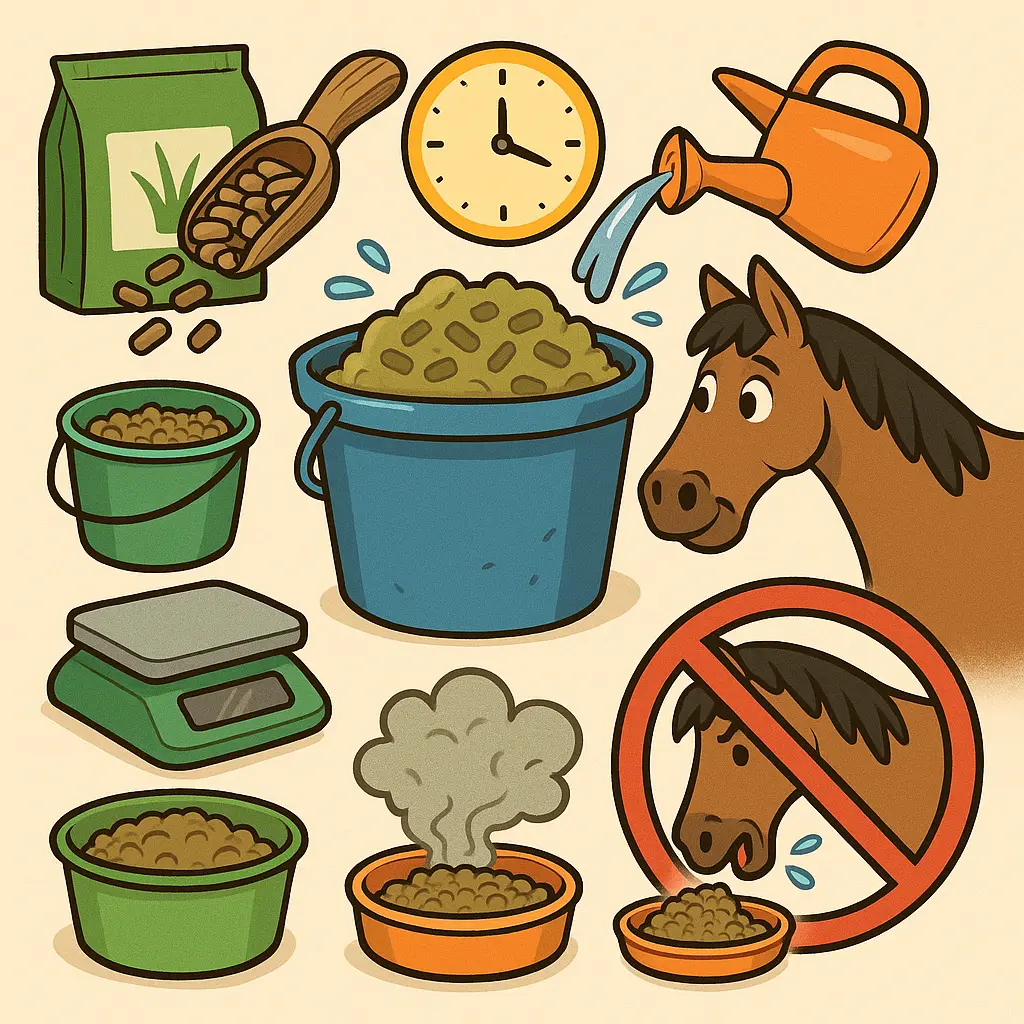
Under-soaking, feeding large dry portions, and storing mash too long in warm weather are the biggest risks; always check for hard lumps and throw away any mash that smells “off”.
- Under-soaking: A quick splash isn’t enough. Stick to 2 hours cold or 15 minutes hot water, then check the middle of the pellets.
- Wrong ratio: Too little water creates dense, crumbly mash. Start at 1:4 pellets-to-water and adjust to your horse’s preference.
- Feeding dry in bucket quantities: Dry feeding should be limited to tiny, supervised treat amounts for healthy adults only.
- Warm-weather storage: In summer, soaked pellets may ferment in 8–24 hours. When in doubt, throw it out.
- Not monitoring higher-risk horses: Foals, seniors, greedy or dentally challenged horses should always be fed soaked pellets and supervised.
- Dirty buckets: Poor hygiene encourages spoilage. Rinse after every feed and give a proper scrub regularly—our grooming essentials make this chore faster.
Pro tip: If your horse bolts feed, slow things down with a wetter mash and split meals into smaller portions. Supervise until you’re confident with their pace.
Kit checklist for soaking and feeding
You’ll need a sturdy bucket or trug, accurate scales, a reliable scoop, and clean storage. Add seasonal extras—fly protection in summer, rugs in winter—for comfort while feeding.
- A heavy-duty soaking bucket or muck tub with a lid or cover.
- Digital scales for weighing pellets and checking your scoop weight (~1.6 kg per large Stubbs scoop of Dengie Pure Grass Pellets).
- A marked jug for consistent water volumes (1:4 ratio is your baseline).
- Stirrer or gloved hands to break up clumps and test for hard centres.
- Clean, dry storage for pellets, away from damp and pests.
- Seasonal add-ons: in summer, control flies around the feed area and your horse with breathable fly rugs and sheets; in winter, keeping horses warm and comfortable supports appetite—browse our weatherproof turnout rugs.
- Yard safety: if you’re prepping feeds at dawn or dusk on dark lanes, wear hi-vis for riders so you’re seen around the yard and fields.
- Tiny dry treats for enrichment: use small, supervised portions in toys—shop our selection of horse treats and stable snacks.
At Just Horse Riders, we trial and stock quality yard kit to make feeding routines smooth, safe and repeatable—so every helper on the yard can follow the same method without guesswork.
Seasonal UK tips for soaked pellets
In summer, soak little and often to avoid fermentation; in winter, warm water shortens soak time but always serve at a safe temperature and keep horses comfortable for steady intake.
British weather matters. In June–August, mash spoils fast—so prep per-feed or morning-evening at most, and keep flies down around feed areas. In autumn-winter, use hot water for a quick 15-minute soak and a cosy mash, but be certain it’s cool enough before serving. Many owners find that comfortably rugged horses maintain weight and eat more consistently; if your horse needs extra protection in the field, our robust winter turnout rugs are built for UK rain and wind.
Quick tip: Store pellets somewhere frost-free but dry. Extreme cold can make soaking sluggish, while damp storage clumps pellets and affects consistency.
Troubleshooting and when to call the vet
If your horse coughs, drools, stretches their neck or struggles after eating, stop feeding and call your vet—choke is an emergency. Prevent issues by soaking properly and supervising higher-risk horses.
Most mash issues are solved by longer soaks, a higher water ratio, and better hygiene. But don’t “wait and see” with potential choke. British Equine Veterinary Association (BEVA) practices deal with choke routinely—your prompt call helps avoid complications like aspiration. After any choke episode, follow your vet’s feeding advice, which may include a period of softened feeds only.
If hydration is a concern—after travel, hard work or heat—ask your vet about adding electrolytes or salt to a soaked mash for palatability and fluid intake. Our performance and wellbeing supplements collection can help you build a simple, effective routine under professional guidance.
FAQs
Yes—most UK owners should soak grass pellets unless feeding tiny, treat-sized amounts. The answers below cover when to feed dry, exact soak times, ratios and how to store mash safely.
Can grass nuts be fed dry to adult horses?
Yes, but only in small quantities such as treats or in a snack ball, and only for healthy adult horses. For any bucket feed or vulnerable horse (foals, greedy, elderly, dentally challenged), soak to a mash to reduce choke risk, as advised by Dengie and consistent UK yard practice.
How long should I soak grass pellets in cold UK tap water?
Soak for 2 hours in cold water, then break a few pellets to check there’s no hard centre. If pellets are extra-dense, extend the time until fully soft. Hot water can reduce this to about 15 minutes—cool before feeding.
What’s the best water ratio for soaking?
Start at 1:4 pellets-to-water to create a mash. Adjust for your horse’s preference but ensure all pellets are fully softened and lump-free before feeding.
How long do soaked grass pellets last?
Feed immediately or within 24 hours in cool conditions. In UK summer heat, soaked pellets can ferment within 8–24 hours—discard anything that smells sour and prepare fresh daily.
Should I always soak for ponies or seniors?
Yes. Foals, ponies, seniors, greedy eaters and horses with dental issues should always be fed pellets soaked, because dry pellets can swell and increase choke risk. This mirrors UK consensus on New Rider and manufacturer guidance.
Can I mix supplements or medication into soaked grass pellets?
Yes—many owners use a soft mash as a carrier so horses eat everything reliably. Add vet-prescribed medication as directed and consider palatable support like electrolytes or balancers from our supplements range.
Do I need to supervise feeding if my horse is a fast eater?
It’s wise. Offer a wetter mash, split feeds into smaller portions, and supervise until you’re confident they eat at a safe pace. If you ever see signs of choke (coughing, drooling, neck stretching), call your vet immediately.
Ready to set up a safe, simple soaking routine? Keep a dedicated bucket, measure accurately, and stick to the 1:4 ratio and 2-hour (cold) or 15-minute (hot) soak. For seasonal comfort while you feed, don’t forget yard-friendly essentials like fly rugs for summer and dependable turnout rugs for winter, plus visible, safe trips to the yard with hi-vis gear. If you’re using tiny dry portions for enrichment, browse our horse treats—and if you need tailored nutrition support, our team at Just Horse Riders is here to help.