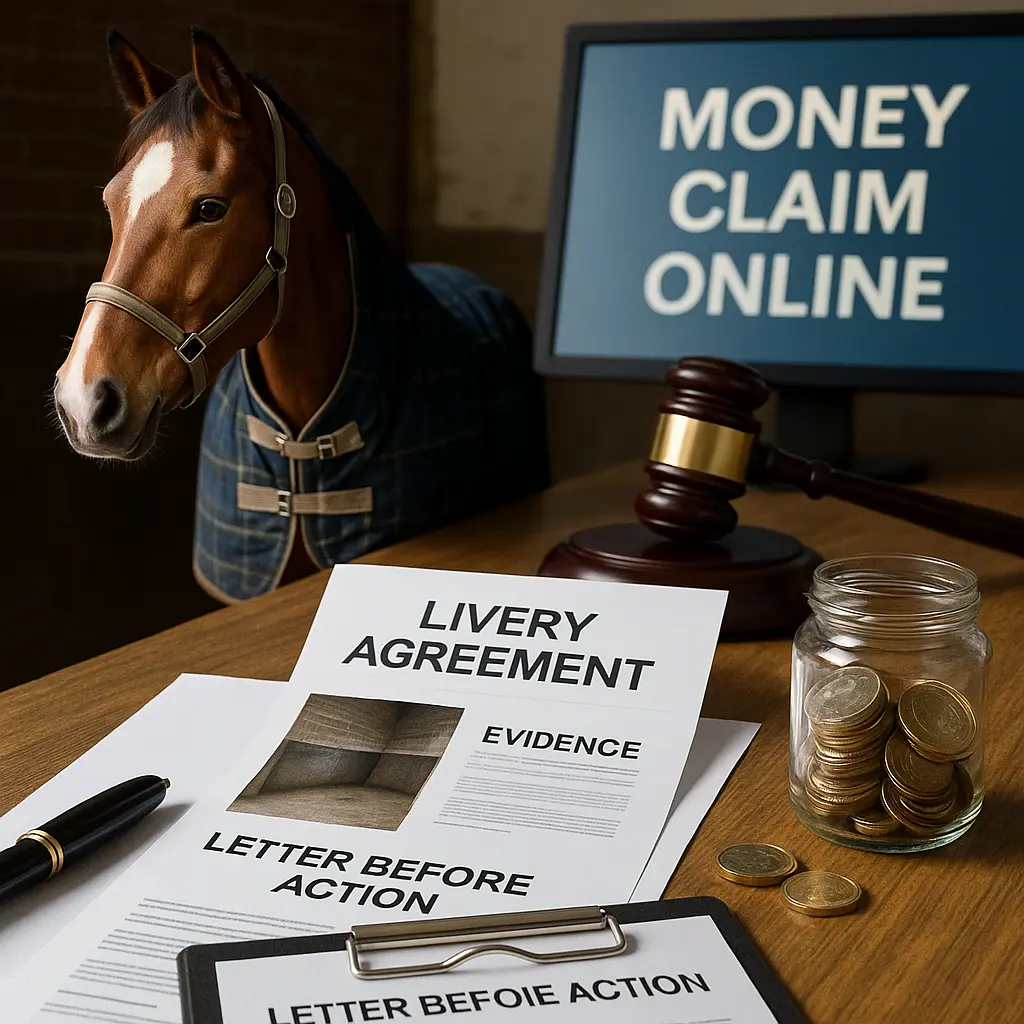
If your livery yard won’t return your deposit, you don’t have to just “chalk it up to experience.” With a clear paper trail and a firm but fair process, most UK horse owners recover their money—often without stepping inside a courtroom.
Key takeaway: A livery deposit is a contractual security bond, normally paid with your first month’s fees and refundable in full within 7–30 days of leaving if there’s no debt or damage; if it’s withheld, send a 14‑day letter before action and, if needed, file a small claim (under £10,000) via MCOL or Form N1 to recover the deposit, court fees and interest.
When is a livery deposit due and when should it be returned?
In the UK, livery deposits are usually paid with your first month’s fees and should be refunded in full within 7–30 days after you leave, provided there are no debts or damage. Most deposits are modest (e.g., £150 in one reported case) and sit far below the small claims limit of £10,000.
Standard livery agreements treat the deposit as security against unpaid bills, damage or abrupt departures. Reputable advice for yard owners is to specify the amount (commonly around one month’s fees), exactly what it can be used for, and when it will be repaid. Industry guidance suggests prompt refunds: some recommend within 7 days once the final invoice is settled and everything is left in good order, while others work to a 30‑day window to check for outstanding fees or issues. Either way, transparency in the contract stops confusion later.
At Just Horse Riders, we recommend you request that deposit terms—amount, acceptable reasons for retention, inspection process, and refund timeline—are written into your livery contract before your horse arrives. Clarity now prevents arguments at exit.
What to do first if your deposit is withheld
Start by gathering evidence and sending a formal letter before action giving the yard at least 14 days to return the money. Many disputes settle at this stage without court.
Prepare a tidy bundle of proof. This should include your signed livery contract or any written agreement, records of payments (bank statements or receipts), all messages about the deposit, photos and videos of the stable and yard area on departure, and any invoices for alleged repairs. A well‑organised pack shows you’re serious and makes a judge’s job easy if it goes that far.
“Gather evidence such as a copy of your tenancy agreement, letters and messages about your deposit, records of payments, inventory, photos/videos, repair invoices, and deposit receipt before sending a formal letter before action.” — Shelter England
Even though Shelter’s guidance targets tenancies, the evidence principles apply neatly to livery contracts because you’re still enforcing a private agreement. Your letter before action should set out: what’s owed, why it’s owed, the evidence you hold, and a firm deadline (at least 14 days) to refund in full or explain any itemised deductions with proof.
Quick tip: Send your letter by recorded delivery and email. Keep the proof of delivery—if you later seek a default judgment, it matters.
Also, keep your final livery invoice separate from the deposit. Yard management advice is to settle the final bill, while handling the deposit refund independently; that way, any genuine issues discovered post‑departure can be treated on their own merits without muddying the waters.
How to make a small claim for your livery deposit
If the yard doesn’t pay, issue a county court claim using Form N1 or Money Claim Online (MCOL) and claim court fees and interest from the due date. The small claims track covers disputes up to £10,000, so it’s the right route for almost all livery deposit cases.
Here’s a straightforward path to follow:
- Give a final 14‑day deadline in writing. Your letter before action is both fair and required by the court’s pre‑action protocol spirit.
- File your claim. Use Form N1 (paper) or MCOL (online). Your particulars should state: the contract existed; you paid a deposit of £X on [date]; you left on [date]; no debts/damage justify retention; the deposit fell due for refund on [date]; and interest is claimed from that date. Attach your evidence list.
- Pay the claim fee. Court fees scale with the claim amount (typical livery deposits of £150–£500 attract relatively low fees). If you win, the court normally orders the yard to repay your fee and your deposit, plus interest. Check GOV.UK for the current fee bands.
- Track the yard’s response. They have 14 days to reply. If they ignore it, you can request judgment in default—normally on Form N227—and may avoid a hearing entirely.
- Prepare for hearing if defended. Small claims are designed for self‑representation. Organise your bundle: contract, payment proof, correspondence, photos/videos, any inventories, and a concise witness statement telling the story in date order.
Pro tip: Label your photos with dates and a short caption (e.g., “Stable after cleaning, 3 March, no damage visible”). Judges value clear, chronological evidence over sheer volume.
“If the owner is not willing to refund you the deposit, issue a money claim online (MCOL) through the county court process.” — JustAnswer UK Law Expert
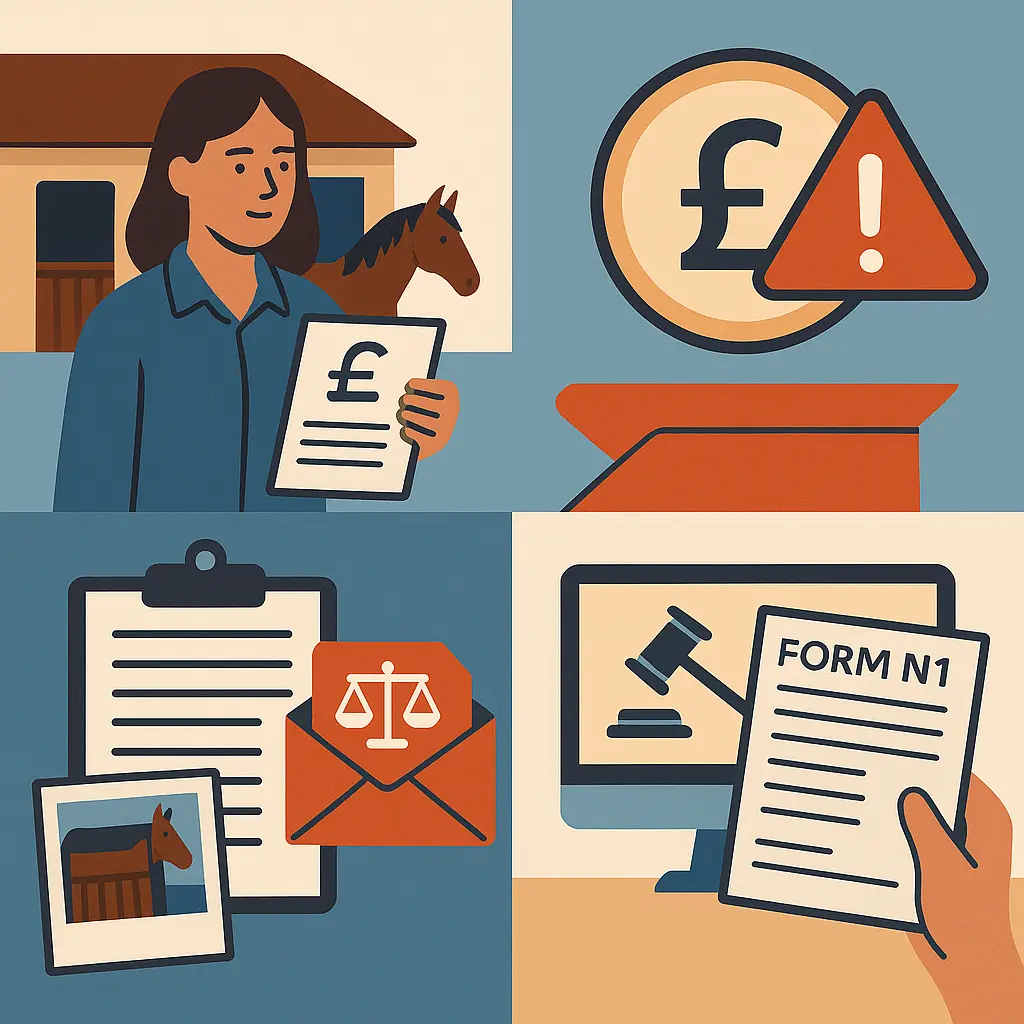
What can a yard deduct from your deposit?
A yard can deduct reasonable, evidenced costs for cleaning or minor damage agreed in the contract, and must refund the remainder promptly. Any deduction should be specific, proportionate and supported by photos, messages, and invoices where relevant.
Practical equestrian guidance recognises modest deductions for clearly identified issues—e.g., £50 for extra deep cleaning or minor repairs—especially where the contract sets this out. The yard should provide itemised reasons and evidence and return the balance within the agreed timeframe (often 7–30 days).
By contrast, blanket or unexplained retentions (“we’re keeping it because X owner always leaves a mess”) won’t wash with a judge. The yard can’t invent charges or delay indefinitely. If they believe you owe more than the deposit covers, they’re free to pursue you through small claims, exactly as you can pursue them for a refund.
“The security deposit is retained until the horse owner departs; refund in full within 7 days of departure and final invoice settlement if all is left in good order—keep final invoice separate to avoid disputes.” — Horse & Mart
Important: Livery agreements are contracts under UK common law. Without an explicit lien clause, a yard cannot automatically retain your horse for unpaid fees. Equine solicitors advise using the Torts (Interference with Goods) Act 1977 notices if a yard needs to deal with uncollected goods properly. This is one more reason to keep your exit organised and documented.
Costs, timelines and what to expect at the hearing
Small claims under £10,000 are designed for self‑representation, with hearings in person, by phone or video, and typical orders for deposit return plus court fees and interest. You don’t need a lawyer, though you can seek advice if you wish.
After you file, the yard has 14 days to acknowledge and a total of 28 days to file a defence if they acknowledge within time. If they defend, the court will give directions—usually to exchange evidence and witness statements by certain dates—then list a short hearing. Many cases settle once your organised evidence lands on the other side’s desk.
On the day, the judge will skim your contract and evidence, ask a few clarifying questions, and decide whether the yard was entitled to keep any of the deposit. If you win, the order usually includes:
- Your deposit (or the undisputed remainder if some deductions were justified)
- Your court issue fee, and sometimes fixed costs for service
- Interest from the date the refund fell due
Unlike assured shorthold tenancy cases, livery deposits typically don’t fall under the government deposit protection schemes, so the 1–3x deposit penalty for non‑protection does not automatically apply. You are enforcing a straightforward breach of contract claim: the deposit became due back and was not paid.
Quick tip: Keep your tone professional throughout. Judges respond well to factual, organised claimants; emotive language and long grievances don’t help your case.
If you win but still don’t get paid
If the yard ignores a judgment, you can enforce it through GOV.UK options, including bailiffs (warrant of control), attachment of earnings (if appropriate), or a charging order. The court often sets payment within 14 days; if that deadline passes, act promptly.
Enforcement is rarely needed in livery deposit disputes, but it’s there if you require it. Choose the method best suited to the yard’s situation; many owners simply need the nudge of a judgment to pay.
Maintain meticulous records of all correspondence and proof of delivery; if enforcement becomes necessary, this paperwork shows you’ve been reasonable at every step.
“Maintain records of all correspondence, including emails, letters, and proof of delivery, which can be invaluable if the matter goes to court.” — Roythornes Solicitors (Equine)
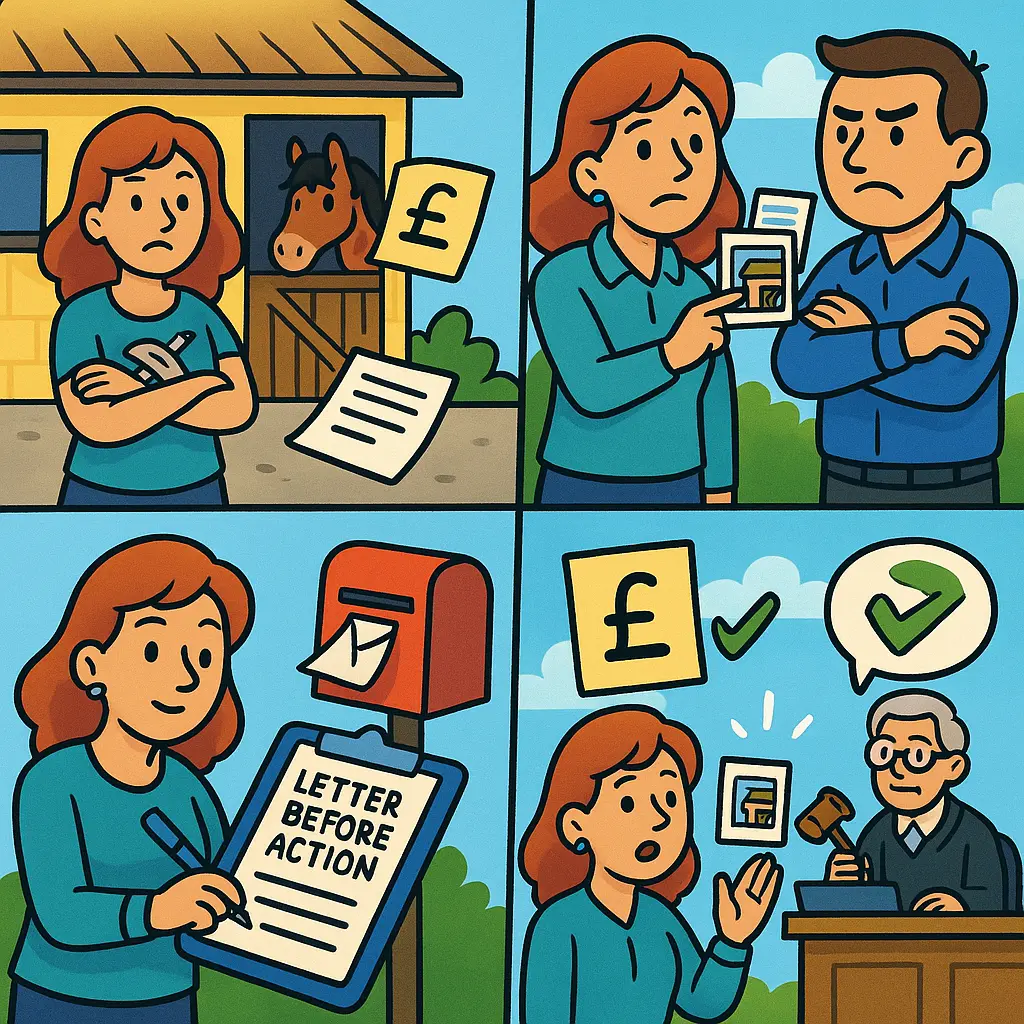
Prevent disputes with better livery contracts and exits
Clear contract wording on deposit amount, reasons for retention and a 7–30 day refund timeline prevents most disputes. The cleaner your exit, the harder it is for anyone to justify deductions.
Use these contract and exit checklists:
- Contract clarity — Write the deposit amount (e.g., equivalent to one month’s fees), exactly what it can cover (debt, damage, cleaning), the inspection process, photo evidence, and a refund timeframe (e.g., 7 days if all clear, up to 30 days for checks).
- Separate accounts — Keep your final invoice separate from the deposit refund to avoid confusion if additional issues are found later.
- Evidence on exit — Take dated photos and short videos of the stable, yard area, tack space and muck heap after you’ve cleaned. Photograph any pre‑existing scuffing or wear before you start.
- Return keys and confirm — Hand back any keys/fobs promptly and get a signed receipt or an email acknowledgment.
- Leave no trace — Sweep, disinfect, and bag up leftover bedding. A spotless bay removes most arguments.
Our customers often tell us that doing a final clean and photo set takes 20 minutes and saves weeks of back‑and‑forth. A simple grooming and cleaning kit left in your car for moving day is worth its weight in gold. If you need to restock, see our curated grooming kits and brushes.
Moving yard? Your horse-care checklist
Plan your move around UK weather and welfare, organising rugs, grooming and transport protection to avoid last‑minute issues and damage claims. A smooth move reduces stress for your horse and minimises any excuse for deductions.
Build your move-day kit with the seasons in mind:
- Rugs for British weather — If you’re moving in a wet or cold spell, have a clean, named rug ready so your horse doesn’t borrow yard kit. For turnout days under rain and wind, choose a reliable, waterproof layer from our winter turnout rugs. For box rest or overnight stabling at the new yard, pack an appropriate stable rug to keep them comfortable if temperatures drop.
- Transport protection — Avoid knocks that could lead to care concerns or vet visits. Fit travel boots or brushing boots from our horse boots & bandages range.
- Visibility if hacking to your new yard — If you’re riding on roads to relocate, prioritise safety with a correctly fitted hat and high‑viz. Check our selection of certified riding helmets and consider a tabard or exercise sheet from our hi‑vis collection.
- Clean exit, clean entry — Pack a bucket, disinfectant, stiff brush and cloths. A quick scrub of your old stable (and a tidy on arrival) helps evidence your condition reports. Top up your kit via our grooming and cleaning tools.
- Trusted brands — Keep it simple with proven gear that lasts. Browse hard‑wearing rugs and accessories from WeatherBeeta and Shires for dependable quality during changeovers.
Pro tip: Label everything and use sealable boxes for small items (bit guards, spare lead ropes, travel ties). An organised tack area reduces the risk of mislaid kit and prevents spurious “missing item” deductions.
FAQs
How much does it cost to start a small claim for a withheld livery deposit?
Court fees are banded by claim value. Typical deposits of £150–£500 attract relatively low fees, and if you win, the court usually orders the yard to repay your fee along with the deposit and interest. Check GOV.UK for the current fee schedule before filing.
What if the yard ignores my demand letter?
File a claim using MCOL or Form N1. If the yard doesn’t respond to the claim within 14 days, you can request judgment in default—normally via Form N227—often avoiding a hearing altogether.
Can yards deduct for damage without notice?
They can deduct reasonable, evidenced costs if your contract allows it, but they must justify the amount (e.g., itemised cleaning or repair with photos) and promptly refund the remainder—within the agreed 7–30 days.
Do I need a lawyer for small claims over a livery deposit?
No. The small claims process is designed for self‑representation. Prepare a clear evidence bundle (contract, payments, correspondence, photos/videos) and a short witness statement; hearings can be in person, by phone, or by video.
What happens if I win but the yard won’t pay?
You can enforce the judgment using options on GOV.UK, such as bailiffs (warrant of control). The court often sets a 14‑day payment deadline; if it passes without payment, begin enforcement promptly.
Is a livery deposit like a tenancy deposit with 1–3x penalties?
No. Livery deposits are contractual security bonds and aren’t generally covered by the government tenancy deposit schemes. You can claim the deposit, fees and interest for breach of contract, but the 1–3x penalty usually applies only to protected residential tenancies.
Can a yard keep my horse for unpaid livery fees?
Not automatically. Without a specific lien clause in the contract, the yard can’t simply retain your horse. Equine legal guidance points to using Torts (Interference with Goods) Act 1977 procedures to handle uncollected goods correctly.
At Just Horse Riders, we’re here to help you keep moves calm, clean and documented. If you’re preparing to change yards, get ahead of the weather with dependable stable rugs and robust turnout rugs, and keep your exit spotless with our ready‑to‑go grooming kits. A tidy exit and a tight paper trail are your best friends—both for your horse’s welfare and your wallet.