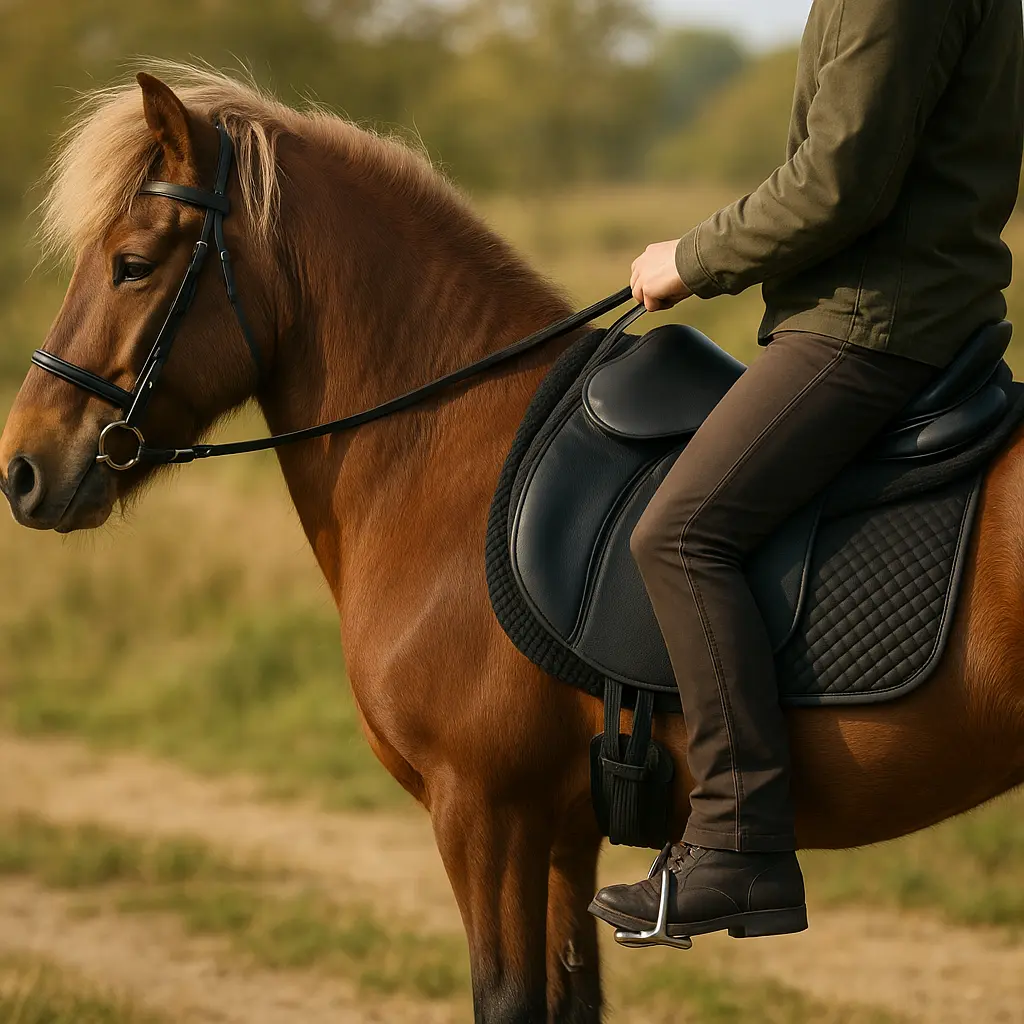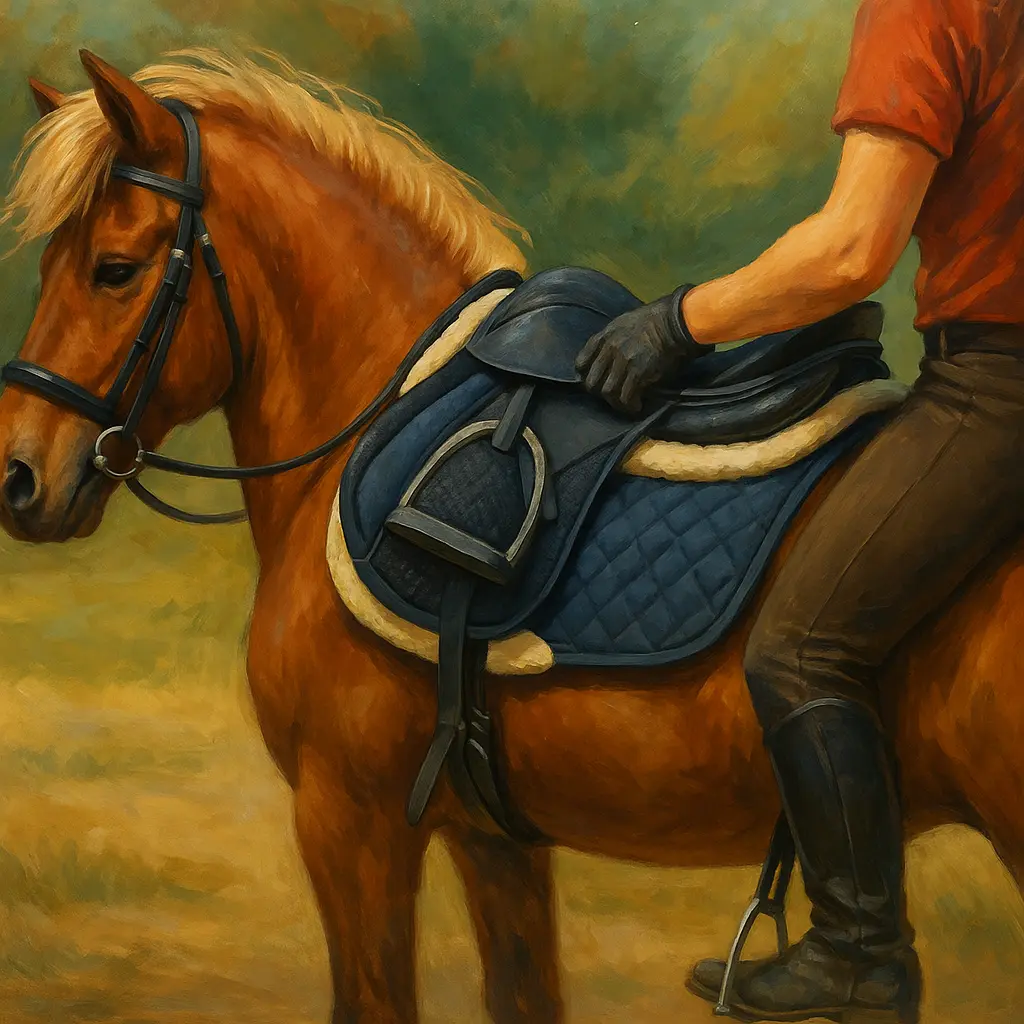
If you ride an Icelandic horse in a treeless saddle, the pad you choose is doing most of the heavy lifting for comfort, stability and spinal protection. Get the pad right, and your 330–400 kg partner can cover miles of tölt and trail in balance; get it wrong, and you risk pressure points, slipping and a sore back.
Key takeaway: With treeless saddles on Icelandic horses, a high-quality, shock-absorbing pad that creates a clear gullet over the spine is non-negotiable — it’s the “tree substitute” that protects your horse and stabilises your seat.
Why treeless saddles on Icelandic horses need special pads
Treeless saddles lack a rigid tree, so the pad must provide shock absorption, spine clearance and weight distribution. This is especially important on short, compact Icelandic backs that work across multiple gaits, including tölt.
Icelandic horses are sturdy yet short-coupled, typically 330–400 kg, and often ridden over distance in a range of gaits. Treeless designs offer lighter weight and closer contact, but without a tree the rider’s weight can concentrate over the spine unless the pad offers genuine pressure relief and a defined channel. As our own guidance notes:
“Choose the right padding: With treeless saddles, using high-quality, shock-absorbing pads is essential to protect your horse’s back and ensure proper weight distribution.” — Just Horse Riders Expert Tips
Purpose-built treeless pads create a gullet over the spine, stabilise the saddle across the back, and reduce peak pressures as you sit, rise, or transition between gaits. Without those features you’ll see slipping (especially downhill or in winter mud), muscle soreness, or reactive behaviour when mounting or girthing.
What to look for in a treeless pad for Icelandic backs
Pick a pad that guarantees spine clearance, uses shock-absorbing materials, fits high or low withers, and is cut for short backs so it doesn’t bridge or sit on the loins. This combination protects the back and keeps treeless saddles stable.
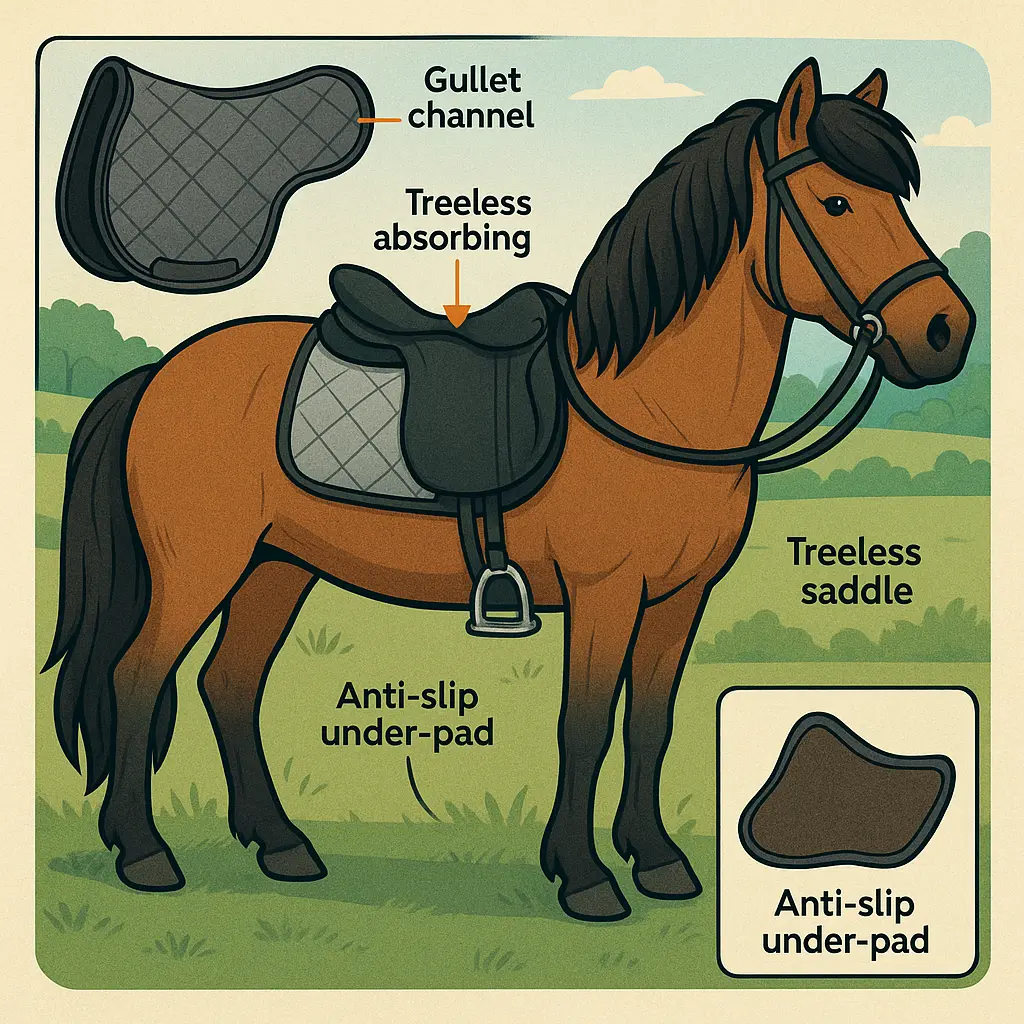
Start with structure. A good treeless pad builds a defined channel or gullet that keeps pressure off the spine and dorsal ligament system. Look for pads designed specifically to “create a gullet,” accommodate withers, and support the rider’s weight evenly front to back — exactly what specialist treeless pad makers specify (Treeless Saddle).
Materials matter. Shock-absorbing inserts such as foam rubber or latex panels help blunt impact and improve stability in energetic gaits like tölt; it’s why foam-rubber Icelandic numnahs like the FENGUR Héla are popular for grip and cushioning on compact backs. Premium options such as Mattes treeless pads focus on pressure dispersion and can be ordered with shims, but note they can vary in length by ±2 cm and may shrink up to 5% after washing (Pink Equine).
Fit is as important as fabric. Icelandic backs are short, so choose pad shapes that keep clear of the last rib and hindquarter swing, and that “sit up” into the gullet to avoid collapsing onto the spine. Some models add anti-slip undersides to stop the saddle moving on rounder barrels or through transitions. And always check withers: some horses need extra lift at the front to prevent pressure or tipping.
Our guide also stresses clearance and fitting:
“Check for spine clearance: Always ensure the saddle has a channel or gullet that prevents direct pressure on the horse’s spine. Professional fitting: Have your saddle fitted by a professional, especially with lightweight or treeless models, to avoid discomfort or injury.” — Just Horse Riders Expert Tips
Quick tip: Video yourself in tölt from behind — any side-to-side rolling, tail swishing or pad “creep” forward is a red flag that your pad lacks structure or grip.
UK-focused fit and sizing for short backs and withers
Measure back length and depth, allow a little extra for withers, and choose Icelandic-specific cuts; expect up to ±2 cm pad variance and around 5% shrinkage after washing on some premium models. Always confirm a clear gullet once girthed.
Sizing and setup checklist for UK riders:
- Measure A–B (usable back length) and C–D (depth) per the brand’s guide, and allow up to 4 cm extra at the withers if needed for clearance (Mattes guidance via Pink Equine; Treeless Saddle).
- Confirm the pad’s built-in channel stands up under the saddle and doesn’t collapse on the spine after you mount.
- Match pad shape to short Icelandic backs — pads like the Kavalkade “Iceland” are cut for curved backs and hindquarter freedom, with sweat-absorbent 75% polyester/25% cotton outers/linings and 100% polyester filling at around £50 in the UK market (FUNDIS Equestrian).
- Use anti-slip under-pads on rounder types or for hilly UK hacking to reduce forward shift.
- Wash at 30°C with mild detergent, close Velcro before washing, and air-dry flat to maintain shape; expect small size changes on some premium pads.
Pro tip: After a ride, check the sweat pattern. A uniform damp “print” with a dry spine channel and no isolated dry or sore spots is your green light.
Pad options and UK price guide
Expect to spend £50–£150+ for Icelandic/treeless pads in the UK, from value polyester-cotton models to premium shock-absorbing designs. Choose a true “treeless” pad for spine protection and weight distribution.
Here’s how the market breaks down:
- Entry level: Pads like the Kavalkade Iceland (~£50) offer Icelandic-specific cuts, sweat management and everyday comfort for schooling and hacking (FUNDIS Equestrian).
- Mid to premium: Barefoot and Lamefelle treeless pads are widely recommended by UK riders for proper structure and safety, though they cost more. As one experienced rider put it:
“The safest option is a proper treeless pad like the Barefoot or Lamefelle ones but they are expensive.” — Horse & Hound forums
- Premium specialist: Mattes for treeless saddles prioritise pressure dispersion, quality sheepskin options, and shim systems for fine-tuning, with noted ±2 cm sizing variance and up to 5% shrinkage after washing (Pink Equine).
- Function-first options: Foam rubber and latex-panel numnahs (e.g., FENGUR Icelandic Numnah Héla) add grip and shock absorption that helps through tölt and transitions.
Equitex-style pads are popular but not all models are optimised for treeless spine clearance; UK riders often favour Barefoot or Lamefelle for truly tree-free setups when stability is the priority (Horse & Hound forums).
Designer insight also matters. Icelandic specialist Þórður Þorgeirsson emphasises fine-tuned contact and seat feel in collaboration with EQUES:
“On the basis of many years of experience with pads, I have, together with EQUES, designed this pad to achieve the optimal contact with the horse, while still having the feeling of a saddle sitting in the seat. Every detail is carefully considered to make sure that the new þþ pad offers the best possible fit for horse and rider.” — Taktur
Whatever you choose, prioritise a pad built specifically for treeless and Icelandic conformation with a real gullet, not just extra thickness.
Pairing pads, saddles and stirrups for Icelandic setups
Combine a structured treeless pad with an Icelandic-appropriate saddle and supportive stirrups to maximise stability, comfort and rider security. Professional fitting is strongly advised for treeless and lightweight models.
On the saddle front, UK-made bespoke Icelandic saddles from Walsall workshops such as Heritage are designed for short backs and shoulder freedom, typically £1,200–£1,500, with flexible padding options to suit wet British weather (Heritage Saddlery). Some riders opt for RDA-approved treeless models (e.g., the Criterion Versatile around £390) for adaptable use across horses on busy livery yards.
Stirrups make more difference than you’d think. Icelandic-specific stirrups with curved shapes or transverse suspension enhance balance in tölt and can reduce joint strain for both horse and rider — a boon for anyone with sensitive knees or osteoarthritis on longer hacks. Pair them with anti-slip under-pads on round-barrelled types or for hilly routes.
For UK hacking, safety and comfort kit rounds out the setup:
- Stay visible on lanes and bridleways with high-quality hi-vis rider gear.
- Protect yourself with a properly fitted riding helmet and supportive horse riding boots for secure, shock-absorbing footing on long rides.
- Give your Icelandic extra protection through uneven going with appropriate horse boots & bandages.
At Just Horse Riders, we recommend checking treeless pad fit at walk, trot and tölt, including uphill and downhill, and reassessing after 20–30 minutes as the horse warms and the pad “beds in.”
Seasonal care and maintenance for UK weather
Choose breathable, moisture-wicking pads for summer and add grip/cushioning for winter mud; wash at 30°C, close Velcro, and air-dry to avoid shrinkage or distortion. Rotate pads to keep them dry in damp British conditions.
Summer: Icelandics can sweat under dense manes and saddles on warm, humid days. Opt for pads with sweat-absorbent linings (polyester/cotton blends are a solid choice) and breathable structures. Keep coat and saddle area clean with a regular grooming kit to avoid grit that can abrade when pads get damp.
Winter: Mud and slick ground increase saddle movement risks. Consider anti-slip under-pads and slightly more cushioning to maintain stability through spooks or downhill sections. After riding, remove the pad promptly, brush off mud, and air in a warm, ventilated space to prevent mildew. If your horse is living out, pair stable fit with suitable winter turnout rugs so sweat isn’t trapped under the saddle area before mounting.
Care: Follow the manufacturer’s washing instructions — many specify 30°C with mild detergent and Velcro closed. Expect up to 5% shrinkage on some premium sheepskin/wooled pads. Never tumble dry. Store flat or loosely rolled to protect the gullet structure.
Recovery and comfort: If you’ve upped mileage or intensity, supportive horse supplements can be considered alongside rest days and careful pad selection, especially for older or sensitive-backed horses.
FAQs
Are treeless Icelandic saddles safe without a tree?
Yes, when paired with a proper treeless pad that provides a clear gullet, shock absorption and correct weight distribution; without that, you risk spine pressure and instability. Treeless can be brilliant for close contact and lighter weight, but high-performance or very long-distance riding demands meticulous fitting and pad choice (JHR Expert Tips).
What pads work best for UK hacking under treeless or Equitex-style setups?
Choose pads built expressly for treeless spine clearance and stability. UK riders frequently recommend Barefoot or Lamefelle as “safer options,” and foam-rubber Icelandic numnahs like the FENGUR Héla add grip on short backs; avoid cheap, unstructured pads that can slip (Horse & Hound forums).
How do I fit a pad on a short-backed Icelandic?
Measure spine length and depth, select an Icelandic-specific cut that clears the loins, and confirm a standing gullet once mounted. Pads like the Kavalkade Iceland are shaped for curved backs and hindquarter freedom and use sweat-absorbent linings for comfort (FUNDIS Equestrian).
How much should I budget for a treeless pad in the UK?
Plan for £50–£150+ depending on materials and structure. Around £50 buys a solid Icelandic-cut, sweat-managing pad; premium treeless pads with shims and high-end materials cost more (Pink Equine).
Can treeless setups help riders with joint pain or arthritis?
Many UK riders report that endurance-style treeless setups with shock-absorbing pads and supportive Icelandic stirrups reduce joint stress and improve comfort over distance, especially in tölt. As always, combine with a fitted saddle and a helmet from our riding helmets range for safety.
Do pads need special care in UK weather?
Yes. Choose moisture-wicking linings for summer and anti-slip cushioning for winter mud, wash at 30°C with Velcro closed, air-dry, and rotate pads to keep them fresh and mould-free (FUNDIS Equestrian). Keep your horse’s coat clean with regular grooming to protect the skin under the pad.
Should I consider a bespoke Icelandic saddle if I ride a lot?
If you ride frequently or your horse is hard to fit, a UK-made bespoke Icelandic saddle designed for short backs and shoulder freedom (around £1,200–£1,500) is a smart long-term investment — and still pair it with a structured treeless pad if you choose a treeless model (Heritage Saddlery). For everyday hacking and competitions, complete your kit with weather-ready turnout rugs, protective horse boots & bandages, and visible hi-vis gear.
If you need help choosing, our team at Just Horse Riders is here to advise on pads, protection and rider kit — so you and your Icelandic can enjoy every mile of tölt in comfort.