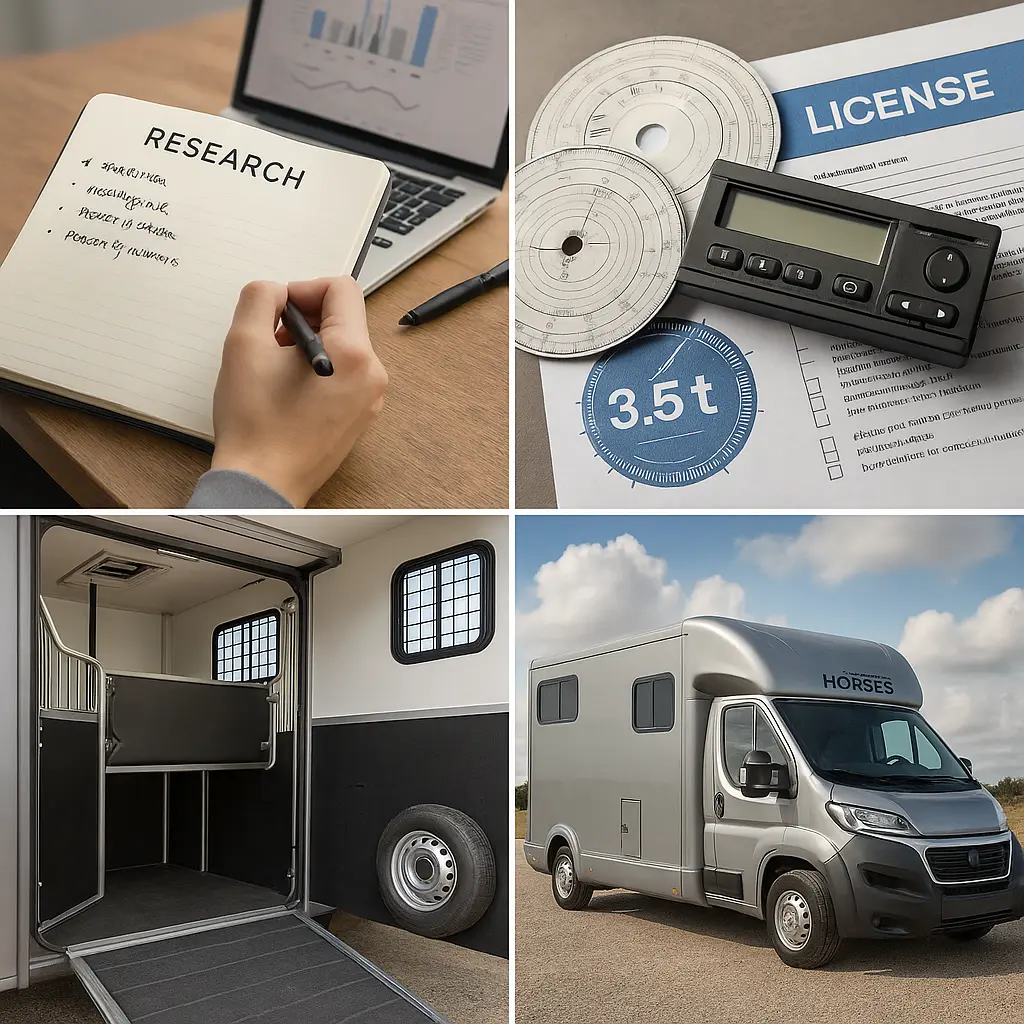
Thinking about hitting the road in a 3.5-tonne horsebox this season? Before you load up, make sure you’re on the right side of UK rules so your horses travel safely — and you avoid roadside headaches.
Key takeaway: For private leisure use, most 3.5-tonne horsebox owners can drive on a car licence, don’t need a tachograph, and don’t need an operator’s licence — but you do need to manage weight, carry the right paperwork, and meet animal welfare standards every time you travel.
Do you need a special licence to drive a 3.5-tonne horsebox?
In the UK, a standard car licence (category B) typically covers driving a 3.5-tonne horsebox, provided the vehicle’s Maximum Authorised Mass (MAM) is 3,500 kg or less.
Check your photocard licence categories and the vehicle’s plate (and V5C) to confirm the MAM. If the horsebox is plated above 3,500 kg, you’ll move into higher licence categories (such as C1), and the compliance picture changes. If you plan to tow with a 3.5-tonne horsebox, ensure both your licence entitlement and the vehicle’s train weight allow it. Many 3.5-tonne horseboxes have limited towing capacity and can breach weight limits quickly once horses, water, fuel, and kit are on board.
Pro tip: Check the manufacturer’s plate in the cab/engine bay for the MAM (and axle limits) and compare it to what’s on your licence. If you’re in doubt, call your insurer and a local weighbridge before your first trip.
When do you need an operator’s licence for horse transport?
If you move horses for hire or reward, you may need a goods vehicle operator’s licence and additional animal transport authorisations; purely private/leisure transport is usually exempt.
“Hire or reward” covers any commercial gain — from paid transport to charging clients as part of a business service. If this applies, check the Traffic Commissioner guidance for operator licensing and the animal transport rules for commercial journeys. You’ll also need the right insurance for business use. Hobby owners who transport only their own horses for leisure activities typically don’t need an operator’s licence, but must still comply with construction standards, roadworthiness, and welfare law.
Quick tip: If money changes hands in any form for the journey, assume commercial rules may apply and get written confirmation from your insurer before you travel.
Do tachographs and drivers’ hours apply to 3.5-tonne horseboxes?
Private, non-commercial horsebox trips are generally exempt from tachographs and drivers’ hours rules; commercial journeys can fall under GB/EU drivers’ hours, especially for international transport.
If you’re transporting horses professionally or as part of a business, check whether GB domestic drivers’ hours or EU rules apply to your vehicle and journey type. Changes being phased in across Europe extend tachograph obligations to more light commercial vehicles used internationally; if you operate outside the UK commercially, expect tighter requirements and plan ahead. For private owners attending lessons, clinics, or shows with their own horses, tachographs typically aren’t required.
Pro tip: Keep a simple log of driving/rest time on longer trips even if exempt — it’s a good safety practice and helps if you’re stopped for a roadside check.
What animal welfare rules apply when transporting horses?
You must plan journeys to protect equine welfare, use competent handlers, and ensure the horsebox, loading, and travel conditions are suitable for your horses.
UK welfare law requires that horses are fit to travel, are loaded and transported safely, and are cared for appropriately throughout the journey. That means safe ramps and partitions, secure footing, adequate ventilation, and sensible journey planning with rest, water, and feed as appropriate. For longer or commercial journeys, additional competence certification, record-keeping, and vehicle standards may apply — check current guidance for your nation (England, Scotland, Wales) and your journey type.
Protect your horse’s legs and tail with appropriate travel protection. Our riders rate purpose-designed horse travel boots and bandages for stability without overheating, and an easy-access grooming kit to clean and check legs at stops. In summer, a breathable fly rug can help keep horses comfortable when parked or queueing; in colder months, consider a light stable rug or weather-appropriate turnout rug if horses will be tied to the box outside.
Pro tip: Pack water from home if your horse is fussy about taste and bring familiar forage; a small tub of favourite treats can help encourage drinking at rest stops.
What paperwork must you carry when transporting horses?
Carry your driving licence, insurance and MOT details, and a valid passport for each horse; commercial operators must also carry their authorisations and journey records.
Keep originals or easy-to-produce digital copies where permitted (for example, insurance certificates). Each horse must travel with its passport. If you transport horses commercially, you’ll also need proof of your authorisations and any required journey logs or competence documents. Store documents in a labelled folder in the cab so they’re ready for roadside checks.
Quick tip: Photograph key documents and store them in a secure cloud folder for backup; it’s not a substitute where originals are legally required, but it speeds up checks and claims.
How do you avoid overloading and payload breaches in a 3.5-tonne horsebox?
Know your plated weights and weigh your horsebox loaded as you actually travel; aim to stay comfortably under the vehicle’s MAM and axle limits.
Overloading is one of the most common issues DVSA finds at shows and sales. Your true travelling weight includes horses, people, fuel, water, tack, hay, feed, clothing, and any extras like generators or dogs. Weigh at a public weighbridge with your normal load — and re-check if you change horses or equipment. Remember axle limits matter as much as total weight; distribute weight evenly, keep heavy items low and forward of the rear axle, and secure everything properly.
Slim your kit to the essentials. Fill water at the venue when possible, and avoid carrying duplicate sets of heavy tack. Travel in your show gear to reduce load — a well-fitting riding helmet, your competition wear from our women’s competition clothing range, and lightweight layers are easier than packing extras. If you need to upgrade to lighter or multi-use pieces, check the value finds in our Secret Tack Room clearance.
Pro tip: Two average adult horses plus fuel and people will push many 3.5-tonners beyond their safe payload. If you regularly travel two, validate your figures at a weighbridge and consider a larger vehicle or travelling one at a time.
What MOT, insurance and maintenance do you need for a 3.5-tonne horsebox?
Your horsebox must be taxed, correctly insured for its actual use, and MOT’d to the right test class; service it on time and keep records to prove roadworthiness.
Check the V5C for body type and confirm which MOT class applies; a 3.5-tonne horsebox is typically tested on the same schedule as comparable light goods vehicles. For vehicles over 3.5 tonnes MAM, you’ll enter annual HGV testing at an authorised facility. Tell your insurer exactly how you use the vehicle — private leisure, business, hire and reward, domestic UK only or international — and confirm tack and horse cover arrangements. Keep maintenance logs, inspect ramps, partitions, latches and flooring regularly, and replace tyres based on age and condition as well as tread depth.
For roadside safety, put a couple of high-visibility vests in the cab so every adult has one to hand. Our rider hi-vis collection makes you easier to spot in poor light if you need to manage horses at the roadside. Add a basic first aid kit, warning triangle, torch, and gloves, and check your jack and wheel brace fit the vehicle.
Pro tip: Build a monthly 10-minute check: tyre pressures and ages, lights, ramp hinges and catches, floor (lift mats), leaks, and partition pins. Small fixes now prevent big problems under load.
What should you pack in your horsebox for safe, compliant travel?
Pack for the horse, the humans, and the roadside: welfare essentials, PPE, documentation, and a breakdown kit.
- Horse passports, insurance and MOT details, plus any commercial authorisations if applicable.
- Travel protection: well-fitting travel boots or bandages, tail guard, and an appropriate rug for the season (turnout or stable).
- Comfort and care: hay, water buckets, spare headcollar and leadrope, a compact grooming kit, and a fly mask or fly rug in summer.
- Calm and focus: familiar forage and, if your vet approves, supportive supplements from trusted brands.
- Rider kit you can move in: your riding boots, competition wear from our comp collection, and breathable jodhpurs and breeches for the drive.
- Safety and roadside: hi-vis, first aid kit, torch, gloves, warning triangle, and a power bank.
- Spare gear: a basic tool roll, duct tape, bungee cords, baling twine, and a sharp knife for emergencies.
- Nice-to-haves: favourite treats, wet wipes, hand sanitiser, and bin bags.
At Just Horse Riders, we see the difference well-chosen kit makes to smooth journeys. If you’re refining your set-up, our curated brands — from hard-wearing Shires yard essentials to soft-touch LeMieux travel gear and weatherproof WeatherBeeta rugs — are a great place to start.
Pro tip: Pre-pack a “load and go” box you never unload: passports, spare headcollar, gloves, twine, tape, torch, triangle, wipes. It lives in the horsebox so you never forget the basics.
Bottom line: keep it simple, safe, and within the rules
For most private UK riders running a 3.5-tonne horsebox, the checklist is straightforward: drive on your car licence, keep your vehicle roadworthy and insured, carry passports, and plan every journey around welfare and weight. If any part of your trip is commercial, stop and confirm what extra licences, authorisations, records, and equipment you need before you roll.
Need to upgrade your travel kit? Our team can help you choose the right travel boots, rugs, and rider essentials so you arrive calm, compliant, and ready to ride.
FAQs
Can I drive a 3.5-tonne horsebox on my car licence?
Yes, in most cases. A category B car licence typically covers vehicles up to 3,500 kg MAM. Always check the vehicle’s plate and your licence categories, especially if you plan to tow.
Do I need a tachograph if I’m just going to clinics and local shows?
Private leisure use is usually exempt from tachographs and drivers’ hours rules. Commercial journeys, particularly international ones, can be different — check current DVSA guidance if you’re paid or operating as part of a business.
Is a 3.5-tonne horsebox enough for two horses?
It depends on your horsebox’s true payload and your horses’ weights. Many 3.5-tonners struggle with two adults plus people, fuel, and kit. Use a weighbridge with your normal load to be sure you’re within limits.
Do I need an operator’s licence as a coach if I transport clients’ horses?
If you move horses for hire or reward as part of your business, operator licensing and animal transport authorisations may apply. Confirm your position with your Traffic Commissioner’s office and your insurer before you transport clients’ horses.
What happens if my horsebox is overloaded?
DVSA can prohibit you from continuing your journey, and overloading can lead to penalties. It also compromises safety and handling. Weigh your vehicle loaded as you travel and aim to stay well under plated limits.
Can I sleep in my horsebox at shows?
Many owners do, but ensure the vehicle’s layout is safe, that ventilation is adequate, and that venue rules allow it. Never compromise horse ventilation or safety for human sleeping space, and follow fire safety best practice.
What welfare essentials should I never travel without?
Passports, water and forage, a spare headcollar and leadrope, appropriate travel protection, and a basic grooming and first aid kit. In summer, consider a fly rug; in cold or wet weather, pack the right turnout or stable rug to keep horses comfortable at the venue.