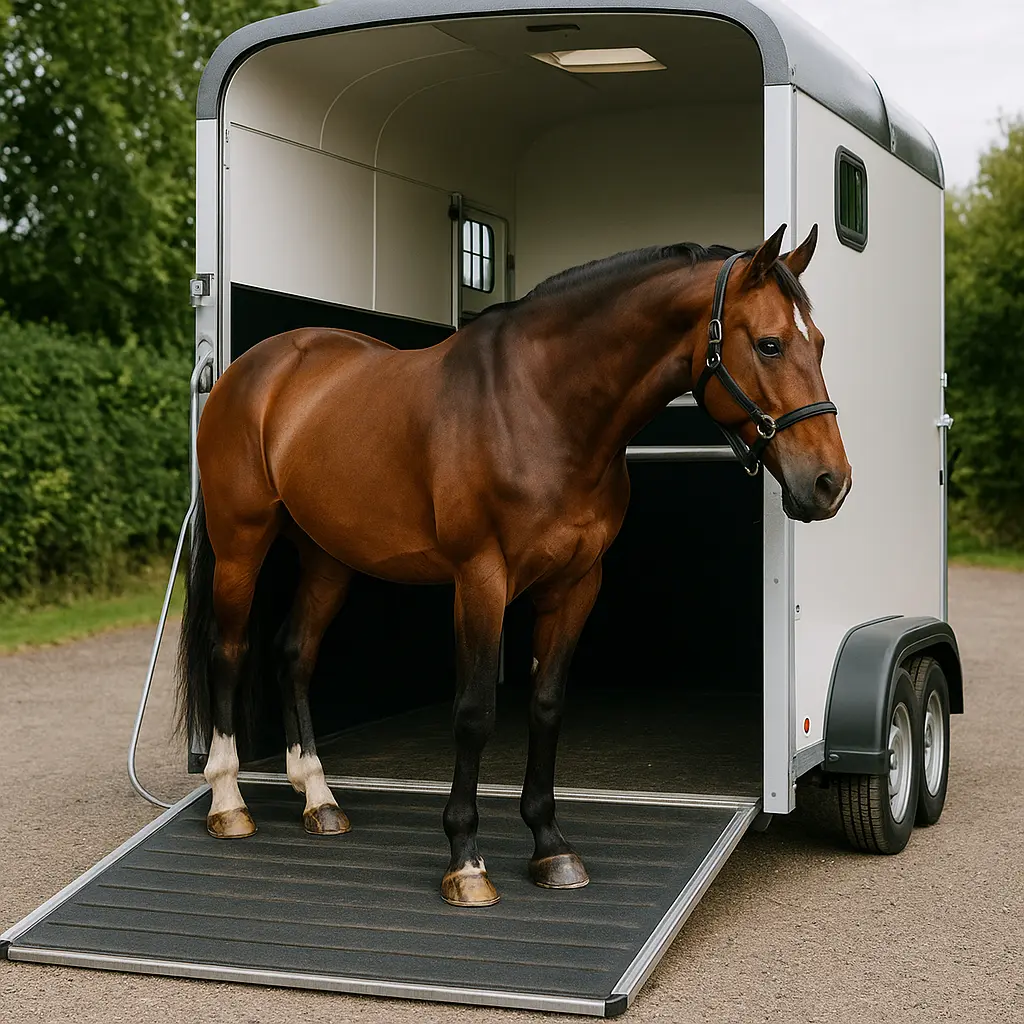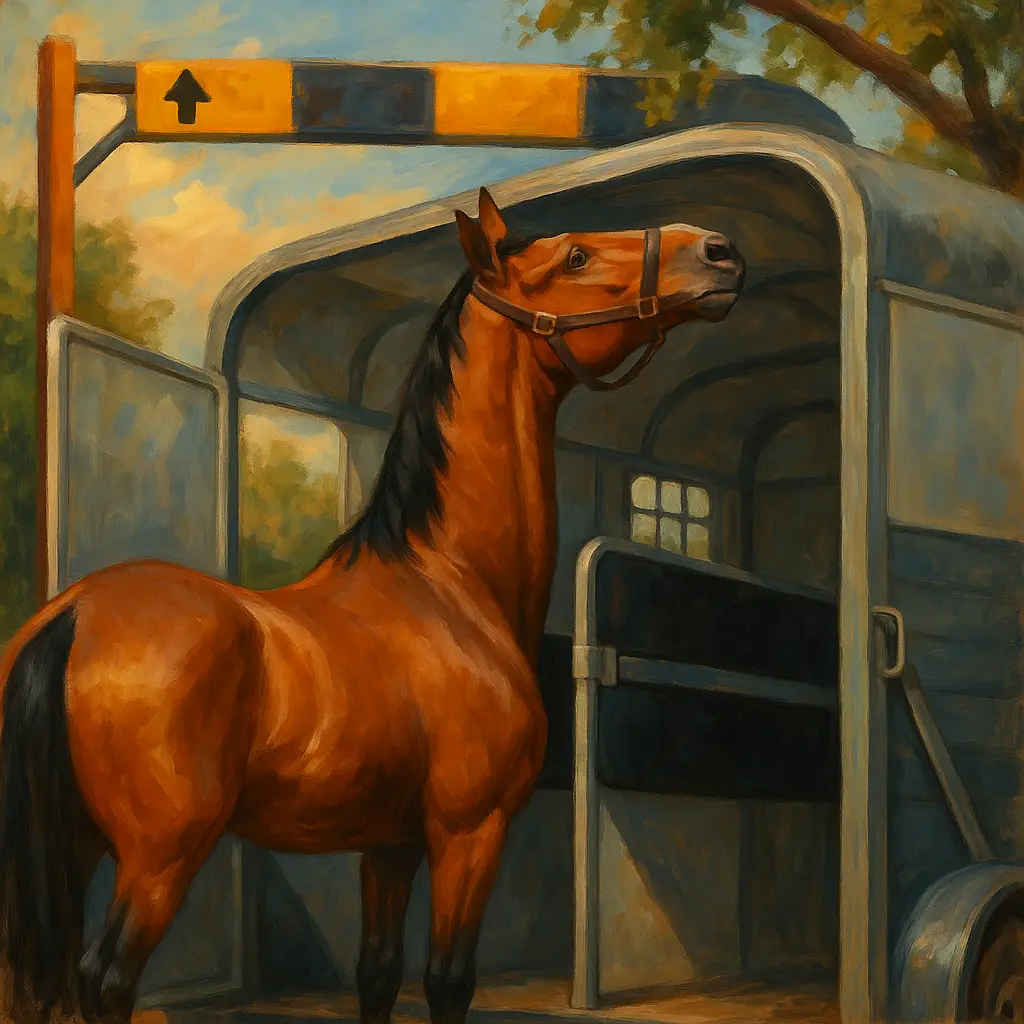
Your horse only gets one head and neck. Choosing the right trailer height and planning for safe overhead clearance protects their airway, balance and confidence every mile of the journey.
Key takeaway: In the UK, the legal minimum internal height is your horse’s withers height plus 75 cm. Add a further 30 cm margin for any overhead obstacles on route to protect your horse and your trailer.
Why trailer height matters and the UK legal minimum
The UK legal minimum trailer or horsebox internal height is the tallest horse’s withers height plus 75 cm. This is a welfare requirement, not just advice, set out in GOV.UK (DEFRA) guidance.
That extra 75 cm gives your horse room to raise and lower their head, clear the ceiling over bumps, and use their neck to balance. World Horse Welfare emphasises that more space improves comfort and reduces the risk of respiratory issues during travel when horses are forced to hold their heads too high.
“The current recommendations for space allowance are 20 cm both sides and 75 cm above wither height. Horses should be able to comfortably move their head and neck up and down; having their head held in a higher position when travelling can increase the risk of respiratory infection.” — World Horse Welfare
Typical UK two-horse trailers have an interior height of about 2.13–2.32 m (7–7 ft 6 in), which suits many horses up to around 15.2–16.0 hands if they meet the legal formula (Farmhouse Tack). Always measure your individual horse: a 15.2hh with withers around 155 cm needs at least 230 cm (7 ft 6 in) internal height; a taller 16hh type may need 235 cm (7 ft 8 in) to comply.
For bigger horses, interior height must increase accordingly. Some US sizing guides suggest 6 ft 8 in (2.03 m) for horses up to 18hh (EquiSpirit), but UK law is stricter: withers + 75 cm is the rule. For very large horses and drafts, that often means moving from a standard trailer to a taller horsebox. The British Horse Society (BHS) notes large horseboxes commonly stand 3.1–4 m high overall (vehicle height), reflecting the increased internal space.
Quick tip: Don’t guess your horse’s height in hands. Measure with a stick and convert to centimetres. The legal formula is in cm, so work in cm for precision.
How to measure your horse and your trailer correctly
Measure your horse’s withers height on level ground, then add 75 cm to get your minimum internal height. Next, confirm your trailer’s internal height from floor to roof at the highest point and compare.
Follow this simple process:
- Measure withers height to the top of the shoulder using a measuring stick or tape, in centimetres.
- Add 75 cm (29.5 in). That’s your legal minimum internal height requirement.
- Measure your trailer’s interior height, interior width and stall length. Don’t rely on memory or sales brochures—measure it.
- Write the exact dimensions in metres and feet on a laminated card and keep it in the cab.
For hands-on measuring, a sturdy tape is ideal; browse grooming and yard essentials to keep your kit organised: grooming and yard tools.
As a quick reference:
- Example: 15.2hh with 155 cm withers → 155 + 75 = 230 cm (7 ft 6 in) minimum internal height.
- Example: Compact 16hh with 160 cm withers → 160 + 75 = 235 cm (7 ft 8 in) minimum internal height.
Also check stall length and width. EquiSpirit advises around 11 ft (3.35 m) stall length for tall horses up to 18hh and 12 ft (3.66 m) for heavy drafts, with stronger axles, floor supports and tyres for weight and stability (EquiSpirit).
“Ensure the trailer’s interior height is several inches higher than your horse’s withers to allow for comfort and head movement.” — Farmhouse Tack
Pro tip: If you buy second-hand, ask for the original spec sheet and measure everything yourself. If dimensions don’t match, walk away.
Safe clearance on UK roads, bridges and venues
You should maintain at least 30 cm clearance above the highest point of your trailer or horsebox before passing under any structure. If you can’t confirm that margin, don’t proceed.
Why 30 cm? Road surfaces vary, tyres compress over bumps, and suspension travels. That buffer protects both your horse and your roofline. The BHS highlights that small horseboxes often stand 2.6–3.0 m high and large horseboxes 3.1–4.0 m overall, and many rural approaches were never designed for vehicles above 3.0 m (BHS guidance).
Plan routes with height in mind:
- Use satnavs or apps with height and weight restrictions to avoid low bridges and unsuitable lanes.
- Before a new venue, phone ahead to ask for lowest bridge/barrier heights and tight gateway turns.
- Do a slow “dry run” if possible. Stop and measure doubtful obstacles with a tape or marked pole—never guess. If in doubt, read our towing safety checklist.
Seasonal note: UK hedgerows and tree canopies can drop 30–50 cm into the carriageway by mid-summer, while winter storms leave partially fallen limbs at dangerous heights. Assume overhanging branches are hazards; choose another route or ask landowners/councils to address obstructions.
Quick tip: When you’re out on foot checking a lane or yard approach, wear high-visibility gear for safety. Our rider hi-vis collection keeps you seen on busy or narrow roads.
Stall width, length and partitions: what your horse needs
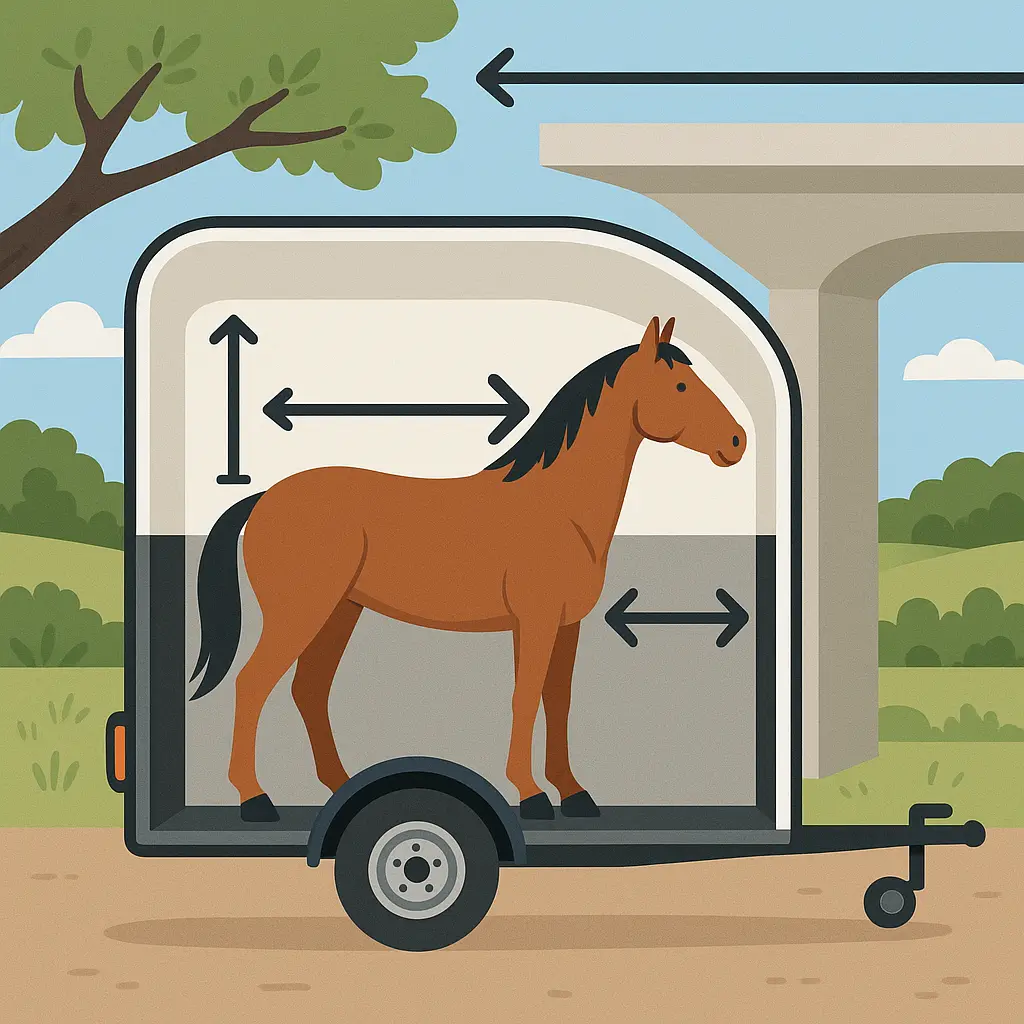
Horses need at least 20 cm (8 in) of free space on each side and 75 cm above the withers to balance and travel comfortably. Narrow stalls and tight partitions increase fatigue and risk of slips.
World Horse Welfare recommends wider stalls so horses can spread their legs and use their neck to stabilise. Allow adequate headroom and avoid fixing the head high for long periods to reduce respiratory risk.
Key points:
- Side clearance: aim for 20 cm free space on both sides of the widest point (World Horse Welfare).
- Stall length: around 11 ft (3.35 m) for big horses up to 18hh; 12 ft (3.66 m) for heavy drafts (EquiSpirit).
- Position your horse square and centred. Avoid loading too far forward or at an acute angle if roof height is tight—raising the head to rebalance can reduce clearance.
- Use appropriate travel protection. Travel boots and tail guards protect limbs and dock during braking and cornering—see our horse boots and bandages.
Pro tip: Keep partitions wide and ties long enough for natural head and neck movement without allowing the nose to drop near the floor.
Towing: matching vehicle, legalities and speed limits
Stay within 80% of your vehicle’s rated towing capacity and obey UK towing speed limits: 50 mph on single carriageways, 60 mph on dual carriageways and motorways.
Staying at or below 80% of your tow rating helps maintain braking, steering and stability when you need to crawl under trees, reverse off a low bridge approach or make an evasive manoeuvre. Overloading compromises control at exactly the wrong moment.
Know your legal duties:
- Minimum internal height = withers height + 75 cm (UK law). Horses must not be carried on more than one deck (GOV.UK (DEFRA)).
- Commercial use and 3,500 kg thresholds: you’ll usually need a goods vehicle operator licence if you transport for commercial purposes with a combined gross plated weight over 3,500 kg (GOV.UK).
- Speed limits when towing: 60 mph on motorways/dual carriageways, 50 mph on single carriageways, which can add 20–30% to journey times on rural routes (Moving Manes).
At Just Horse Riders, we recommend planning travel days as if every mile could involve a slow detour for a height restriction. Build in generous time and hydration stops, and keep horses comfortable with the right seasonal layers—fly protection in summer and warm, breathable layers for winter hold-overs at showgrounds. Explore fly rugs for summer travel and winter turnout rugs for pre- and post-journey comfort.
Pre-journey route planning and seasonal checks
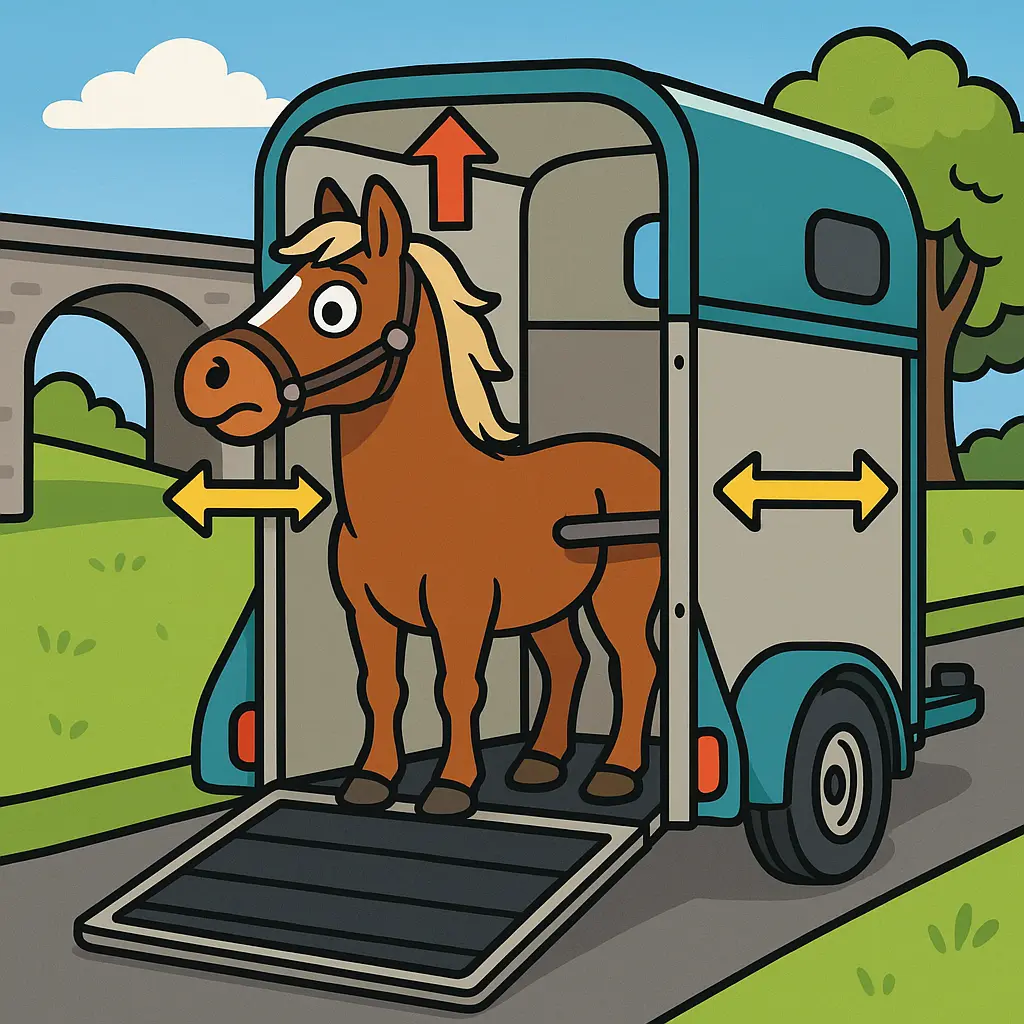
Always do a “dry run” of your route and leave at least 30 cm overhead margin at every known low point. If you haven’t checked it, don’t drive under it.
Build this routine before each trip:
- Confirm your trailer’s exact height (including any roof vents, racks or camera pods) and write it on a dash label.
- Check the route for low bridges, barriers and tree growth. Phone venues for approach details and the tightest turn/lowest arch measurements.
- After storms or high winds, assume fallen limbs. Never try to brush through light branches—many hide solid boughs at windscreen level.
- Walk tricky access on foot first when safe to do so. Use hi-vis and carry a measuring pole or tape.
- Do a loaded test (sandbags or water drums) to simulate suspension travel if you’ve never taken that route.
Pro tip: Keep treats handy to reward calm loading/unloading during route checks or detours. Our popular horse treats make positive reinforcement easy on the move.
When your horse is too tall: options and upgrades
If your horse’s withers + 75 cm exceeds your trailer’s interior height, you need a taller solution—full stop. For borderline cases, don’t “make do”: an anxious horse that can’t drop its head will travel poorly and risks injury.
Your options:
- Move to a taller trailer model (7 ft 6 in to 7 ft 8 in internal height) if within legal formula for your horse.
- Hire or purchase a horsebox with sufficient headroom; BHS notes large horseboxes commonly stand 3.1–4.0 m overall, offering greater internal heights (BHS).
- For drafts approaching 19hh and ~2,000 lbs, plan for around 8 ft (2.44 m) internal height and a 12 ft (3.66 m) stall, plus upgraded axles, floor supports and tyres (EquiSpirit).
“Be careful if a trailer company does not have various model sizes in their lineup, but is just adding footage and width without upgrading tires, floor structure, axle rating, and re-engineering the balance of the trailer.” — EquiSpirit
Never compromise structural integrity or load rating to chase more space. Increased height and length change the trailer’s centre of gravity and stress on components—speak to the manufacturer and request proof of axle and floor capacity for your horse’s weight and size.
Quick tip: If you’re between sizes, err larger. Horses travel better with more headroom and a little more width than with less.
Practical kit to make height and clearance easy
These low-cost additions make measuring, planning and safe travel simpler:
- Measuring kit: Keep a 5–10 m tape for withers height, interior height and bridge checks. Organise stable-side tools with our grooming and yard accessories.
- Laminated dimension card: Record interior height/width, stall length, and overall vehicle height in metres and feet; mount on your dash.
- Satnav with height filters: Use HGV/horsebox-friendly routing to avoid low bridges and weight-restricted lanes.
- Magnetic clearance pole or hi-vis cord: Test doubtful arches before you commit; wear hi-vis for roadside safety.
- Travel protection: Fit quality travel boots and tail guards from our horse boots and bandages range to protect during braking and turns.
- Seasonal layers: Summer journeys need airflow and fly defence; winter waits need warmth. Browse fly rugs and sheets and trusted brands like WeatherBeeta for breathable comfort.
- Show-day comfort: For those long, weather-exposed holds, consider an extra stable layer from turnout rug collections to keep muscles warm.
At Just Horse Riders, we recommend keeping a compact travel first-aid kit onboard and a pair of gloves and hat for handlers. If you step out to check a low bridge on a busy road, behave like a road worker: be seen, be methodical, and never guess heights.
FAQs
How do I know if my trailer is tall enough for my horse?
Measure your horse’s withers height and add 75 cm—the UK legal minimum internal height. Compare that figure to your trailer’s internal height. For example, a typical 16hh horse (155–160 cm at the withers) needs about 230–235 cm (7 ft 6 in–7 ft 8 in). Source: GOV.UK (DEFRA) and World Horse Welfare.
What’s a safe overhead margin under bridges or trees?
Leave a minimum 30 cm clearance above your trailer or horsebox’s highest point to account for surface variation, suspension movement and error. If you can’t verify at least 30 cm, do not proceed. Guidance informed by BHS practical advice.
What should I do if I’m unsure about clearance under a structure?
Stop, exit safely in hi-vis, and measure with a tape or marked pole. Check against your vehicle’s recorded height (include any roof racks/vents). If in doubt, find an alternative route or proceed only with a ground guide. See our towing safety guidance for more tips.
Can overhanging branches damage my trailer or injure my horse?
Yes. Branches can puncture roof panels and vents; a limb striking the horse can cause injury and panic. After storms, treat any partially fallen tree as a severe risk and avoid. Source: World Horse Welfare and BHS good practice.
Are there specific regulations about trailer height in the UK?
Yes. Minimum internal height must be 75 cm above the tallest horse’s withers, and horses may not be transported on more than one deck. Commercial transport over 3,500 kg combined may require an operator licence, and different licence categories may apply for heavier vehicles. Source: GOV.UK.
How often should I re-check my trailer’s height and dimensions?
After any repair or modification (roof racks, vents, aerials), annually before show season, and seasonally to reflect vegetation growth on routes. Keep a laminated card with exact heights in metres and feet in your cab.
My tall horse fits with millimetres to spare. Is that acceptable?
No. Meeting the legal minimum doesn’t guarantee practical safety under real-world bumps and rebalancing. Increase headroom or use a taller horsebox so your horse can lower its head and travel comfortably, and maintain a 30 cm overhead margin for any route obstacles.