Few things spike the stress levels faster than hitching up for a show, only to find your trailer lights playing up. Good lighting isn’t just convenience — it’s the difference between a safe journey and a roadside stop with a horse on board.
Key takeaway: In the UK, your horse trailer must have fully working lights and reflectors every time you tow — check them before you roll, carry basic fix-it kit, and sort recurring faults with a professional.
Are trailer lights a legal requirement in the UK?
Yes — UK law requires all trailers used on public roads to have working lights and reflectors. Driving with faulty or missing trailer lights risks penalties and, more importantly, compromises safety for you, your horse, and other road users.
Under long-standing UK road vehicle lighting rules, your horse trailer must display correct-colour lights that are clearly visible and securely mounted. Enforcement and roadside checks fall under agencies such as the DVSA, and guidance appears in the Highway Code. Treat light checks as part of your routine pre-journey safety, just like tyre pressures and breakaway cables.
The British Horse Society (BHS) consistently highlights transport preparedness as critical to equine welfare. If you do end up on the hard shoulder, working lights — especially indicators and a fog/rear lamp in poor visibility — make you much more visible while you get your horse safe.
What lights must your horse trailer have working before you set off?
Your horse trailer must display working tail lights, brake lights, indicators, a number plate light and red rear reflectors. Many trailers also require a rear fog lamp; front white reflectors are commonly fitted.
Here’s the simple checklist most UK horse trailers should meet:
- Two red tail (side) lights at the rear
- Two red brake (stop) lights that brighten only when braking
- Left and right amber indicators, plus hazard function
- A white number plate light to clearly illuminate the trailer’s plate
- Two red rear reflectors (triangular on many trailers)
- A rear fog lamp for reduced-visibility conditions (commonly required)
All lenses must be intact, correctly coloured, and clean. If you’ve recently power-washed or driven in heavy rain, water can sit behind lenses and around bulb holders — a common cause of intermittent faults. Wipe lenses dry and give the plug and socket a quick look each time you hitch up.
How do you run a 5-minute pre-journey trailer light check?
Do a quick two-person check of all lights every single time you hitch up. One person sits in the tow vehicle, the other stands safely behind the trailer to confirm each function.
Use this fast routine:
- Plug in the trailer’s electric connector, hitch up fully, and check your breakaway cable is correctly attached.
- With the handbrake on, switch on vehicle sidelights: confirm both rear tail lights and number plate light are on.
- Press the brake pedal: confirm both brake lights illuminate and look brighter than the tail lights.
- Indicate left, then right: confirm each flashes clearly and at the correct speed. Test hazards too.
- If fitted, switch on rear fogs: confirm a solid bright red lamp at the rear.
- Walk around to check reflectors are clean and secure; ensure nothing inside the trailer has shifted to press against wiring runs.
Quick tip: If you’re solo, reverse towards a reflective surface (stable wall, garage door) in low light and use hazards and brakes to spot obvious failures. It’s not foolproof, but it’s better than skipping the check.
What are the most common trailer light faults and quick yard fixes?
Most trailer light problems come down to a poor earth, blown bulbs, corroded connectors, damaged wiring near moving parts, or a blown tow-vehicle fuse. A calm, methodical approach solves many issues in minutes.
Work through these practical checks:
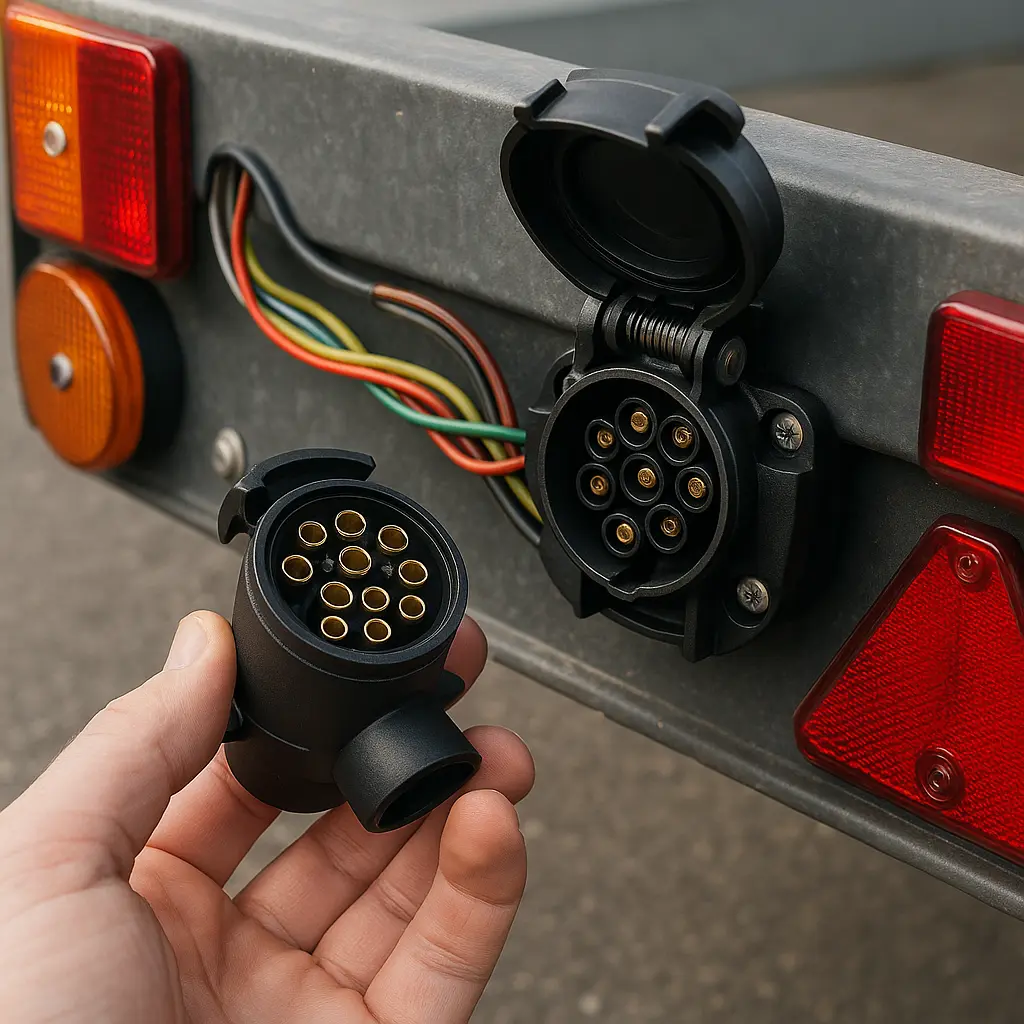
- Connector cleanliness: Dirt, rust, and moisture inside 7‑pin or 13‑pin plugs and sockets cause half the problems you’ll meet. Dry the plug, gently clean with contact cleaner, and ensure pins are straight. A light smear of dielectric grease helps keep moisture out.
- Blown bulbs or failed LEDs: Traditional bulbs blow; LEDs rarely fail but their wiring can. Carry spare bulbs if your trailer uses them and replace like-for-like. If an LED unit is out, swap the whole sealed unit.
- Bad earth (ground): A poor earth often shows as dim or flickering lights, indicators glowing when brakes are pressed, or multiple lights behaving oddly. Look for the earth wire connection to the trailer chassis; clean and retighten it.
- Tow-vehicle fuses: If all trailer lights are dead, check the towing electrics fuse in your vehicle. Many modern cars have a dedicated towing module with its own fused circuit.
- Wire damage at hinges and corners: Wiring looms near ramp hinges, inside lamp housings, and under the floor are vulnerable. Look for crushed or chafed sections and secure them away from moving parts.
- Water ingress: After pressure washing or heavy rain, trapped water inside lamp units or the plug can cause intermittent faults. Dry, reseal with a fresh gasket where needed, and keep drains in lamp housings clear.
- Mixed lamp types: Some modern vehicles “sense” bulbs and may misread low‑draw LED trailer lights. If only the indicators flash too quickly or the car reports a bulb failure with LEDs fitted, seek advice from a towing electrics specialist for a vehicle‑specific solution.
Pro tip: Label your trailer’s light circuits inside the rear lamp housings with a small diagram or note. The next time something fails, you’ll know which wire feeds which lamp and where to test first.
7‑pin vs 13‑pin: which plug should your horse trailer use?
UK trailers commonly use either 7‑pin or 13‑pin plugs; if your car and trailer differ, carry a good‑quality adapter and keep all connections clean and dry. The plug type doesn’t change the legal requirements — it just affects how the lights connect and, on some setups, which extra functions are available.
Here’s how to stay out of adapter trouble:
- Identify what you have: Check your trailer plug and your vehicle socket before show day. A quick phone photo of each saves surprises later.
- Buy a quality adapter: Cheap adapters often corrode faster and have weaker springs in their contacts. Keep the protective cap on when not in use.
- Secure the join: Support the cable and adapter so bumps don’t tug on the plug; strain can loosen pins and create intermittent faults.
- Keep it dry: Store the adapter in a zip bag when not in use and wipe it after wet drives.
- Test everything: After connecting via an adapter, always run the full light check before loading your horse.
If your lights work on one vehicle but misbehave on another, the culprit is often a dirty/loose connection, a wiring difference in the tow vehicle’s electrics, or a fuse. Systematically clean, reseat, and test before assuming a bigger fault.
When should you call a professional auto electrician?
Book a qualified towing-electrics specialist if lights are intermittent, fuses keep blowing, multiple circuits fail at once, or you smell overheated wiring. Persistent faults usually point to deeper wiring or module issues that need proper diagnosis and safe repair.
Look for technicians experienced with towing electrics and trailers. Bodies such as the National Trailer & Towing Association (NTTA) and guidance from the DVSA and BHS emphasise the importance of correctly installed, robust trailer wiring. A pro can test the tow vehicle socket, the trailer wiring loom, and each lamp unit to pinpoint the issue — and advise on corrosion-resistant replacements where needed.
At Just Horse Riders, we recommend scheduling a preventative electrics check ahead of the busy spring and summer show seasons. A quick expert inspection now is far cheaper than a missed class and a stressed horse later.
What safety and repair kit should you carry on every trip?
Carry a compact light-repair kit and roadside safety gear on every journey. A few inexpensive items turn most lighting hiccups into a 5‑minute fix rather than a cancelled day out.
- Contact cleaner, small wire brush, and dielectric grease for plugs and sockets
- Spare bulbs (if applicable), assorted fuses for the tow vehicle, and a basic screwdriver set
- Insulating tape, small cable ties, and a short length of spare automotive wire
- Head torch and disposable gloves
- Hi‑vis waistcoat for you and any helper — see our rider hi-vis collection
- Wheel chock and a good-quality jack suitable for your trailer
- Equine travel boots and a tail guard to protect your horse if you need to unload roadside — browse horse travel boots & bandages
- Horse calmer (if appropriate) and a few favourite morsels to keep loading relaxed — explore calming supplements and horse treats
Quick tip: Keep this kit in a bright, grab-and-go bag stored by your tow bar. In wet or dark conditions you’ll find it fast.
For cooler months, a lightweight rug helps your horse stay comfortable if you’re delayed. Choose based on weather on the day — a breathable option in damp conditions from our turnout rugs selection, or an insulating layer from our stable rugs range for frosty mornings. Popular travel-friendly picks are available from brands like WeatherBeeta and LeMieux.
If you’re kitting out on a budget before show season, check our rotating deals in the Secret Tack Room clearance.
What pre‑travel routine keeps light checks quick and your horse calm?
A calm, consistent loading routine makes your 5‑minute light check safer and faster. Getting organised before you hitch up reduces time pressure and stops small lighting niggles becoming big delays.
Use this simple flow:
- Prepare the tow vehicle: Hitch point cleared, socket cap removed, electrics ready to plug in.
- Set your safety gear out: Hi‑vis on, wheel chock ready, head torch accessible — our hi‑vis range is ideal for early starts and dusky finishes.
- Run the full light check before loading: Confirm lights first so your horse doesn’t stand on the box while you troubleshoot.
- Protect your horse for loading: Fit travel boots and tail guard from our horse boots & bandages selection. If your horse is sharp, consider wearing a helmet during loading — see our riding helmets.
- Keep loading positive: A small handful from our treats collection and, where appropriate, a proven calmer from supplements can help maintain a low-stress routine.
- Dress comfortably for the drive and unload: Good footwear matters around ramps and at service stops — browse supportive riding and yard boots.
On wet days, plan for extra time to towel connectors dry after hitching and before the light check. A minute here often prevents 10 minutes of head‑scratching later.
FAQs
Do I need a rear fog light on my horse trailer?
Many UK trailers require a working rear fog light for reduced-visibility conditions. If your trailer has one fitted, it must work — include it in every pre‑journey check.
My indicators flash quickly when the trailer is connected — what does that mean?
Rapid flashing usually signals the car thinks a bulb has failed. Start by cleaning and reseating the trailer plug, then check the trailer’s indicator bulbs or LED units. If all looks fine, check the tow-vehicle’s towing-electrics fuse and seek advice from a towing electrics specialist.
Can I tow if just one light is out?
No — you should not tow until all legally required lights work correctly. It’s a safety risk and may attract penalties. Use your repair kit to fix simple issues or switch vehicles if you can’t resolve it quickly.
Why do my trailer lights work with one car but not another?
Common reasons include a dirty or loose connector, different wiring or towing modules in the vehicles, or a blown fuse in one car. Clean and dry all connectors, test again, and if the issue persists, have both the tow socket and the trailer wiring checked.
How often should I service trailer electrics?
Do a quick functional check every tow, a visual inspection of wiring and lamp housings monthly in heavy use, and a thorough professional inspection at least annually — especially before the busy spring-summer season.
Is LED better than bulbs for trailer lights?
LED units are sealed, bright, and more resistant to vibration and moisture than filament bulbs. They reduce bulb-blow issues but still rely on good wiring and clean connectors. If upgrading, choose quality sealed units and have them fitted by a competent technician.
What should I wear if I have to stop roadside with my horse?
Visibility and footing are key: slip on a hi‑vis waistcoat from our hi‑vis range, wear sturdy yard or riding boots, and consider a helmet if handling an anxious horse near traffic. Keeping yourself safe helps you look after your horse.