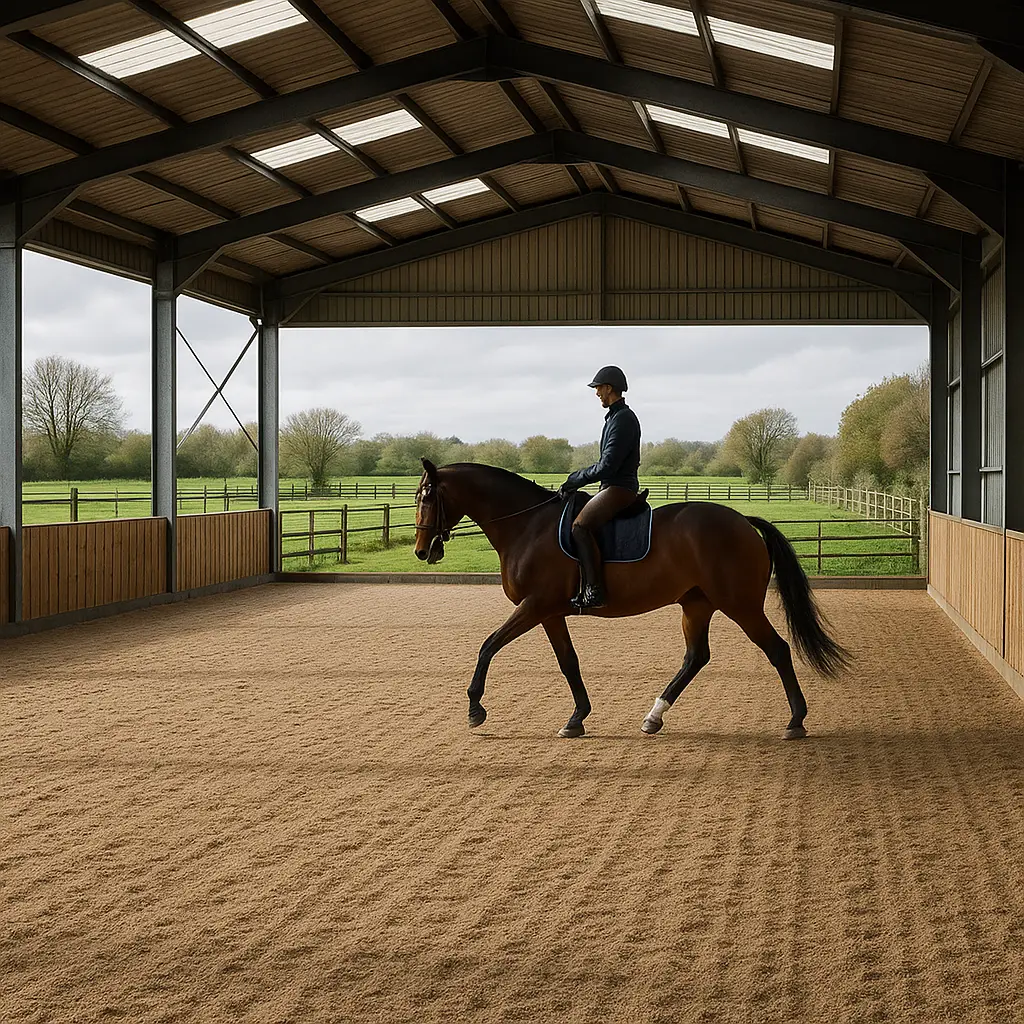
Wet winters and short daylight can stall your riding just when your horse needs consistent work. If you’ve got limited space and a realistic budget, the right small arena can keep you training all year in the UK.
Key takeaway: On most small UK yards, a well-built 20m x 20m to 20m x 24m sand arena with good drainage and lighting will safely cover daily schooling for ponies and small horses; extend the length toward 20m x 40m as space and budget allow, and consider an indoor only if winter access and reliability justify the higher cost.
What size arena do you really need on a small UK yard?
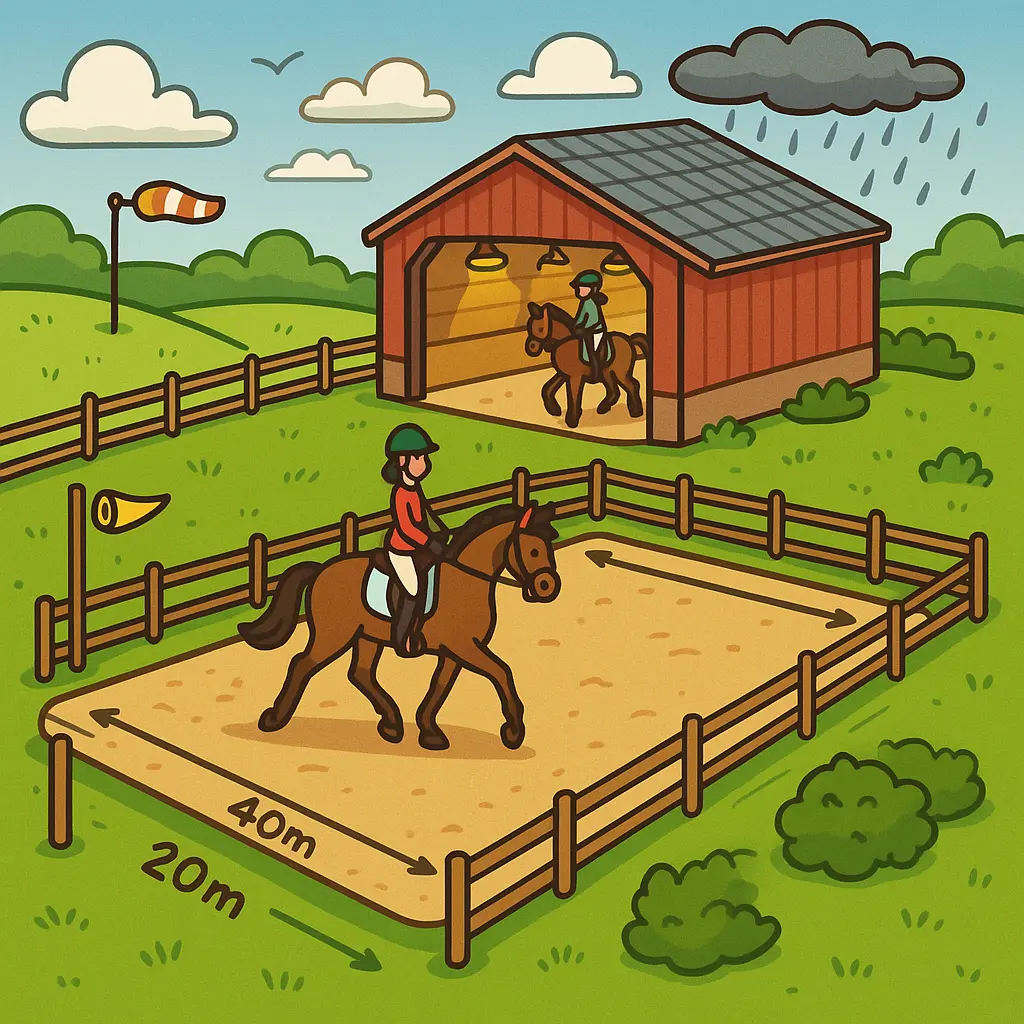
A 20m x 20m arena is the practical minimum for small-horse dressage training at home; 20m x 24m rides much better, and 20m x 40m is the standard “small dressage” rectangle if space and budget stretch.
For many UK owners juggling livestock rotation and winter mud, you often can’t rely on fields during the wet months, making an arena essential for year-round work on small properties (Horse & Hound Forum). Community experience shows 18m x 24m and 20m x 24m are viable for lunging, low-level flatwork, and children’s riding at home when a full 20m x 40m isn’t affordable. Formal dressage layouts start at 20m x 20m for training and scale upward to the standard 20m x 60m (Performance Footing), but that larger footprint isn’t necessary for effective day-to-day schooling on small horses.
If your available footprint is closer to 15m x 30m (about 50ft x 100ft), it’s still usable for flatwork on ponies around 14.3hh–15.1hh, though tight turns will limit some movements; if you can, extend length for more comfortable lines and better horse balance (Chronicle of the Horse Forum). On tight plots, prioritise length over width to give yourself a more useful long side for transitions, lateral work, and poles. That single decision can make a compact arena ride “bigger” immediately.
Quick tip: If you’re building in phases, set your earthworks and drainage to accommodate a future extension. Start with 20m x 24m, ride it for a season, then add length when funds allow.
Indoor vs outdoor: which comes first for UK winters?
Outdoor sand arenas are the most budget-friendly way to secure daily schooling; an indoor adds year-round reliability in UK rain, wind, and snow but comes with significantly higher upfront costs.
The UK’s wet, windy winters and short days (often under eight hours of daylight in Dec–Jan) routinely cancel outdoor schooling, making covered or indoor spaces highly desirable for consistent programmes (Horse Riding Arena UK). As trainer Sarah Miller notes:
“Indoor arenas are a game-changer... They allow me to maintain a consistent training schedule with my horse, no matter the weather. The controlled environment and even footing give me peace of mind.”
However, many private UK set-ups start with an affordable outdoor sand arena, adding a cover or indoor structure later once the base and drainage prove themselves. Sand is cost-effective and drains well, but plan for moisture management to control dust and maintain hoof support (Performance Footing). Indoors, you’ll gain weather protection and better lighting, but you must budget for ventilation, safe kickboards, and lighting control to avoid glare during evening schooling (EquiPro Surfaces).
Pro tip: If winter field access is often impossible where you live, an indoor or covered arena can save your horse’s fitness through Jan–Feb. If your winters are merely “muddy but manageable,” a well-drained outdoor with good lighting is usually the smarter first step.
The best footing for small arenas on a budget
Washed, well-graded sand is the most affordable footing that drains well in UK weather; it demands regular watering and maintenance to keep dust down and depth consistent.
Sand alone can ride beautifully when correctly specified and maintained, and it’s the go-to footing for many UK outdoor arenas on a budget (Performance Footing). The key is consistency: correct particle size, uniform depth (often around 7–10 cm for pure sand), and robust drainage layers beneath. Without moisture, even good sand dries, becomes dusty, and loses stability—so plan access to water or a bowser during dry spells.
Discipline matters, too. As Mark Neihart of Premier Equestrian explains:
“Not every arena is suitable for every single discipline. The surface interacts differently... Dressage horses require grip and stability, while jumping horses need cushioning.”
On small arenas, horses turn more frequently, so the interaction between hoof and surface has an even greater impact on tendons and joints. Neihart also reminds us:
“Arena footing is probably the most important part of any equestrian facility, because it will have the greatest impact on the horse’s health over the long term.”
If you’re schooling dressage basics on small horses and ponies, keep the surface shallow and consistent for reliable grip. If you incorporate small grids or cavaletti, ensure the top layer doesn’t “grab” or bog the foot on landing. For additional limb support during schooling or polework, consider appropriate leg protection and brushing boots from our curated horse boots & bandages collection.
Quick tip: Walk your arena daily the first season. Rake back displaced sand on the track, check depth with a simple marked stick, and water before dust appears rather than after—it’s far easier to maintain moisture than to recover it.
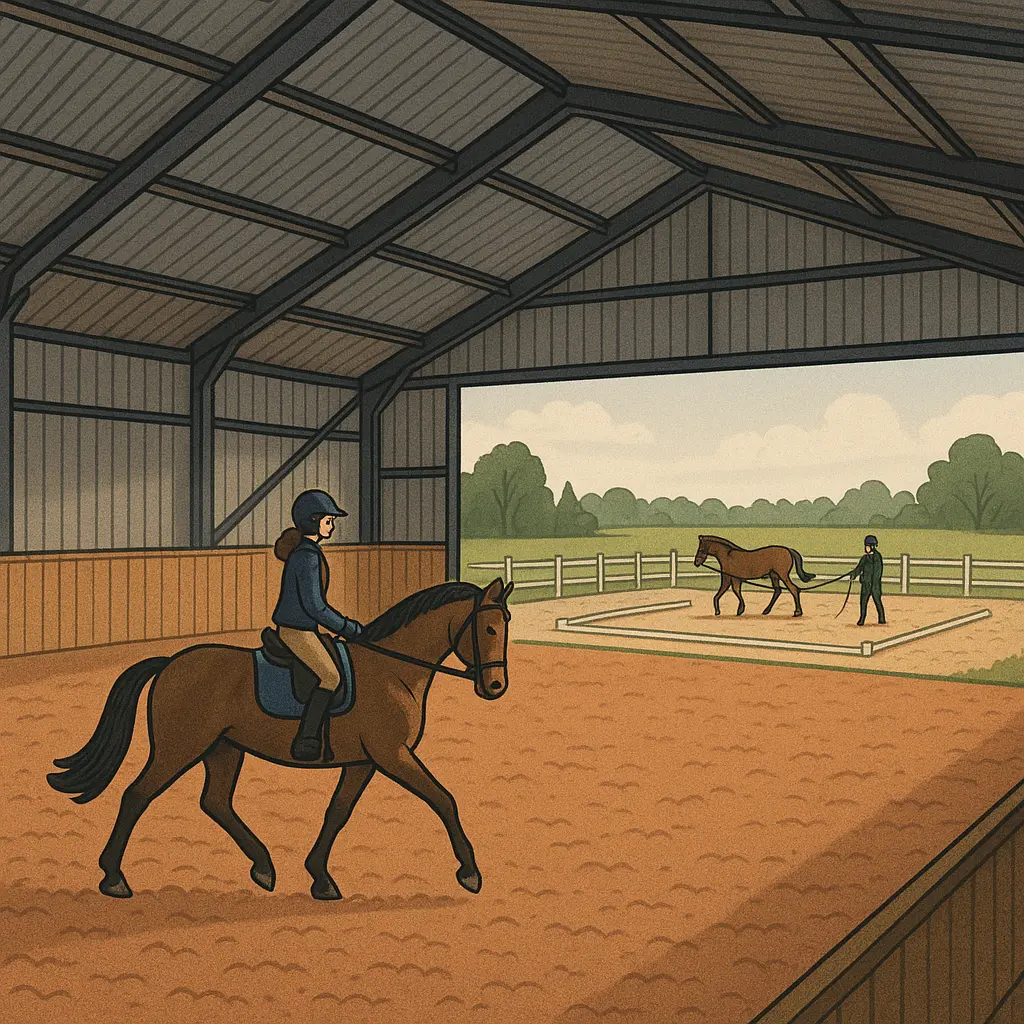
Design tips that make small arenas ride bigger
Prioritise length, safe boundaries, clear markers, mirrors, and good lighting to make compact arenas ride larger and more effective.
Start by stretching the long side: 20m x 24m rides significantly better than a square 20m x 20m because it gives you room for transitions, lateral lines, and pole patterns without constant turning. Low, solid kickboards or safe fencing help horses stay straight, while clear, portable dressage letters keep schooling accurate without permanent structures (handy if your yard shares space with livestock or needs flexible use).
Lighting is transformative in the UK. Even on an outdoor, correctly placed, glare-free lighting extends safe ride time through winter’s short days. If you opt for an indoor or covered space, design lighting that avoids hard shadows and ensure good ventilation to control condensation.
Mirrors, if you can add them, multiply the training value of a small arena by making straightness and self-carriage “visible” without a ground person. Place them safely and high enough to avoid kick damage. For rider safety and confidence—especially when riding alone—use a properly fitted, standards-compliant helmet from our range of riding helmets.
Pro tip: In small spaces, tidiness is training. Keep poles stored neatly, rake corners, and place markers so figures are easy to ride precisely—precision makes any arena feel bigger.
Training smart in 20x20–20x24m: weekly plan ideas
A small arena supports varied, effective schooling by emphasising transitions, lateral lines, thoughtful polework, and short, focused sessions.
Here’s a simple, small-arena-friendly weekly structure for ponies and small horses (adjust to your horse’s level and fitness):
- Day 1 – Straightness and rhythm: Large circles (18–20m), centreline halts, transitions every quarter line. Ride from letter to letter to sharpen accuracy.
- Day 2 – Lateral basics: Leg yield on the quarter line, shoulder-fore on long sides, shallow loops that preserve balance in tight spaces.
- Day 3 – Poles and proprioception: A simple line of three poles on the long side (3–3.3m apart for walk, 1.1–1.3m for trot depending on stride), raised cavaletti once balance is confirmed.
- Day 4 – Lunging and voice aids: A 20m circle is ideal; if your space is 18m x 24m, lunge diagonally to keep the circle wide. Use a cavesson and a proper whip for clarity and safety.
- Day 5 – Suppling and stretch: Serpentines, figure-eights, and a long, low stretch to finish, keeping reins elastic and rhythm unbroken.
Children and novice riders particularly benefit from the controlled environment of a 20m x 24m during winter when the fields are slick. Dress the part for comfort and security: supportive, grippy lower layers make a difference when schooling lots of transitions. Explore our breathable, durable women’s jodhpurs & breeches and comfy, hard-wearing children’s jodhpurs & breeches.
Quick tip: Keep sessions short (25–35 minutes of purposeful work) in compact arenas to reduce repetitive strain from frequent turns, especially in young or rehab horses.
Winter-proof your programme when daylight is short
Fit reliable lighting and plan efficient pre/post-ride routines with the right rugs and grooming to maintain work through the UK’s sub‑8‑hour daylight in mid-winter.
From December to January, safe evening schooling depends on two things: visibility and warmth. For lighting, aim for even, shadow-minimising coverage and reliable switching so you’re not wasting power. Indoors, add ventilation to keep air fresh and manage condensation on cold nights. Outdoors, windbreaks at the prevailing-wind side improve comfort and reduce chill.
Keep horses warm when they’re clipped or standing around in winter winds with well-fitting turnout rugs for the yard-to-arena walk and post-ride cool-down. After work, a quick flick and pick-out makes a big difference to skin health. Our curated grooming range helps you whisk away sweat and mud quickly so your horse doesn’t chill before you rug back up.
Pro tip: Set a “winter arena kit” by the gate—hoof pick, sweat scraper, spare cooler, pole block, reflective cones—so you can set up and pack down in minutes when daylight’s fading.
Health and safety: protect joints, backs and riders
Consistent footing depth, sensible exercise progressions, and appropriate protective kit reduce strain on joints and backs—yours and your horse’s.
Small arenas mean more frequent bending lines and transitions. Protect your horse with thoughtful warm-ups, regular straight-line walking (even up the drive if safe), and disciplined footing maintenance. For limbs that brush or for pole sessions, fit suitable protection from our horse boots & bandages selection. Support recovery and overall resilience with targeted nutrition from NAF supplements, and consult your vet for specific joint or digestive needs. The British Horse Society (BHS) remains a trusted source for general yard safety practices—factor their guidance into your overall plan.
For riders, safety is non-negotiable when schooling alone on winter evenings. Choose a certified, properly fitted helmet from our range of riding helmets, keep your phone on you (not on the fence), and tell someone you’re riding. Check doors, gates, mirrors, and lights before mounting so nothing moves or flashes unexpectedly in high winds.
Quick tip: Schedule a quarterly arena “health check”—laser-level sample points for depth, inspect drains, re-pack corners, and top-up sand where you’re consistently raking it back from the track.
Your small arena, working hard year-round
A carefully planned 20m x 20m to 20m x 24m arena with a well-drained sand surface and good lighting can keep you schooling ponies and small horses productively right through a UK winter. Build for length when space is tight, choose footing for your main discipline, and commit to simple weekly maintenance to protect soundness.
At Just Horse Riders, we help UK owners ride safely and comfortably whatever the weather—with dependable helmets, warm, practical breeches, quick-grab grooming essentials, and winter-ready turnout rugs that earn their keep. Build smart, ride smart, and let your small arena punch above its weight.
FAQs
Can a 20m x 24m arena really work for ponies and low-level schooling?
Yes. Community experience in the UK shows 18m x 24m and 20m x 24m arenas are very usable for lunging, flatwork, and safe children’s riding at home, particularly when winter fields are off-limits (Horse & Hound Forum). You’ll be more limited than in a 20m x 40m, but you can still school effectively with smart planning.
What’s the minimum arena size for a 14.3hh horse?
Plan for at least 20m x 20m for basic dressage schooling (Performance Footing). Arenas around 15m x 30m can work in a pinch for ponies, but turns get tight and may affect comfort, so extend the length if possible (Chronicle of the Horse Forum).
Indoor or outdoor first on a tight UK budget?
Start with a well-drained outdoor sand arena for the best value, then consider adding a cover or building indoor once you confirm usage and can justify the cost. Indoors offer unrivalled weather protection and consistency in UK winters (Horse Riding Arena UK), but the initial outlay is substantially higher.
How does footing choice affect small horses in compact arenas?
Sand is budget-friendly and drains well but must be watered and maintained to prevent dust and keep depth even (Performance Footing). In smaller spaces, you turn more often, so stable, not-too-deep footing helps protect tendons and joints. As Premier Equestrian notes, dressage needs grip and stability; jumping needs more cushioning (Premier Equestrian).
How do I maintain a sand arena through winter?
Grade the surface weekly to redistribute displaced sand, clear drains and perimeter ditches after storms, and control moisture to stop dust during cold, dry spells. Walk it daily the first season to spot hollows, high spots, and track build-up early.
Is 20m x 20m too small for lunging?
It’s suitable if you manage line length and horse balance; aim for the largest circle you can ride within the space. In 18m x 24m arenas, travel slightly on the diagonal to open the circle. Use a cavesson and long-line skills for clarity and safety.
What should I budget for rider and horse safety in a small arena?
Budget for a certified helmet, practical winter layers, and appropriate limb protection for the horse. See our curated riding helmets, supportive women’s breeches, and protective horse boots & bandages, and consider recovery support with NAF supplements to keep your horse feeling its best.