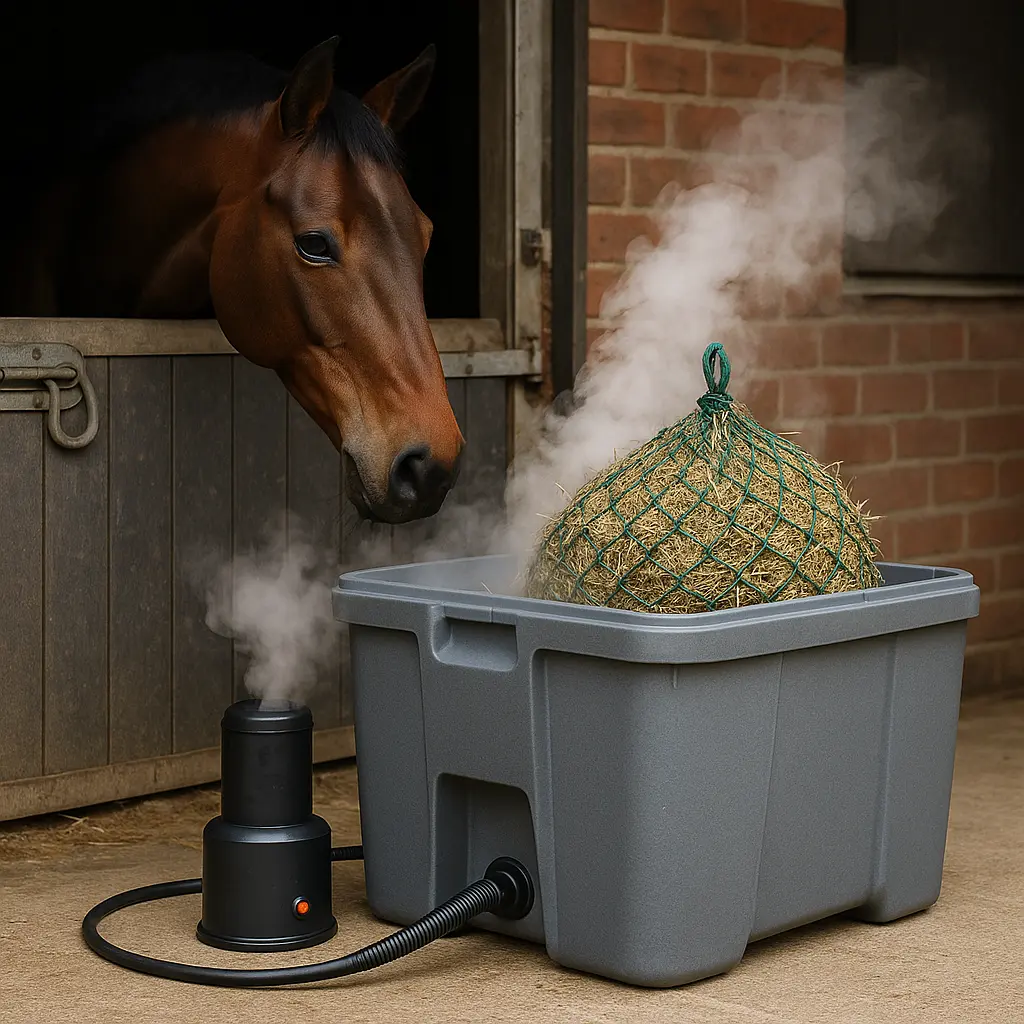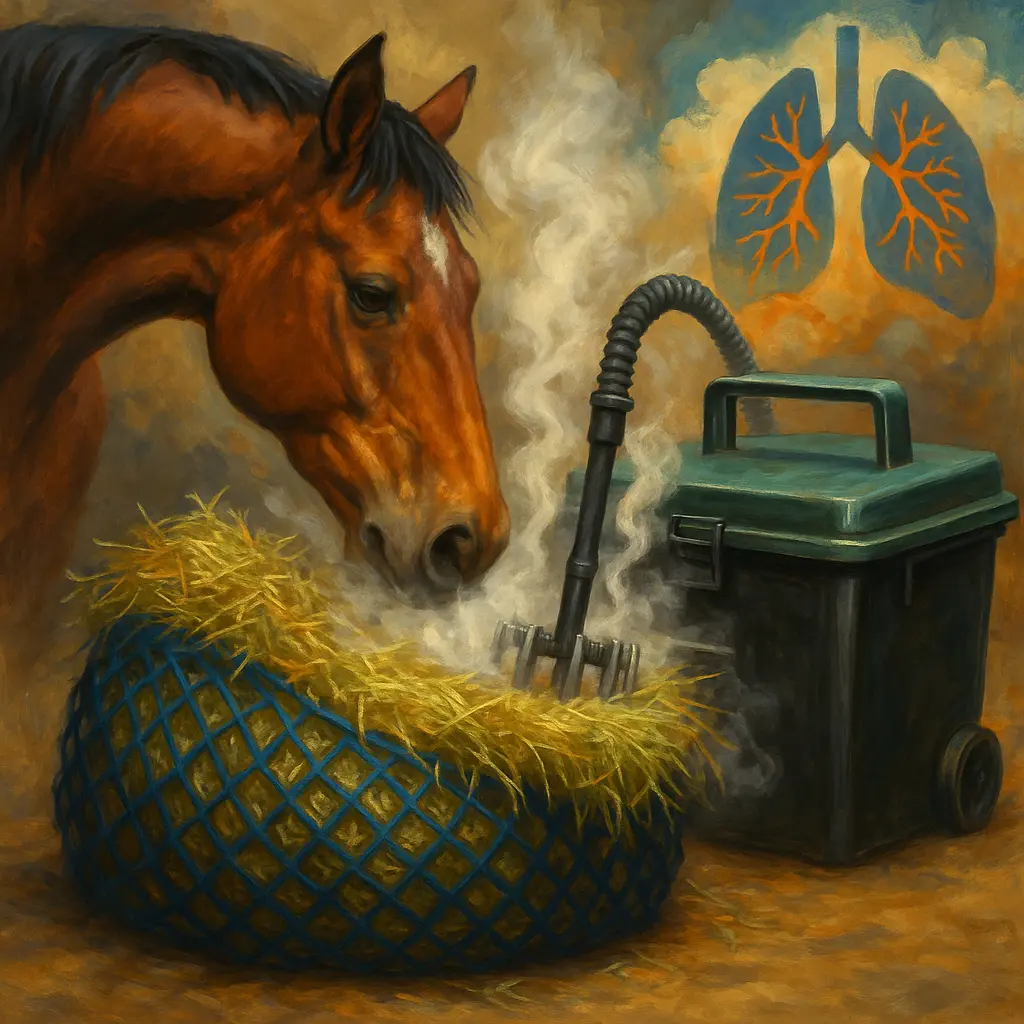
Persistent coughs, flare-ups in the school, or a horse that’s just “not right” on the rein? In the UK’s damp climate, dust and mould in hay are major culprits — and you can fix most of it at the source. High-temperature steaming is the fastest, cleanest way to make forage safer and more appetising, without washing the goodness away.
Key takeaway: Steaming hay at 95–100°C for 50–60 minutes with a purpose-built steamer removes up to 99% of dust, fungi and yeast, cuts IAD risk by 65%, and preserves nutrients and palatability while using a fraction of the water of soaking.
Is steaming hay worth it for UK horses?
Yes — steaming hay at 95–100°C with a purpose-built unit cuts respirable particles by up to 99% and reduces Inflammatory Airway Disease (IAD) risk by 65% while maintaining nutrients and improving palatability.
Multiple independent and manufacturer-supported studies show steaming hay in a manifold-spike system (e.g., Haygain HG600/HG1000) kills all fungi and yeast and 98.84% of bacteria in hay. In one trial, a Haygain HG1000 reduced respirable particles by 94% immediately after a 50-minute cycle and maintained a 79% reduction 24 hours later. This matters for UK yards where hay is often stored in humid barns and fed in enclosed stables through autumn and winter — exactly when RAO/COPD and IAD tend to flare.
Steaming is also horse-approved: in a 2023 preference study, horses spent a mean of 30.07 minutes eating steamed hay versus 11.76 minutes for wet hay and just 0.19 minutes for soaked hay (p=0.028). That’s not just a nicety — better intake supports condition, energy and overall welfare, especially for fussy eaters or those recovering from illness.
Finally, steaming is water-savvy and yard-friendly. A Haygain One uses about 3.5 litres to treat a 7 kg haynet, compared with roughly 70 litres to soak the same amount — a significant saving on UK water bills and a win for environmental management, as soaking wastewater is a biohazard.
How does steaming hay reduce respiratory disease?
By eliminating fungi and yeast and 98.84% of bacteria and reducing respirable dust by 94–99%, steaming removes the aeroallergens and irritants that inflame equine airways.
Steamed hay tackles the root triggers behind common UK respiratory syndromes like IAD and RAO/COPD. In RAO trials using the Haygain HG1000, horses showed fewer clinical signs of respiratory distress when fed steamed hay compared with dry. In broader field data, horses fed steamed hay had a 65% lower risk of IAD — a meaningful reduction for stabled horses on livery yards where airflow and bedding dust add to the burden.
The British Horse Society (BHS) emphasises dust-free forage as a welfare necessity. Steaming meets that brief by physically neutralising organisms and dust where they live — deep in the bale. Importantly, unlike soaking, high-temperature steaming does not wash away minerals or protein, so you’re not trading breathing comfort for a nutritional shortfall.
“Our findings show that steaming is the most effective way to reduce both aeroallergens and bacteria from hay... High-temperature steaming dry hay does not alter the bacterial diversity, making it more like the dry forage horses traditionally ingest, and it does not alter the nutrient content. However, it does reduce potential pathogens.” — Dr. Simon Daniels, equine nutrition researcher (The Horse)
Steaming vs soaking: which is better for forage hygiene?
For hygiene, palatability and nutrient retention, steaming is superior; soaking leaches nutrients and creates contaminated wastewater, though it’s the better choice if you need a large reduction in water‑soluble carbohydrates (WSC).
Head-to-head comparisons show clear differences:
- Hygiene: Steaming kills all fungi and yeast, and 98.84% of bacteria; homemade steamers and soaking cannot reliably achieve this and may incubate microbes.
- Nutrients: Steaming typically causes only about a 2.3% WSC drop and minimal mineral/protein loss, whereas soaking strips minerals, protein and non-structural carbohydrates (NSC).
- Microbiome: High-temperature steaming preserves beneficial bacteria (e.g., Verrucomicrobia, Fibrobacters) while targeting pathogens. Soaking reduces overall bacterial diversity.
- Water: Steaming ~3.5 L per 7 kg haynet vs ~70 L for soaking the same net.
- Preference: Horses strongly prefer steamed hay — 83% approached it first and ate it longer in a 2023 study.
“Collectively, these findings add to a body of evidence that suggests high temperature steaming is the most suitable pre-feeding treatment for equine health.” — Dr. Simon Daniels (Haygain research summary)
Quick tip: If your vet or nutritionist wants a dramatic WSC reduction for a metabolic horse, use a controlled soak instead of steaming — then discard wastewater responsibly and rebalance the diet to account for lost nutrients.

How do you steam hay correctly?
Steam hay for 50–60 minutes until the core reaches 95–100°C using a manifold spike system; then spread and cool for 10 minutes on a clean surface before bagging or feeding.
Follow this proven, yard-ready routine for hygienic results every time:
- Load: Pack a 7 kg haynet (or flakes) loosely to allow steam penetration. Use a purpose-built steamer with a manifold spike plate that injects steam from the inside out.
- Steam: Run a full 50–60 minute cycle. You’re aiming for 95–100°C in the hay’s core to kill respirable irritants, fungi, yeast and most bacteria.
- Cool correctly: Tip onto a clean tarp, spread the flakes, flip after 5 minutes and cool for another 5 minutes. This prevents warm, damp conditions that could incubate surviving microbes.
- Feed or store: Bag into clean, breathable sacks (e.g., canvas haylage bags) and feed as needed. Hygiene improvements remain high for at least 24 hours (94% dust reduction immediately; 79% at 24 hours), so you can steam ahead for the day.
- Housekeeping: Empty condensate, wipe seals, and keep the unit limescale-free for consistent temperatures and safety.
Pro tip: Test your hay’s nutritional and hygiene profile if you’re planning long-term steaming or feeding sensitive horses (RAO/IAD, poor dentition). A baseline guides better management — especially when swapping between UK meadow hays and ryegrass batches.
At Just Horse Riders, we recommend steaming smaller nets daily in winter to boost water intake safely — steamed hay’s moisture content can be nearly three times that of dry hay, aiding hydration without the freezing risks of soaked forage.
Which hay steamer should you choose?
Choose a purpose-built steamer such as the Haygain HG600 or HG1000; DIY grit-bin or wheelie-bin conversions are significantly less effective at microbe reduction and can become pathogen incubators.
Purpose-built steamers are engineered to drive high-volume, high-temperature steam through dense hay. The manifold spike system ensures even core penetration — something a kettle or wallpaper steamer cannot achieve, especially in winter when heat loss is faster. Trials have shown homemade units fall well short of the microbial kill rates achieved by Haygain’s HG-series models.
What to consider:
- Capacity: HG600 is ideal for smaller yards or individual horses; HG1000 suits busier yards and multiple nets per cycle.
- Water and waste: Around 3.5 L per 7 kg net vs ~70 L for soaking — no dirty wastewater disposal.
- Workflow: Nylon hay nets handle steaming easily and keep your tack room tidy; designate clean vs used nets to avoid cross-contamination.
- Storage: Use breathable, clean bags post-steam; avoid sealing in warmth and moisture that encourage bacterial regrowth.
Quick tip: Place the steamer under cover with good drainage and non-slip access. If you’re feeding outdoors, keep steamed forage protected from rain and mud with robust yard set-up and appropriate rugging for your horse. For reliable turnout protection, see our curated winter turnout rugs from leading brands, including WeatherBeeta.
What does hay steaming mean for UK seasons and storage?
Steaming prevents mould growth through our wet autumns and winters and supports hydration in cold snaps, all without the freezing and wastewater issues of soaking.
UK-sourced meadow and ryegrass hays are often baled in variable weather and stored in damp barns. That’s prime territory for the fungi and bacteria linked to coughs and RAO on busy livery yards. Steaming breaks this cycle by neutralising contaminants right before feeding, not weeks earlier in the field or barn.
Seasonal advantages:
- Autumn/winter: Reduce the respiratory load when stabling increases. BHS welfare guidance to provide dust-free forage is easier to meet with steamed hay.
- Cold weather hydration: Steamed forage’s higher moisture supports fluid intake when buckets ice over or horses drink less.
- Spring: As pollen counts rise, cutting background hay dust can help sensitive horses stay comfortable.
- Storage hygiene: Treat hay close to feeding; don’t stockpile steamed hay warm — cool and bag cleanly and feed within 24 hours for best results.
If you’re feeding outside between showers, keep forage off the mud and shielded; check your horse’s comfort with appropriate layering inside and out. Our stable rugs help maintain warmth in-box on damp nights, and fit smoothly under your chosen turnout rug for the yard-to-field transition.
Stay visible on short winter days too — if you hack after yard chores, don’t forget hi-vis essentials for riders.
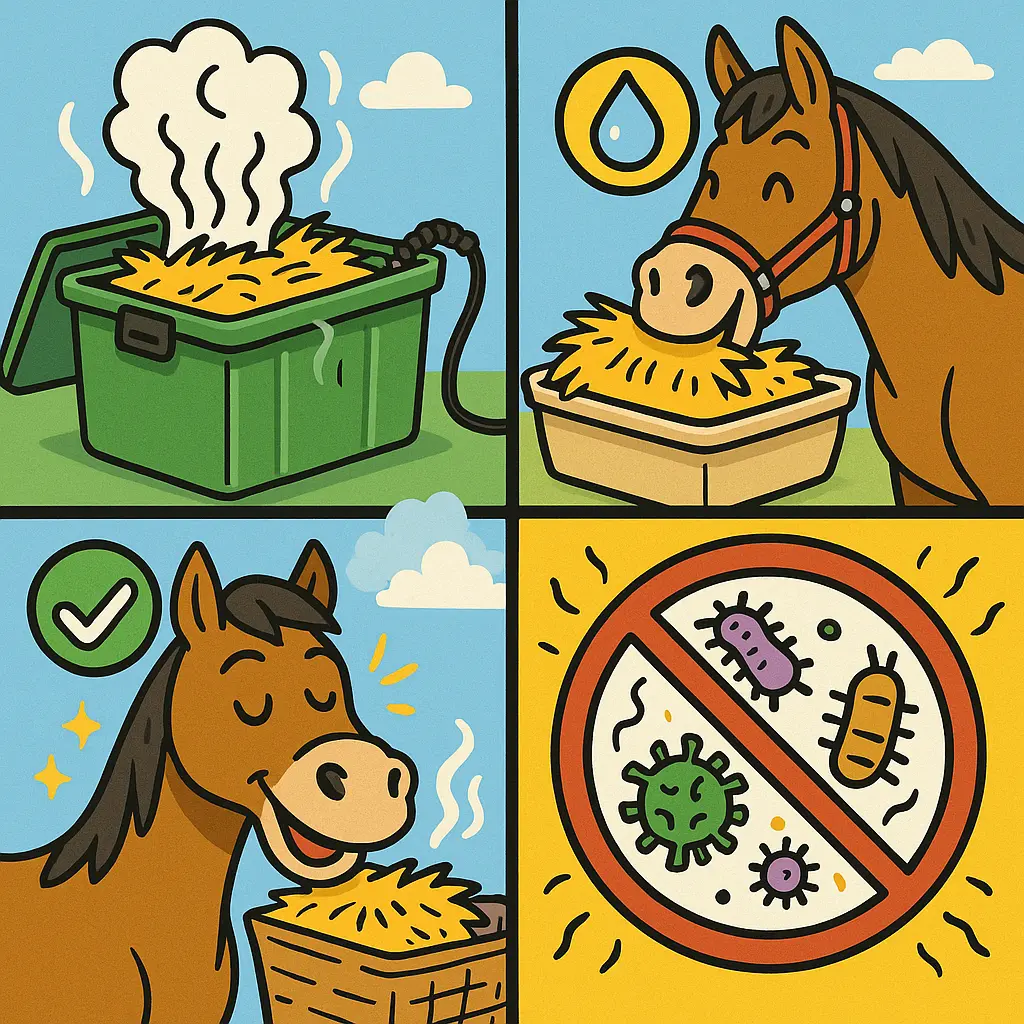
When should you not steam hay?
Avoid steaming when a significant reduction in water‑soluble carbohydrates is required for metabolic management; use a controlled soak instead and rebalance minerals and protein lost in the soak water.
Steaming typically reduces WSC by only around 2.3%, which is ideal for preserving nutrition but not enough for horses needing strict NSC control (e.g., laminitis risk, EMS, PPID where advised). In these cases, soak to your vet/nutritionist’s protocol and manage the leachate responsibly — it’s nutrient-rich and biologically contaminated. After soaking, a short steam can be considered to improve hygiene and palatability, but the primary sugar reduction must come from the soak.
Quick tip: Work with your vet and an equine nutritionist to balance soaked forage with appropriate vitamins/minerals and to monitor weight and laminitis risk factors across the UK grazing seasons.
What else do you need to make steaming easy on your yard?
Pair your steamer with tough hay nets, breathable storage bags and a clean, repeatable workflow so forage stays hygienic from barn to stable.
At Just Horse Riders, we suggest building a simple, effective kit list:
- Hay nets: Use durable nylon nets dedicated to “clean” use post-steam; colour-coding avoids mix-ups.
- Breathable bags: Canvas haylage bags for cool storage and tidy transport to the stable or lorry.
- Clean tarp and hooks: A tarp for cooling flips and high hooks to keep nets off floors.
- Rug plan: Keep horses comfortable as their intake and routines stabilise — explore our dependable stable rugs for in-box comfort and weatherproof turnout rugs for the field.
- Respiratory support: Combine clean forage with targeted nutrition where advised. Browse proven respiratory and general health supplements, including options from NAF.
- Yard safety: With darker evenings after steaming chores, keep yourself seen with practical hi-vis rider gear.
Our customers often tell us that once they dial in a 50–60 minute daily steaming routine and a clean handling flow, coughs ease, appetites improve and yard life gets simpler — with far less water sloshing around.
“RAO horses showed less clinical signs of respiratory distress when fed steamed hay compared with dry hay.” — RAO trial summary (Haygain HG1000) (research PDF)
For the science-minded, the hay microbiome evidence is compelling, too. High-temperature steaming targets pathogens while leaving beneficial bacteria more akin to traditional dry forage — a smarter approach than washing everything away.
FAQs
Below are concise answers to the most common UK hay steaming questions so you can act with confidence today.
Does steaming hay preserve nutrients better than soaking?
Yes. Steaming causes minimal nutrient loss (about a 2.3% drop in WSC is typical) and does not strip minerals or protein, while soaking leaches minerals, protein and NSC — and produces contaminated wastewater that must be disposed of responsibly.
Do horses actually prefer steamed hay?
Yes. In a 2023 study, 83% of horses approached steamed hay first and ate it significantly longer (mean 30.07 minutes) than wet (11.76 minutes) or soaked hay (0.19 minutes; p=0.028), confirming both palatability and intake benefits.
Is a DIY steamer (grit bin or wheelie bin) as effective as a Haygain?
No. Homemade set-ups are significantly less effective at microbial reduction and can act as incubators; purpose-built units like the Haygain HG600/HG1000 achieve the necessary 95–100°C core temperatures and even penetration via manifold spikes.
How long should I steam hay for, and how soon should I feed it?
Steam for 50–60 minutes to reach 95–100°C in the core. After steaming, cool on a clean tarp for about 10 minutes, then feed or bag. Hygiene benefits remain high for at least 24 hours (94% dust reduction immediately; 79% at 24 hours), so you can steam ahead for the day.
Will steaming reduce sugars enough for a laminitic or EMS horse?
Usually not. Steaming preserves nutrients and typically reduces WSC by only around 2.3%. If your vet requires a larger WSC reduction, use a controlled soaking protocol and rebalance the diet accordingly.
How does steaming help with UK yard coughs in winter?
It eliminates key aeroallergens and reduces respirable dust by 94–99%, slashing IAD risk by 65%. That’s crucial when horses are stabled in damp, enclosed environments where hay dust and mould are most problematic.
Does steaming increase my horse’s water intake?
Yes. Steamed hay’s water content is nearly three times that of dry hay, supporting hydration in cold weather when horses naturally drink less.
Clean, palatable forage is the foundation of respiratory health. If you’re ready to streamline your routine for UK conditions, set your timer to 50–60 minutes, use a manifold steamer, and keep handling spotless — your horse’s lungs (and your water bill) will thank you.