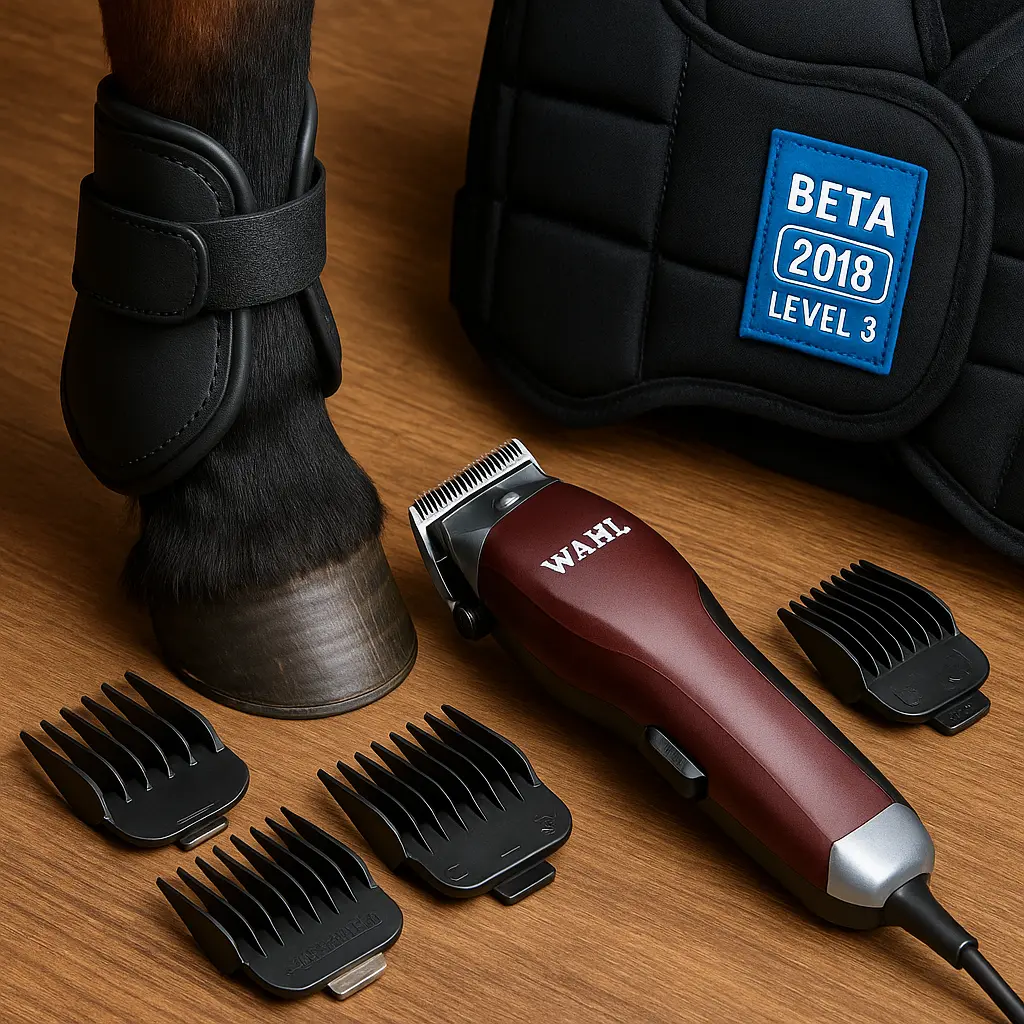
Clipping season, schooling shows and soggy paddocks all arrive together in the UK. If you’re swapping blades, fitting guards, or strapping on boots, a few rule-led checks will save you time, money and hassle.
Main takeaway: Use the right Wahl 5‑in‑1 blade for the coat, never assume guards are universal, and follow British Showjumping and BETA body protector standards to stay safe and competition‑legal.
Which Wahl 5‑in‑1 blade should you use on thick coats and cob legs?
Choose the coarse or pro 5‑in‑1 blade for thick coats and cob legs; the pro adds a protective shield, a reinforced tab and rust resistance for harder, hairier jobs. For longevity in damp stables, the diamond 5‑in‑1 is the most durable option.
Wahl’s 5‑in‑1 system comes in four types with distinct jobs. The fine blade is the original “general use” choice that leaves a neat finish on lighter coats. The coarse has teeth set further apart, so it feeds thicker, denser hair (think feathered cobs) without clogging. The pro retains that cutting performance but adds a debris shield to reduce hair ingress, a stronger attachment tab and a rust‑resistant coating, making it a smart pick for heavy clipping and frequent use. For the longest service life, the diamond 5‑in‑1 adds a hardwearing coating for significantly improved durability over standard steel. See Wahl’s official comparison here: Wahl Help.
At Just Horse Riders, we recommend matching the blade to the job: coarse or pro for feather and winter legs; fine for tidy face/bridle paths on finer coats; diamond if you clip often in damp conditions and want maximum lifespan. You’ll find oils, sprays and tools to prep and maintain your kit in our grooming clippers and blades range.
Quick tip: Work clean and dry. Even the best blade labours if you clip a wet, greasy leg—wash, fully dry and brush through first to protect coat and blade.
Are Wahl clipper guards universal across models?
No. Wahl guards are not universal; they’re model‑specific and depend on blade width and attachment style (snap‑on, slide‑on or magnetic).
Professional guards are engineered to lock to a particular blade profile and latch. Full‑size Wahl models (for example, within the Magic Clip/Senior/Legend family) often share “premium” metal clip guards, but this does not extend to every Wahl clipper or to detachable‑blade systems. Narrow trimmers, wide fade blades and detachable blades change both width and the way a guard fastens, which is why compatibility charts matter. A clear, practical overview is here: Wahl guard compatibility guide.
Do not expect cross‑brand fit. Differences in blade shape and latch design mean Wahl guards won’t clip securely to Babyliss or Andis, and cross‑fitting risks a guard popping off mid‑clip. The same logic applies to many non‑Wahl animal clippers—always check the exact blade head and guard system.
Pro tip: Guard fit should be positive and rattle‑free. If you can rock or slide a guard by hand, it’s the wrong one for that blade.
How to check guard and blade compatibility before you buy
Confirm three things: your clipper’s exact model, the blade’s width/profile, and the guard’s latch style. Only buy if all three match.
Use this quick, foolproof checklist:
- Identify your model: The model name/number is usually printed near the power switch or on the body. Note it exactly (e.g., Senior vs. Legend).
- Measure the blade width: Wide blades need wide guards; 5‑in‑1 heads take their own slide range. Detachable blades use clip‑on combs designed for that specific plate.
- Match the latch: Premium metal “snap” guards for full‑size clippers won’t fit magnetic or slide‑on systems. Buy guards built for your latch type.
- Cross‑check a chart: Use the maker’s compatibility chart for your exact clipper and blade head. If you use multiple tools (e.g., a Wahl trimmer for precision and a larger yard clipper for legs), expect different guard families.
- Test the fit on the bench before the barn: If a guard won’t seat with a solid click or slides, don’t use it.
Because blade geometries vary, avoid “universal” promises—guards that fit a Wahl Senior won’t necessarily fit detachable systems, and they’re incompatible with many non‑Wahl brands like Babyliss and Andis. For yard‑friendly finishes on legs, our customers rate premium metal guards for full‑size models, sized for natural, tidy lengths. Find the finishing tools you need in our grooming section.
What leg protection is legal in British Showjumping right now?
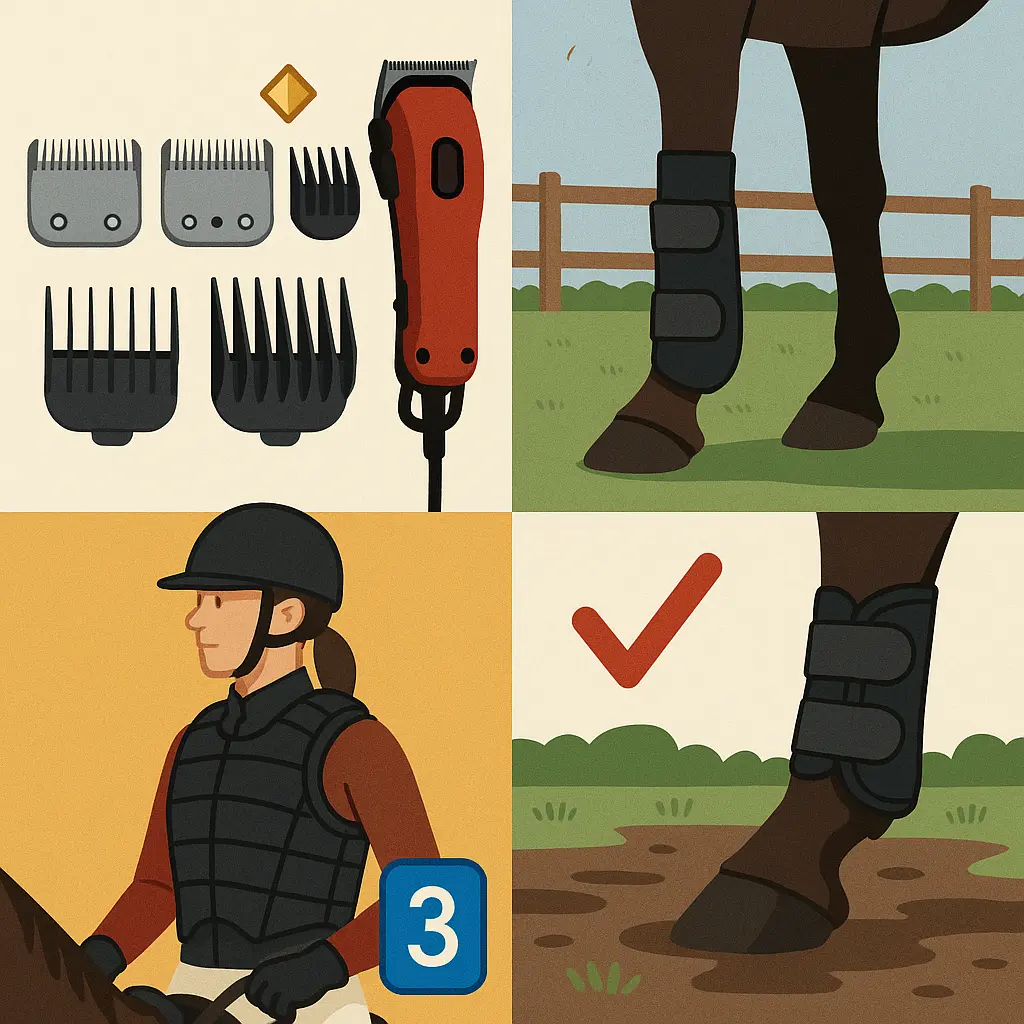
Leg equipment must add no more than 500 g per leg; hind protections must be smooth inside, max 16 cm interior length, and minimum 5 cm exterior width (4 cm for ponies) with non‑elastic Velcro at least 5 cm wide.
These rules protect welfare and keep competition fair, particularly for young horse classes. The essentials you need to check before walking into the ring are summarised by Redpost’s practical guide: maximum added weight 500 g per leg; hind boots smooth on the inside with no pressure points, hooks or rigid straps; minimum 5 cm exterior width (4 cm ponies), maximum 16 cm interior length; and non‑elastic Velcro fastenings at least 5 cm wide. See details here: Equestrian equipment rules guide.
For muddy UK autumns and winter schooling, choose boots that wash clean and dry quickly while staying within the dimensional and fastening rules. Explore compliant designs and everyday support in our curated horse boots and bandages collection, including options from brands riders trust such as LeMieux.
Quick tip: Weigh boots after washing. Waterlogged liners can push you towards the 500 g limit—spin dry inside a towel and air well the day before you compete.
What body protector standard do UK riders need in 2024/25?
For racing, the BHA mandates BS EN 13158:2018 at a minimum of Level 2 with BETA approval from October 2024; for general riding and most UK disciplines, Level 3 (BETA 2018 blue label) is recommended and widely required.
The British Horseracing Authority has raised minimum safety standards, making EN 13158:2018 Level 2 the baseline with BETA approval for professional racecourse use from October 2024. In the BHA’s own words:
Outside racing, Level 3 is the accepted benchmark for day‑to‑day riding and most competitions under UK bodies (for example Pony Club, British Eventing and British Riding Clubs) because it offers materially greater impact protection. As Horse & Hound summarises:
At Just Horse Riders, we suggest you treat Level 3 (BETA 2018 blue label) as your everyday standard for lessons, hacking and competition, pairing it with a correctly fitted riding helmet for a complete safety setup. If you compete, always check your discipline’s current tack and dress rules before show day, and keep receipts/labels handy for tack checkers.
What does the BETA 2018 blue label actually test?
The BETA 2018 scheme certifies protectors that meet EN 13158:2018, covering defined body areas, impact performance on flat ground and rails, secure attachment and annual retesting for consistency.
Understanding the label helps you buy with confidence. BETA is the UK industry’s independent certification body; products on the scheme must satisfy every clause of EN 13158:2018 (coverage, impact attenuation and retention) and pass routine surveillance to ensure consistency between factory runs. As BETA states:
Manufacturers such as Charles Owen detail how the standard tests strikes on both flat and rail‑type anvils and checks secure fastening under load, reflecting real equestrian falls and fences. For a deeper dive into what’s assessed, see Charles Owen’s guide to body protector standards. In practice: if it’s labelled BETA 2018 Level 3 with the blue label, you’re buying a protector designed and tested for the broader risks of general riding and competition.
Quick tip: Replace your body protector after a major fall, visible damage, or when the foam stiffens or cracks. Store it dry and flat—never on a hot radiator.
Recommended kit that keeps you compliant and comfortable
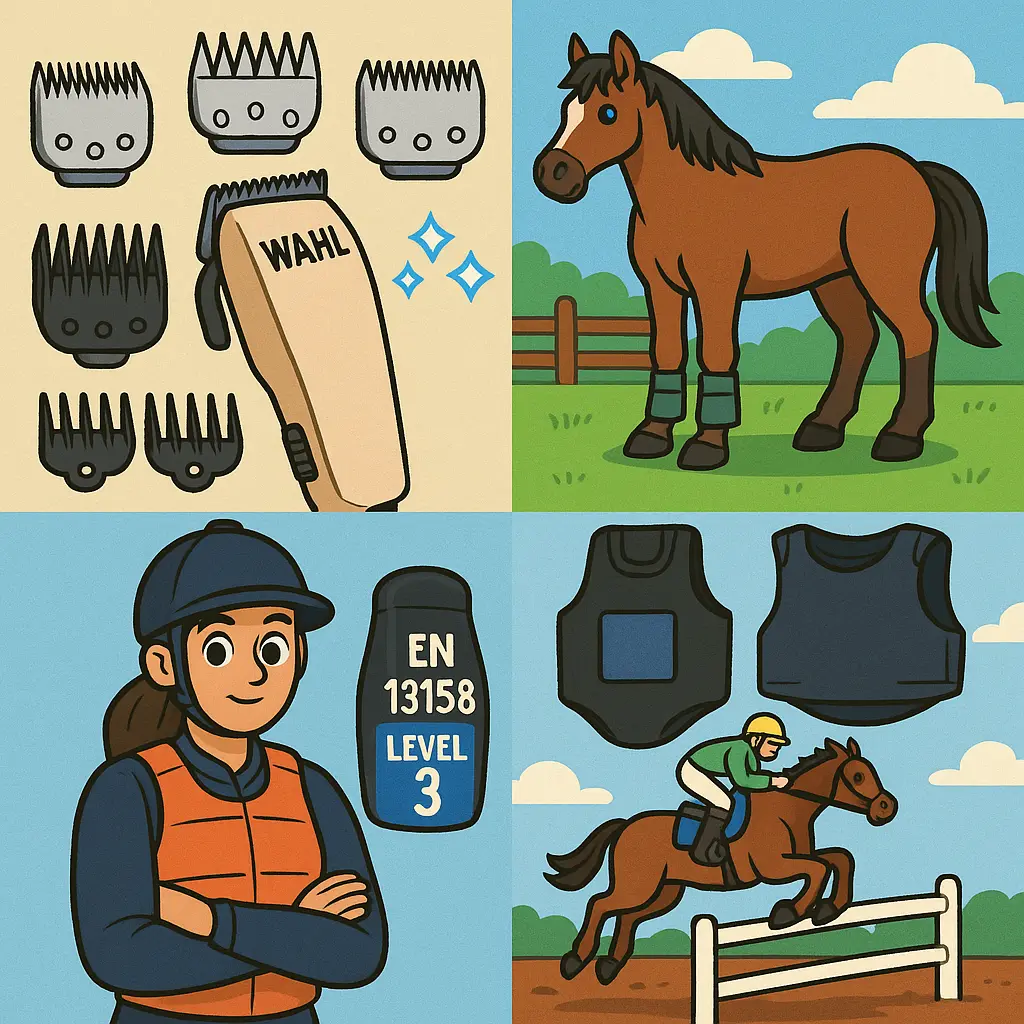
Pick a coarse or pro 5‑in‑1 blade for thick legs, choose model‑specific guards, use boots that meet the 500 g/16 cm/Velcro rules, and wear a BETA 2018 Level 3 body protector with a current‑standard helmet.
Here’s a simple, rule‑aligned kit list we trust for UK yards and showgrounds:
- Clipping power: Use Wahl 5‑in‑1 coarse or pro blades for cob legs and dense coats to reduce clogging and hair ingress, with the diamond option for maximum durability in damp conditions. Keep oils, coolants and spare guards to hand from our grooming clippers and blades.
- Tidy finishes: Fit premium metal guards designed for your specific full‑size Wahl model to leave natural‑looking lengths on legs and bridle paths. Always seat and test guards before clipping.
- Show‑legal leg protection: Choose smooth‑lined hind boots with non‑elastic Velcro at least 5 cm wide and dimensions within the British Showjumping limits. Explore everyday and competition options in horse boots and bandages and check favourites from LeMieux.
- Body protection: Wear a BETA 2018 Level 3 protector for lessons, hacking and most competitions; racing requires EN 13158:2018 Level 2 minimum with BETA approval from October 2024. Pair it with a current‑standard riding helmet.
- Ready for the ring: Keep your outfit smart and rule‑compliant with breathable show shirts, jackets and breeches from our women’s competition clothing selection.
- After‑clip comfort: A freshly clipped horse loses insulation; plan ahead with waterproof, breathable winter turnout rugs from trusted brands such as WeatherBeeta.
Pro tip: If your horse is boot‑shy, acclimatise at home. Start with schooling boots for short sessions, then switch to your show‑legal pair once the horse goes forward and relaxed.
Seasonal care: clipping and kit maintenance in wet UK weather
Clip only on clean, dry hair, keep blades oiled and cool, dry your boots fully between uses, and store body protectors and helmets away from damp and heat.
Wet UK winters are brutal on steel, foam and Velcro. After each clip, brush out hair, spritz a dedicated blade cleaner, then oil lightly before storage. Rust‑resistant coatings (as found on the 5‑in‑1 pro and especially the diamond blade) buy you extra time in a damp tack room, but they still need routine care. If you groom outdoors, bring a dry towel and a tarp to keep cables and tools off wet ground.
Boot care is more than a hose‑off: remove grit from seams, then squeeze out water with a towel and air dry away from direct heat. Hook Velcro closed as it dries to stop lint build‑up and maintain that essential 5 cm fastening width. If your yard air is humid, a simple box with silica sachets helps keep boots and guards corrosion‑free.
For riders, store body protectors flat and dry; don’t crush them under saddles or stuff them into a damp lorry locker. Helmets should air dry naturally—excess heat can degrade the liner. For safer dark‑evening hacking to and from the arena, add a layer from our hi‑vis collection.
Quick tip: Put a reminder in your phone to wash boots and clean blades the day you get home from a show. Twenty minutes then will save you replacing rusty kit later.
FAQs
Which Wahl 5‑in‑1 blade is best for thick cob legs?
Use the coarse or pro 5‑in‑1. The coarse feeds heavy hair cleanly; the pro adds a protective shield, reinforced tab and rust‑resistant coating for tougher, dirtier work. For maximum longevity, the diamond 5‑in‑1 is the most durable.
Are Wahl clipper guards compatible with all Wahl models like Adore or with other brands?
No. Compatibility depends on your exact clipper, blade width and guard latch style; many guards for full‑size Wahl models won’t fit trimmers or detachable systems, and they won’t fit non‑Wahl brands like Babyliss or Andis. Always check a model‑specific chart and test the fit before use. See the Wahl guard compatibility guide.
What is the minimum body protector standard for UK racing from October 2024?
The British Horseracing Authority requires BS EN 13158:2018 at least Level 2 with BETA approval for racecourse riders under licensed trainers. Read the BHA update here: BHA rider safety equipment standards.
What level body protector should I wear for general riding and competitions?
Level 3 (BETA 2018 blue label) is recommended for everyday riding and widely required across UK disciplines, offering enhanced impact protection. As Horse & Hound notes, Level 3 helps prevent some rib fractures and reduces soft‑tissue injury: Horse & Hound on body protector standards.
What are the British Showjumping hind boot rules I must meet on show day?
Added weight per leg must not exceed 500 g. Hind protections must be smooth inside, have a maximum 16 cm interior length, a minimum 5 cm exterior width (4 cm for ponies), and use non‑elastic Velcro at least 5 cm wide. Details: equipment rules guide.
Can I use “universal” clipper guards on my detachable‑blade clippers?
Don’t risk it. Detachable blades need combs designed for their specific plate and latch; generic guards for snap‑on systems seldom fit securely and can come off mid‑clip.
How do I stop blades rusting in a damp UK tack room?
Clean hair off immediately, spray a blade cleaner, oil lightly, and store in a dry pouch. Choose rust‑resistant options like the 5‑in‑1 pro or diamond blades, and add silica sachets to your kit box.
Ready to refresh your set‑up? Shop yard‑tested clipping and grooming tools, rule‑friendly boots and bandages, and safety essentials including riding helmets and turnout rugs at Just Horse Riders. Stay safe, stay sharp—and enjoy a smoother season.